
In this post, I preview July’s PubSci talk (now booking) and other great science events coming up, we reflect on June’s PubSci and share details of a ticket offer for the coming weekend. Read on!
Our next event is only 2 weeks away

July’s PubSci talk is booking up fast, with 25% of places already snapped up – head to the booking page now if you don’t want to miss out – but before looking in more detail, we’ll serve up some other science-based goodies. There’s lots of science poetry in this edition of the PubSci blog, some great events, some sad astronomy news and some good astronomy news, a look back at June’s topic and an exclusive discount code for a super astronomy talk at the Royal Institution on Saturday 5th July.
~
Art meets science in words and images

Last month we previewed a botanical photography exhibition at Ken Artspace and I’ve found another super photo exhibition for you this month. Since 1997 Wellcome Photography Prize has been celebrating compelling imagery that captures stories of health, science and human experience. This year the winners will be announced on 16th July (the same day as PubSci) and the top 25 images will be on show at The Francis Crick Institute close to London’s King’s Cross from 17th July until 18th October. The Crick is worth a visit just for the fabulous modern architecture and a very nice cafe.
The Poetry of Science and the Science of Poetry
This is a bumper season for poetry and science. The Brilliant is an annual competition celebrating poetry which expresses scientific wonder through verse. Alas, entries closed at the end of June for this year’s competition but you can read last year’s shortlisted entries and the 2024 winners here.
If you’d like to try your hand at writing poetry with a science theme, perhaps with a view to entering next year’s competition, I strongly recommend signing up for the CPD short course on Science Communication Through Poetry run by Sam Illingworth. It’s delivered live via Zoom over four Wednesday lunchtimes and costs just £50. There’s even a bursary for those on low income. Sam, a professor at Edinburgh Napier University, is also one of the judges for The Brilliant competition and has written several books on science and poetry including The Poetry of Physics published earlier this year. I’m hoping to tempt Sam down south for a PubSci event before too long.
If you enjoy the crossover between science and poetry and/or science and art, I recommend looking into a beautiful online journal called Consilience (referring to the convergence of thought between different disciplines). Consilience is free to read but you can support it by subscribing to their Substack. If you’re already a science poet or artist, and looking for somewhere to publish, Issue 22 of Consilience is now open for submissions of poetry and art exploring the scientific topic of ‘Waves’ – but do hurry, submissions for the coming issue close at noon on Sunday 6th July.
EVENT TOMORROW: Live Poetry and Live Neuroscience!
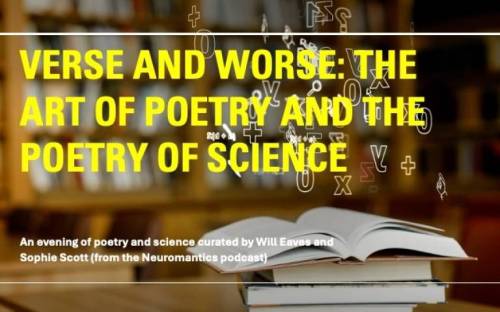
What happens when a poet and a neuroscientist get together to see if they can make sense of their connections?
They create an event called Verse and Worse, with Professor Sophie Scott and Will Eaves, both from the Neuromantics podcast.
On Wednesday 2nd July, at the Bloomsbury Theatre, Will and Sophie will be conducting live neuroscience experiments related to poetry. It looks like being a brilliant event, and it’s only £8, but there are lots of unsold seats at the time of writing, so book a ticket now and I’ll see you there.
~
An Astronomic look back at June

At June’s PubSci Stuart Eves delighted us with “How the Universe is Trying to Kill Us – and How We can Stop It” in which he considered possible mechanisms to explain the surprising periodicity of global mass extinctions, with a focus on the way our solar system moves through the warped plane of the Milky Way every 30 million years or so.
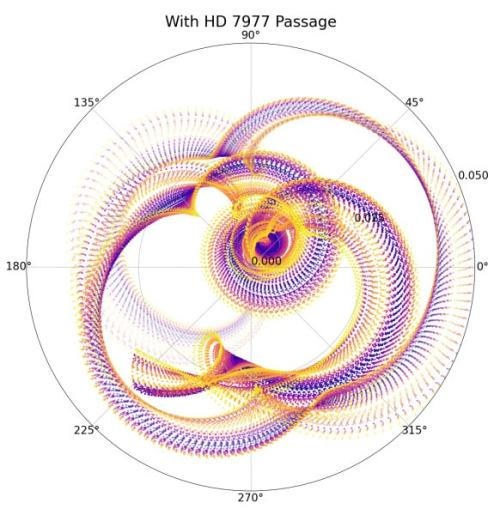
If you want to read more about the effect of distant stars on our own solar system (and by implication, what encountering more of them as the solar system passes through the galactic disk) might mean for the stability of orbits, check out this article called Passing Stars Altered Orbital Changes in Earth and Other Planets, with its lovely illustration of the uncertainty of Earth’s orbit 56 million years ago that arises from the passing of a sun-like star 2.6 million years ago (which is about when we last passed though the galactic disk).
The world’s most powerful camera captures its first images of space
The Vera C Rubin observatory in Chile, home to the world’s most powerful digital camera, has released its first images, and to quote the ‘Super Soaraway Sun‘* (sorry!: WHAT A STUNNER!
*Let’s hope it doesn’t soar away in the light of the previous topic.

The observatory is tasked with detecting potentially deadly earthbound asteroids in time for us to take protective measures (if you came to June’s PubSci you’ll have some idea what these might be and what the pitfalls are). It will also be seeking concrete evidence for “dark matter” which is the standard cosmological explanation for the way galaxies spin. You can read more about that – and learn why the observatory is named after Vera Rubin – on this page.
A farewell to the world’s oldest radio astronomer

The former Astronomer Royal, Sir Francis Graham-Smith who died at the age of 102, was the world’s oldest active radio astronomer according to Jodrell Bank Observatory where he was director from 1982 to 1990. Graham, as he was known, was only the second director of Jodrell Bank after Lowell himself, and technically retired in 1988 but he continued working as emeritus professor of radio astronomy at The University of Manchester. Graham published his final astronomy article earlier this year. You can see Sir Francis Graham-Smith’s photo and read his obituary on the BBC New website.
HOT NEWS: Exclusive ticket discount for a talk on the aurorae of Earth and beyond
Last of the astronomy items in this edition of the PubSci blog is an exclusive discount code for a talk called Understanding the Northern Lights – From Earth to Jupiter on Saturday 5th July.

If the recent aurorae over central and southern Britain have piqued your interest, head to the Royal Institution this Saturday evening to discover what they are, how they happen, and why it’s so significant to the search for extraterrestrial life that Jupiter’s moon Ganymede experiences aurorae.
The speaker, Marina Galand, is Professor of Planetary Science at Imperial College London. I met Marina a few weeks ago and was bowled over by her knowledge, enthusiasm and energy for this subject. It’s going to be a brilliant talk and to make it even better the Ri has kindly offered PubSci a whopping 25% discount for this event with the code LIGHTS25 (feel free to share).
Book on Eventbrite via the Ri Website – your phone camera won’t even need to be in night mode!
~
At last… July’s PubSci
(To be read in the voice of Viv Stanshall on Tubular Bells, for those of a certain vintage)

The nest PubSci talk is just 2 weeks away, on Weds 16th July, and we’re delighted to welcome Professor Adam Kucharski to explore the ideas behind his latest book, Proof: The Uncertain Science of Certainty.
How can we weigh up noisy evidence to decide how safe is an autonomous vehicle or judge somebody’s guilt or innocence?
Adam will explores how scientific opinion is formed, how to convince others of the facts, and what links wine and university exams, royalty and Guinness, cricket and robot racing.
Full details and the booking link are on PubSci’s Next Event page or you can book straight away on Eventbrite.
With over 25% of tickets already snapped [now at 30%] up at the time of writing, the best way to be certain of a place is to book yours today. Copies of Proof will be on sale at the event.
1/7/25 Posted by Richard Marshall, PubSci organiser and host.
PubSci: Sipping • Supping • Science
• • •
PS In case you haven’t checked it out yet, science communicator and PubSci member, Ushashi Basu, recently wrote about PubSci in her excellent blog and interviewed me to find out how I came to be booking and introducing speakers for a public science outreach event in a pub, what led me into science communication, and what motivates me to communicate science.
It was a pleasure to chat with Ushashi over a coffee and look back at seven years of programming, promoting and hosting PubSci. You can read that interview here and see Ushashi’s other blog posts at https://ushashibasu.com/.
Hope to see you all at the Old KIng’s Head on Wednesday 16th July.
• • •
Keeping Up With Future Events
To make sure you don’t miss out on future events, subscribe to our Google Calendar to be the first to know when new talks are scheduled, and follow PubSci’s events on Eventbrite to be notified when tickets are available. You can also sign up to our own mailing list on any page on this site.
• • •
About PubSci talks
PubSci is organised and hosted by science communicator, Richard Marshall, assisted by Mike Lucibella. Events are held upstairs at the Old King’s Head, near London Bridge tube. No specialist knowledge is required, just curiosity. Doors open at 6.30pm for a 7pm start. Talks run for ~45 minutes and are followed by a Q&A session. The Old King’s Head has a happy hour before 7pm, and the kitchen serves excellent pub grub.
There is no charge for attending PubSci talks, but we have a cash whip-round to cover expenses on the night – consider it “Pay What You Can Afford”. As few of us carry cash these days, you can make a donation when registering for ticketed events with Eventbrite. Please help us continue putting on events. PubSci has no other source of funding.
We aim to keep PubSci accessible for all, although it is unsuitable for under 18s as we meet in the function room of a pub. Regrettably, there is no wheelchair access.
You can find all our links on our LinkTree.

Address:
The Old King’s Head (upstairs room)
King’s Head Yard
45-49 Borough High Street
London SE1 1NA


 PubSci