Category Archives: cognition

Books, Bards, Brilliant Demos and a Blast Off!

In this edition of the PubSci blog: Looking back over April, something to do this weekend, details of May’s PubSci, and something to do at the end of the month.

Spring has sprung, the grass is ris’ – and last month I began our interstitial blog post with the words: “The sun is out, the trees are in blossom, and the PubSci blog is bursting with wonderful things to do…”

I can reuse that for today’s today’s post, although the warmest Mayday on record is of course a cause for concern within the context of shifting climate patterns and rising global average temperature.

On a lighter note, if you came to the Ig Nobel Awards tour on Sunday 6th April you might have seen me dressed as a banana for reasons that made sense at the time but are now difficult to explain. Blame the Annals of Improbable Research. Photos exist but have been hidden to protect the innocent.
A woman and two men

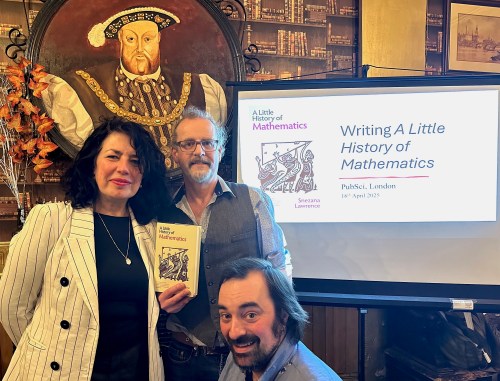
April’s speaker, Snezana Lawrence (https://x.com/mathshistory) with PubSci Hosts Richard and Mike

We had a wonderful evening in the company of Snezana Lawrence at April’s PubSci, hearing about the writing process and contents of her beautifully illustrated new book A Little History of Mathematics. It was great to see so many new faces among the regulars and the Q&A was really engaged.

William Shakespeare

The Royal Institution gets a double mention in this month’s post, firstly because I’m event managing a brilliant talk there this coming Saturday 3rd May. In the Mathematical Life of Shakespeare, award-winning author Rob Eastaway (Why Do Buses Always Come in Threes?) explores the surprising ways that maths and numbers crop up in Shakespeare’s plays. With historical asides about games, optics, astronomy, music and magic, you’ll never think about maths or Shakespeare the same way again. Suitable for adults and anyone aged 8 and above.

If you stay for the evening event, I’ll also be hosting How Physics Connects Our Universe when theoretical physicist Chris White presents a new hypothesis linking quantum mechanics and general relativity.

But enough about them, what about us…?

Next PubSci: Wednesday 16th April | Science Goes Pop!

From Faraday to Van Tulleken, The Royal Institution of Great Britain – known by its chemical symbol, Ri – has been The Home of Science since 1799 and is famous for its public demonstrations which bring science to life. On Wednesday 21st May we bring the wow of live science to The Old King’s Head for a special event celebrating 200 years of Ri monthly Discourses and annual Christmas Lectures.

Royal Institution Christmas Lectures 2024 (Photo: Paul Wilkinson)

Michael Cutts from the Ri’s renowned demonstration team has designed, built, and showcased science demos at the Ri and around the world. He’ll take us through the history of live science and the importance of showing as well as telling. There may even be a few live demos suitable for a pub setting.

Doors 6.30 for 7pm start. Book your place on Eventbrite ASAP – tickets are going fast. As usual, you can make a contribution to PubSci’s costs via Eventbrite (minimum £1) or in cash on the night. Help PubSci keep science live. Hope to see you there!

• • •

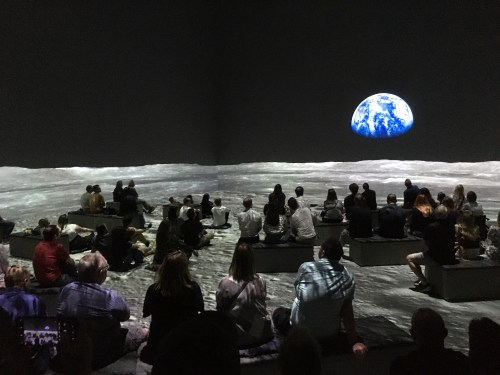
Finally, last weekend I went to Moonwalkers at Lightroom in Kings Cross, and I can’t recommend it enough. I paid full price (£29.50) which feels rather steep, but you can book through TimeOut for £19 if you plan your visit better than we did.
People watching an immersive projection of the moon

Blending archive footage and stills with brilliant graphics and a powerful soundtrack, Moonwalkers tells the story of the Apollo moon landings and looks forward to NASA’s Artemis mission planned for November 2025. It’s movingly narrated by Tom Hanks, who was involved in every stage of its making and shares his personal passion for spaceflight that began with watching Apollo 11 land on the moon in 1969. Highly recommended.

Moonwalkers plays in rotation with other events at Lightroom, next showing over the last week in May.

• • •

Keep Up With Future Events

Dd you know PubSci has an online calendar where you can view future events?

Event titles and dates go in the calendar several months in advance, along with a brief outline of the talk. If you subscribe to our calendar, PubSci events will automatically appear in your own calendar.

We also publish a programme of PubSci events three times a year which you can view online or download for printing. The latest edition has just been uploaded. Why not print it out and put a copy on your work fridge for everyone to see!

Posted by Richard Marshall, PubSci organiser and host.

PubSci: Sipping • Supping • Science

• • •

The evolution of humans from sitting in a chair to talking about science in a pub (after Darwin)

• • •

About PubSci talks

PubSci meets upstairs at the Old King’s Head, near London Bridge tube. No specialist knowledge is required, just curiosity. Doors open at 6.30pm for a 7pm start. Talks run for ~45 minutes and are followed by a Q&A session. The Old King’s Head has a happy hour before 7pm, and the kitchen serves excellent pub grub.

We use Eventbrite booking to manage numbers. Follow us on Eventbrite to be notified when new tickets become available.

Support PubSci

There is no charge for attending PubSci talks, but we have a cash whip-round to cover expenses on the night – consider it “Pay What You Can Afford”. As few of us carry cash these days, you can make a donation when registering for ticketed events with Eventbrite. Please help us continue putting on events. PubSci has no other source of funding.

We aim to keep PubSci accessible for all, although it is unsuitable for under 18s as we meet in the function room of  a pub. Regrettably, there is no wheelchair access. 

You can find all our links on our LinkTree.

• • •

We meet on the third Wednesday of the month, upstairs at the Old King’s Head near London Bridge Underground (Borough High Street east side exit). Join us every month apart from December for a regular dose of Sipping, Supping & Science.

Address:

The Old King’s Head (upstairs room)
King’s Head Yard
45-49 Borough High Street
London SE1 1NA

Weekend update: Ig Nobel awards tour, April’s PubSci, and an exhibition on the science of music

A Greek philosopher on his back with his feet in the air

The Ig Nobels honour research that makes you laugh… then think

The sun is out, the trees are in blossom, and the PubSci blog is bursting with wonderful things to do, starting with a fabulous event this coming Sunday evening (6th April).

One of my greatest delights in freshers week (usual activities notwithstanding) was discovering Annals of Improbable Research *[see note below] amongst the scientific journals in the university library. Packed full of bonkers, sometimes brilliant, and highly improbably research, I couldn’t tell what was genuine and what was pure satire. Every year, the Ig Nobel Prizes honour ten unlikely scientific achievements that make people laugh, then think.

On Sunday 6th April Marc Abrahams, founder of the Ig Nobel Prize ceremony and the Annals, will tell the story of the Igs at the Royal Institution in London’s Piccadilly. He’ll be joined by two Ig Nobel laureates talking about their brilliant, hilarious, thought-provoking research. Learn more about Marc, the igs and the Annals at www.improbable.com – but don’t forget to book for Sunday’s live show!

* Footnote: It was a great show, and I got to dress as a banana for…. well, reasons. After the show Marc told me he founded Annals of Improbable Research in 1995 (after I left university). I had in fact been beguiled by its precursor, the Journal of Irreproducible Results, which was founded way back in 1955. Marc edited the Journal from 1991 to 1994 when he left to found Annals and the glorious Ig Nobel Prize.

Looking back at March’s PubSci

Four stages of Pavlovian Conditioning of a dog
Can cells be conditioned like dogs can?

Many thanks to all who came to March’s PubSci in which Dr Jenny Poulton posed the challenging question Can Cells Think before breaking down exactly how cellular cognition arises in their interactions with the environment. It was a fascinating and well attended event and we’re grateful to Jenny for her whistle-stop tour of cellular interactions. The final question, of course, is left hanging, and largely depends on how we define “thinking” as apposed to “problem-solving”.

Next PubSci: Wednesday 16th April

An illustration of ancient geometers and details of the book


On Wednesday 16th April, PubSci is delighted to welcome author and historian of mathematics Dr. Snezana Lawrence to examine why mathematics is so fundamental to our daily lives and explore just where it comes from.

Snezana addresses these questions and more in her new book, A Little History of Mathematics, which traces the fascinating history of mathematics from ancient Egyptians and the Babylonian empire to Renaissance masters and the enigma codebreakers. This, her latest book is published on 8th April, and April’s PubSci will be the London Book launch. Copies will be on sale on the night at a discounted price.

If you want to know more, head over to PubSci’s Next Event page. Eventually that’ll feature May’s PubSci, of course, but not until after this event. However, don’t hang about: 80% of tickets have already gone. If you want to grab a ticket immediately, head straight to Eventbrite!

As usual, you can choose to make a contribution to PubSci’s costs via Eventbrite (minimum £1) or in cash on the night. Help PubSci keep science live. Hope to see you there!

• • •

Art and Science Combine to create Culture

Colourful Korean designs

Finally, last night I attended the opening of Soundwaves of Science, a new exhibition exploring the science of Korean music.

Staged in collaboration with the National Science Museum of Korea, the exhibition bridges early and modern scientific perspectives to explore the instruments and sounds of Korea, embracing K-pop and traditional culture, it invites audiences to experience Korean music through the science of sound.

Soundwaves of Science: Exploring the Science of Korean Music, is at the Korean Cultural Centre from until 27 June 2025.

• • •

Keep Up With Future Events

Dd you know PubSci has an online calendar where you can view future events?

Event titles and dates go in the calendar several months in advance, along with a brief outline of the talk. If you subscribe to our calendar, PubSci events will automatically appear in your own calendar.

We also publish a programme of PubSci events three times a year which you can view online or download for printing. Why not put a copy on your work fridge for everyone to see!

Posted by Richard Marshall, PubSci organiser and host.

PubSci: Sipping • Supping • Science

• • •

The evolution of humans from sitting in a chair to talking about science in a pub (after Darwin)

• • •

About PubSci talks

PubSci meets upstairs at the Old King’s Head, near London Bridge tube. No specialist knowledge is required, just curiosity. Doors open at 6.30pm for a 7pm start. Talks run for ~45 minutes and are followed by a Q&A session. The Old King’s Head has a happy hour before 7pm, and the kitchen serves excellent pub grub.

We use Eventbrite booking to manage numbers. Follow us on Eventbrite to be notified when new tickets become available and reserve your place for February’s PubSci here! PubSci is a pay-what-you-can event – please consider making a donation with your reservation to help us cover our costs.

Support PubSci

There is no charge for attending PubSci talks, but we have a cash whip-round to cover expenses on the night – consider it “Pay What You Can Afford”. As few of us carry cash these days, you can make a donation when registering for ticketed events with Eventbrite. Please help us continue putting on events. PubSci has no other source of funding.

We aim to keep PubSci accessible for all, although it is unsuitable for under 18s as we meet in the function room of  a pub. Regrettably, there is no wheelchair access. 

You can find all our links on our LinkTree.

• • •

We meet on the third Wednesday of the month, upstairs at the Old King’s Head near London Bridge Underground (Borough High Street east side exit). Join us every month apart from December for a regular dose of Sipping, Supping & Science.

Address:

The Old King’s Head (upstairs room)
King’s Head Yard
45-49 Borough High Street
London SE1 1NA

19th March 2025 – Jenny Poulton: Can Cells Think?

This month PubSci explores the fascinating possibility that cell biology resembles actual problem-solving.

On Wednesday 19th March, PubSci is delighted to welcome Dr. Jenny Poulton to explore the fascinating possibility that cell biology resembles actual problem-solving.

To the uninitiated this may sound like a wild idea but some highly respected names with hundreds of peer-reviewed research papers under their belts are taking the topic very seriously. Decapitated flatworms can regenerate a head complete with apparent ‘memories’ (or at least conditioned responses) from just the surviving tail end, suggesting cognition doesn’t only exist in the brains of very simple creatures. Whilst nobody is seriously talking about consciousness (aka “the c-word”), phrases like conditioning, cognition and cellular-intelligence are increasingly being discussed in some circles of cell-biology.

We know that individual cells perform surprisingly powerful computations as they interact with their environment by means of simple chemical reaction networks, and Pavlovian conditioning only requires four chemicals, which raises the tantalising question whether can cells perform this function too.

Four stages of Pavlovian Conditioning of a dog
Does the dinner bell make you salivate too…?

We know individual cells can perform surprisingly powerful computations as they interact with their environment by means of simple chemical reaction networks, and Pavlovian conditioning only requires four chemicals, which raises the tantalising question whether can cells perform this function too.

After years of surprisingly fierce debate amongst biologists, powerful computational tools might finally provide the answer…

Researcher and tutor, Dr Jenny Poulton has worked with Professor of Machine Learning, Chris Watkins, on the “Intelligence in Context” grant at Royal Holloway, University of London and believes there is much to be discussed in terms of what cells can and can’t in terms of solving complex problems.

Don’t miss this unique opportunity to hear Jenny challenge what you think you know about cells and problem solving. PubSci is on Wednesday 19th March.

A woman wearing spectacles
Dr. Jenny Poulton

Dr Jenny Poulton is a multidisciplinary science researcher, teacher and tutor with a gift for communicating complex topics, for which she was nominated for a Student Academic Choice award in 2019.

She has a background in Theoretical Biophysics, with research interests in Stochastic Thermodynamics, and Information Theory, working internationally as a postdoctoral researcher and has published peer-reviewed papers in her field.

Jenny received her MPhys in Theoretical Physics from the University of Sheffield in 2015, focussing on spherical bacteria such as Staphylococcus aureus, and her PhD in Thermodynamics of Polymer Copying from Imperial College, London, in 2020.

She worked with Professor of Machine Learning, Chris Watkins, on “Intelligence in Context” at Royal Holloway, University of London and in 2021 Jenny presented to the Santa Fe Institute, the world’s leading research centre for complex systems science.

A brain tangled among brain cells
Is there a limit to the complexity of puzzles that cells can solve?

Keep Up With Future Events

Dd you know PubSci has an online calendar where you can view future events?

Event titles and dates go in the calendar several months in advance, along with a brief outline of the talk. If you subscribe to our calendar, PubSci events will automatically appear in your own calendar.

We also publish a programme of PubSci events three times a year which you can view online or download for printing. Why not put a copy on your work fridge for everyone to see!

Posted by Richard Marshall, PubSci organiser and host.

PubSci: Sipping • Supping • Science

• • •

Diagram of pavlovian learning in brain cells

• • •

About PubSci talks

PubSci meets upstairs at the Old King’s Head, near London Bridge tube. No specialist knowledge is required, just curiosity. Doors open at 6.30pm for a 7pm start. Talks run for ~45 minutes and are followed by a Q&A session. The Old King’s Head has a happy hour before 7pm, and the kitchen serves excellent pub grub.

We use Eventbrite booking to manage numbers. Follow us on Eventbrite to be notified when new tickets become available and reserve your place for February’s PubSci here! PubSci is a pay-what-you-can event – please consider making a donation with your reservation to help us cover our costs.

Support PubSci

There is no charge for attending PubSci talks, but we have a cash whip-round to cover expenses on the night – consider it “Pay What You Can Afford”. As few of us carry cash these days, you can make a donation when registering for ticketed events with Eventbrite. Please help us continue putting on events. PubSci has no other source of funding.

We aim to keep PubSci accessible for all, although it is unsuitable for under 18s as we meet in the function room of  a pub. Regrettably, there is no wheelchair access. 

You can find all our links on our LinkTree.

• • •

We meet on the third Wednesday of the month, upstairs at the Old King’s Head near London Bridge Underground (Borough High Street east side exit). Join us every month apart from December for a regular dose of Sipping, Supping & Science.

Address:

The Old King’s Head (upstairs room)
King’s Head Yard
45-49 Borough High Street
London SE1 1NA