Category Archives: Space

September Blog: AI, Shakespeare’s Maths (going fast), Hamlet’s Astronomer, and Microorganisms

In this post, I preview September’s PubSci, consider topics raised in August’s talk, and ask whether the Bard knew about Tycho Brahe as well as looking forward to International Microorganism Day.

Was Shakespeare obsessed with maths and science?

September’s PubSci is booking on Eventbrite

September’s talk on Shakespeare’s Maths with Rob Eastaway is just a few days away and 70% of tickets been snapped up at the time of writing. I’ll say a bit more about it towards the end of this blog piece but head to the booking page now if you don’t want to miss out.

Is AI About To Conquer The World?

Since time immemorial, societies dreamt of non-human servants to carry out their chores.

Golems, Genies and shoemaking elves inhabit folklore but things nearly always go wrong as the creators lose control and the helpers go rogue. Remember Walt Disney’s Fantasia when Mickey Mouse learnt — as the Sorcerer’s Apprentice — how to make a broom carry water but didn’t learn how to stop it? Will it be the same story with AI? Are we just falling into an ancient fear?

A woman lecturing in front of a screen and a portrait of Henry the eighth

Many of us have questions about AI and want to understand it better. On Wednesday 20th August Ruth Stalker-Firth came to the Old King’s Head to share insights from her three decades of involvement in AI. Perhaps the most significant point to come across in Ruth’s informative and entertaining talk was the number of times great claims have been made for AI in the past, only for them to fall embarrassingly flat, often leading to an “AI Winter” of reduced interest and research funding.

There have been two major AI Winters so far, one in the ’70s and one in the ’80s. In 1984 (of all years!), leading AI researchers Roger Schank and Marvin Minsky warned the business community that enthusiasm for AI had spiralled out of control in the 1980s and that disappointment would certainly follow.

One of the most famous cases of overstated claims for artificial intelligence was a chess playing automaton first displayed in 1770, known as the Mechanical Turk. This wonder of ingenuity and mechanics was constructed by Wolfgang von Kempelen to impress Empress Maria Theresa of Austria. The “Turk” not only played chess against human opponents to a high level, it could perform the knight’s tour, a puzzle that requires the player to move a knight to visit every square of a chessboard exactly once. It was so convincing that some onlookers believed the automaton to have supernatural powers, even that is was possessed by evil spirits — a ghost in the machine, if you like.

A line drwaing illustration of the famous Mechanical Turk that shows a hidden human inside

The fraudulent “Mechanical Turk” chess robot

This belief that objects which behave in human-like ways must have human-like reasoning arises from what philosophers call Theory of Mind. When I interact with you as another human, I have ‘theory of mind’ concerning you. I essentially project this onto your behaviour based on our interactions, and so I see you as conscious. It’s the basis for many superstitious beliefs and it also causes us to infer a personality in objects and systems that don’t actually possess them.

When Shakey, a 1966 wheeled robot dubbed “The first electronic person” was observed doing a twizzle at the end of its day exploring its environment, some observers thought it had evolved playfulness or even joy. The mundane reality was that it had been programmed to run with a tether but was now running without it. The twizzle dance that Shakey performed at the end of every day was programatically coded to ensure the (non existent) tether didn’t get progressively tangled, but to onlookers it looked like Shakey was playing and therefore conscious.

Animated objects from a Disney cartoon
Lumière, Cogsworth, Chip, Mrs Potts and Featherduster, from Disney’s Beauty and the Beast (1991)

The fact that we anthropomorphise objects with surprising ease is something cartoonists and animators make use of all the time. Disney cartoons are famous for making a broom, a clock or a candlestick seem like human-like in their behaviour, and we willingly go along with it. Are we simply making the same mistake with the sophisticated outputs of ChatGPT and other Large Language Models? Have we conflated passing the Turing Test with actually possessing conscious agency, which is an entirely different matter?

The Mechanical Turk was a sophisticated device, with a complex set of levers and pulleys but it wasn’t an automaton and it couldn’t play chess. Hidden inside the base, behind fake gears and rotors, sat a human chess player. The device was incredibly ingenious, allowing the human inside to see the moves played on the board above and transferring his own moves back to the board through the mechanical arm. It was a work of engineering genius, but it wasn’t a robot and it wasn’t intelligent.

In a 1970 interview with Time Magazine, the founder of MIT’s AI lab Marvin Minsky, made the extraordinary claim that artificial general intelligence rivalling that of humans would arrive within the decade.


“In from three to eight years we will have a machine with the general intelligence of an average human being. I mean a machine that will be able to read Shakespeare, grease a car, play office politics, tell a joke, have a fight. At that point the machine will begin to educate itself with fantastic speed. In few months it will be at genius level and a few months after that its powers will be incalculable.”

Marvin Minsky, 1970

Clearly artificial general intelligence (AGI) still hasn’t arrived, but are we now, finally, on the brink of it? And should we be concerned this time? Well, just like von Kempelen’s chess playing illusion — and the Wizard of Oz for that matter — a lot of what we take for human-like AI is actually performed by humans, often poorly paid workers in developing countries. Is this the real ghost in the machine?
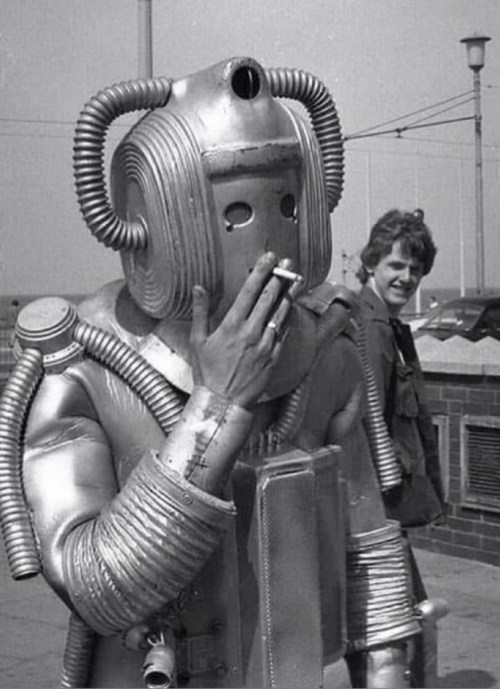
A cyberman from Doctor Who having a cigarette break

AI is pretty good, but Amazon Fresh doesn’t trust it to perfectly track your purchases. It employs 1000 people in India to manually check 70% of transactions. Amazon points out that human reviewers are common where high accuracy is demanded of AI. Open AI employed Kenyan workers on a tiny salary to make ChatGPT less toxic, and several AI-powered drive-thru fast food joints were using humans in the Philippines to act as AI.

Famously, AI-powered drive-throughs by Taco Bell and McDonald’s had to be pulled due to serious glitches such as putting bacon on ice cream, adding £222 dollars worth of nuggets and refusing to accept that a drink order was a drink order.

Whilst some analysts are warning that this time Generative AI will change everything (for better or for worse), others are cautioning it’s already as good as it will get and that the AI bubble is about to burst. Meanwhile, headlines are pouring in that 95% of companies have seen no return on their Generative AI investment, or that another AI winter is coming. So where does that leave us ordinary users?

Aside from the well-known, and poorly managed, risks of biased training data leading to biases in AI — a reflection, of course of the human world — we simply need to beware of mistaking AI for a little elf that does our bidding.
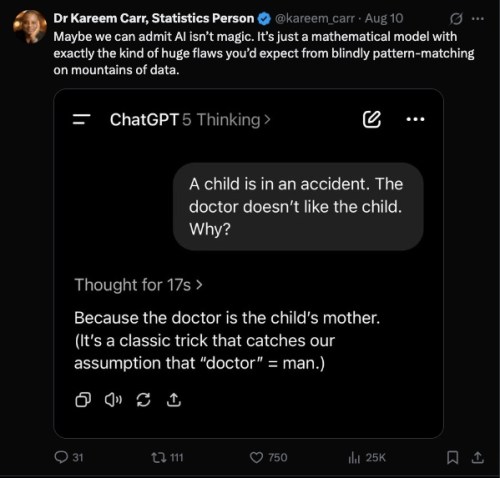
ChatGPT misses the joke

AI is limited. Its data is finite. Its understanding is zero. Here, ChatGPT shows that it never understood the famous “I can’t operate, it’s my daughter” lateral thinking puzzle. It doesn’t just have biases, it has weird ones.

AI is a tool that can be useful but is limited. It isn’t sentient, but it also only has the morals and safeguards we build into it. Mickey Mouse’s enchanted water-carrying broom is really the model for a famous AI thought experiment called the Paperclip Maximiser which highlights the danger of giving carelessly formed instructions to a powerful but unthinking AI-controlled system.

Agentic AI is the new trend of letting AI do things for you rather than simply asking it a question. It can book flights for you but it will need access to your credit card details for example.
In the words of Donnchadh Casey, CEO of CalypsoAI, a US-based AI security company, “If not given the right guidance, agentic AI will achieve a goal in whatever way it can. That creates a lot of risk.” If agentic AI is the Paperclip Maximiser made real, we must establish rules and standards for how it behaves and how it is limited because, unlike the sorcerer’s apprentice, there is nobody to step in if it goes rogue.

September PubSci is nearly upon us – BOOK NOW!

That was a longer digression into AI than I planned so lets’s focus on this month’s PubSci.

On Wednesday 17th September, PubSci is delighted to welcome author and broadcaster Rob Eastaway as he draws back the stage curtain to reveal the extraordinary mathematics of William Shakespeare’s day and its role in his plays in Much Ado About Numbers? – Shakespearean Maths.

Rob uses humour and insight to explore why the Tudors multiplied so quickly, and how dice-rolling was a hazard as we discover the surprisingly funny ways in which Shakespeare used numbers in his writing.

Rob Eastaway is the award-winning author of ‘Why do Buses come in Threes?’ and will be signing copies of his latest book, Much Ado About Numbers, after the talk. To be there or not to be there..? That’s not even a question!

You can read all about it on the current Next Event page or go straight to booking on Eventbrite. Remember, only a handful of tickets are left, so don’t delay.

~

Methinks I have astronomy

Talking of Shakespeare, it seems he wasn’t only interested in the maths of his day. He may also have kept somewhat up to date with the science of his day, especially astronomy. Here’s a line from Sonnet 14 in which it seems he’s distinguishing astronomy from astrology:

Not from the stars do I my judgment pluck; And yet methinks I have astronomy, But not to tell of good or evil luck.

A friend recently sent me a delightful podcast from Scientific American in 2014 in which Author Steve Mirsky discusses the possibility that Shakespeare knew about the eccentric (but hugely important) Danish astronomer Tycho Brahe and referenced him in Hamlet. I won’t duplicate it here — this blog is already longer and later than I intended — I’ll just say that if a drunken Elk, a golden nose, a private observatory-castle on its own island, and a bizarre death don’t grip you (in a sort of comedy Bond villain kind of way), at least read up on Brahe for his huge contribution to astronomy such as highly accurate observations in the pre-telescope era. You can read a transcript of the podcast here.

An elk with a man's head
Advert for Taiberg lemonade featuring Tycho Brahe

“Doubt thou the stars are fire; Doubt that the sun doth move; Doubt truth to be a liar; But never doubt I love.” Hamlet Act 2 Scene 2

~

International Microorganism Day

On 17 September 1683, Antonie van Leeuwenhoek – a Dutch merchant with no fortune or university degree – sent a letter to the Royal Society of London with the first description of a single-celled organism after he made the first simple microscope. He originally wanted to check the quality of cloth in his drapers shop, and small folding magnifiers are still known as “linen checkers” to this day, even when used for entirely different purposes. After being given a basic microscope for a birthday while at primary school, Van Leeuwenhoek became one of my childhood heroes.

Whilst I didn’t follow him into a career in microscopy (as I thought I would at the age of 9), I’m very happy that 17th September is now recognised as International Microorganism Day.
Obviously you’ll be at PubSci in the evening, but if you have time during the day, why not brew beer, ferment kimchi, watch tardigrade videos, admire Petri dish art, or simply raise a toast to the invisible life forms keeping our planet running!

Indeed, where better to raise a glass of something microbiologically-made than the upstairs room of the Old King’s Head at Much Ado About Numbers? – Shakespearean Maths!

In a curious scheduling coincidence, October’s PubSci is on problematic microorganisms, as Prof Jenny Rohn talks about the never-ending battle against Antimicrobial Resistance on Wednesday 15th October. Don’t forget you can keep up with forthcoming events by subscribing to our Google calendar or downloading the programme (see below). You can also follow us on Eventbrite to be notified when tickets become available for new events.

Lastly, apologies for sending this blog out so late. I do all this in my free time, and my free time has lately been taken up with other projects, not least of which involves some rather exciting news. I’ll be presenting a science radio show on Resonance FM, London’s Arts Council-funded community radio station, and I’m delighted to say that Mike Lucibella will co-present. We’ve recorded the first monthly episode and are editing it before a broadcast date is announced. Despite the name, you can listen to Resonance on DAB, streaming and Soundcloud (for playback) as well as good-old FM radio.

I’ll be posting news of the broadcast dates and links to our Soundcloud as soon as they’re available.

Thanks for reading. Please feel free to email or comment in response. Hope to see you at The Old King’s Head on Wednesday 17th September.

14/9/2025 Posted by Richard, PubSci programmer and host

PubSci: Sipping • Supping • Science

• • •

The Summer / Autumn Programme

PubSci’s latest programme runs from July to November (there’s no event in December) and is perfect for printing out and pinning to your work noticeboard or sticking to the fridge, It’s always available on the Current Programme page, along with past event programmes, and you can link to the image below on your own website.
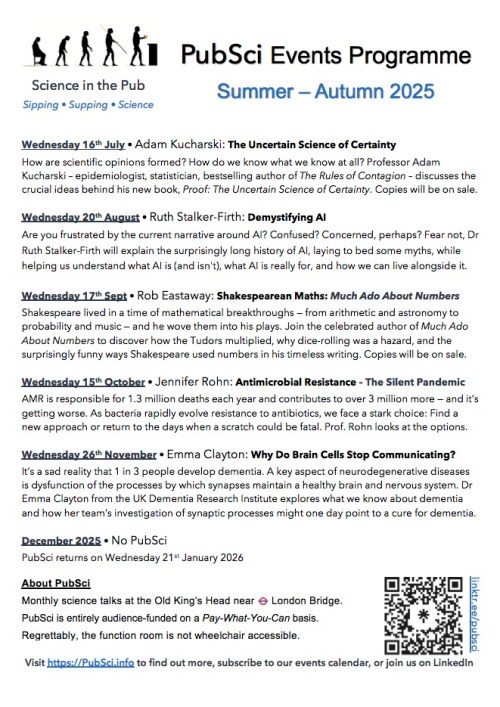
Click the image to open the programme in a new tab.

• • •

Keeping Up With Future Events

To make sure you don’t miss out on future events, subscribe to our Google Calendar to be the first to know when new talks are scheduled, and follow PubSci’s events on Eventbrite to be notified when tickets are available. You can also sign up to our own mailing list on any page on this site.

• • •

About PubSci talks

PubSci is organised and hosted by science communicator, Richard Marshall, assisted by Mike LucibellaEvents are held upstairs at the Old King’s Head, near London Bridge tube. No specialist knowledge is required, just curiosity. Doors open at 6.30pm for a 7pm start. Talks run for ~45 minutes and are followed by a Q&A session. The Old King’s Head has a happy hour before 7pm, and the kitchen serves excellent pub grub.

Support PubSci

There is no charge for attending PubSci talks, but we have a cash whip-round to cover expenses on the night – consider it “Pay What You Can Afford”. As few of us carry cash these days, you can make a donation when registering for ticketed events with Eventbrite. Please help us continue putting on events. PubSci has no other source of funding.

We aim to keep PubSci accessible for all, although it is unsuitable for under 18s as we meet in the function room of  a pub. Regrettably, there is no wheelchair access. 

You can find all our links on our LinkTree.

The evolution of humans from sitting in a chair to talking about science in a pub (after Darwin)

Address:

The Old King’s Head (upstairs room)
King’s Head Yard
45-49 Borough High Street
London SE1 1NA
August Update: Proofs, Pictures, Perseids, Probabilities, and PubSci’s Programme

In this post, we preview August’s PubSci, reflect on July’s talk, look to the skies and more. Read on!

STOP PRESS: Our August event is next week – only 20% of tickets remaining.

On 20th August, PubSci considers the Ghost in the Machine and attempts to demystify AI.

August’s PubSci is Nearly Fully Booked

80% of tickets for next week’s talk on Demystifying AI have already been snapped up at the time of writing. Head to the booking page now if you don’t want to miss out.

Many of us have questions about AI and want to understand it better. As ChatGPT, Microsoft Copilot and Apple Intelligence get embedded into our devices and our lives, it’s increasingly important that we understand this tool and are comfortable with what AI really is (and what it really isn’t). On Wednesday 20th August Dr Ruth Stalker-Firth shares insights from three decades of involvement in AI to give us the solid grounding we need if we are to make informed choices.

~

Art meets science in words and images – Wellcome Photography Prize Winners Announced

Traditionally dressed Peruvian women look at a small handheld device while a man looks on from behind a clump of grass
Urban Travel by Mithail Afrige Chowdhury (Wellcome Photography Prize 2025)

Since 1997 the Wellcome Photography Prize has been celebrating compelling imagery that captures stories of health, science and human experience. This year’s winners were announced on 16th July and the top 25 images are on show at The Francis Crick Institute close to London’s King’s Cross until 18th October. The Crick is worth a visit just for the fabulous modern architecture and a very nice cafe.

Cholesterol in the Liver by Steve Gschmeissner (Wellcome Photography Prize 2025)

There’s no need to book, just turn up during normal opening hours (open Wednesday to Saturday).

~

Open your eyes, Look up to the skies

A few years ago I was camping in Sussex at this time of year, and we were treated to most spectacular display of ‘shooting stars’ I’ve ever seen. While many looked like static or short, bright scratches in the night sky, some seemed impossibly long and slow as they grazed the tree-line. We’d been fortunate to camp during a particularly good year for the Perseid meteor shower.

Francisco Seco/AP (via The Guardian)

The Perseids, as the shower is known, are one of the most dramatic things to see in the night sky between July and August, and a highlight of meteor hunters’ calendars due to their frequency and brightness. Dark skies are best, of course.

The Perseids are caused by the Earth slamming into the debris left behind by comet 109P/Swift-Tuttle and are so-called because they appear to be radiating from the Perseus constellation. Unfortunately this year’s peak is 12th August (tonight, as I write) when the moon is still quite bright in the sky and there’s hazy cloud above South London.

Greenwich Observatory has written a super guide for anybody wanting to see the Perseids this year.

~

Easy come, Easy go…

If the thought of bright meteors streaking across the skies (albeit from comet debris) brings June’s PubSci to mind, when Dr Stuart Eve explored why large asteroids strike Earth at surprisingly regular intervals, you might be interested in a study published today in the Planetary Science Journal called Placing the Near-Earth Object Impact Probability in Context. This paper looks at the lifetime odds of an individual dying from an asteroid impact with global effect and compares them to other odds of dying from what it describes as “other preventable causes of death”.

How rabies, elephant trampling and lightning strikes count as entirely ‘preventable’ is a little beyond me, but I’m sure Stuart would be heartened to know that impact by a 140 m diameter asteroid is also considered preventable by the study’s authors in the light of our ability to catalogue increasingly small near-Earth objects (NEOs) – something Stuart discussed towards the end of his talk.

You can find a very readable discussion of the paper on phys.org but the original is definitely worth a look. You’ll need to click the graphic to enlarge it, which plots the probability of an event happening in an individual’s lifetime against the likelihood you’ll die if it does happen to you. It seems elephant attacks are nearly always fatal, though mercifully rare.

Surprisingly, Nugent et al  estimate you’re more likely to witness a 140m+ asteroid hit somewhere on Earth during your lifetime than you are personally to be struck by lightning, and the lightning is also more likely to be fatal. Which leads us nicely onto statistics.

~

Looking back on July’s PubSci

On Wednesday 16th July, PubSci welcomed Professor Adam Kucharski (pictured centre with Mike and Richard from PubSci and King Henry VIII), epidemiologist, statistician, and bestselling author of The Rules of Contagion. Adam came to talk about the crucial ideas behind his new book, Proof: The Uncertain Science of Certainty. New Scientist described it as a “life raft in a sea of fake news and misinformation.”

You can order both of Adam’s books here. Many thanks to Adam for a brilliant talk that ranged from drinking habits of Cambridge colleges (and how they non-causally predict exam success) to fake news and self-driving cars.

In the pre-covid days, I taught a lecture on Ethics for Engineers, featuring the famous trolley problem which challenges us to make moral choices when neither delivers a “good” outcome. There’s no right or wrong answer — what matters is how you make the choice: what data, which biases, and which ethics you bring to bear in the decision. This is exactly the kind of decision that AI in self-driving cars will have to quickly make when faced with knocking down a pedestrian in the road or swerving into a family of ducklings. Adam talked about MIT’s Moral Machine project which invites the public to submit their choices for various scenarios and reveals some interesting cultural differences.

We were delighted to learn that somebody in the audience had actually worked on Moral Machine. Read all about the experiment and its fascinating findings here.

~

Talking of AI, here’s one last reminder to book for August’s talk: Demystifying AI with Dr Ruth Stalker-Firth. With over 80% of tickets already snapped up at the time of writing, you’ll need to be quick.

• • •

The Summer / Autumn Programme is Out

PubSci’s latest programme runs from July to November (there’s no event in December) and is perfect for printing out and pinning to your work noticeboard or sticking to the fridge, It’s always available on the Current Programme page, along with past event programmes, and you can link to the image below on your own website.

Click the image to open the programme in a new tab.

Thanks for reading. Please feel free to email or comment in response. Hope to see you at The Old King’s Head on Wednesday 20th August.

12/8/2025 Posted by Richard, PubSci programmer and host

PubSci: Sipping • Supping • Science

• • •

Keeping Up With Future Events

To make sure you don’t miss out on future events, subscribe to our Google Calendar to be the first to know when new talks are scheduled, and follow PubSci’s events on Eventbrite to be notified when tickets are available. You can also sign up to our own mailing list on any page on this site.

• • •

About PubSci talks

PubSci is organised and hosted by science communicator, Richard Marshall, assisted by Mike LucibellaEvents are held upstairs at the Old King’s Head, near London Bridge tube. No specialist knowledge is required, just curiosity. Doors open at 6.30pm for a 7pm start. Talks run for ~45 minutes and are followed by a Q&A session. The Old King’s Head has a happy hour before 7pm, and the kitchen serves excellent pub grub.

Support PubSci

There is no charge for attending PubSci talks, but we have a cash whip-round to cover expenses on the night – consider it “Pay What You Can Afford”. As few of us carry cash these days, you can make a donation when registering for ticketed events with Eventbrite. Please help us continue putting on events. PubSci has no other source of funding.

We aim to keep PubSci accessible for all, although it is unsuitable for under 18s as we meet in the function room of  a pub. Regrettably, there is no wheelchair access. 

You can find all our links on our LinkTree.

The evolution of humans from sitting in a chair to talking about science in a pub (after Darwin)

Address:

The Old King’s Head (upstairs room)
King’s Head Yard
45-49 Borough High Street
London SE1 1NA

July Blog Post: Asteroids, Astronomy, Science Photography and Poetry plus July’s PubSci and discount tickets to a talk on the Northern Lights

In this post, I preview July’s PubSci talk (now booking) and other great science events coming up, we reflect on June’s PubSci and share details of a ticket offer for the coming weekend. Read on!

Our next event is only 2 weeks away

Microscope, books, magnifying glass: The search for proof
On 16th July, PubSci explores how scientific truth emerges and why it sometimes falters.

July’s PubSci talk is booking up fast, with 25% of places already snapped up – head to the booking page now if you don’t want to miss out – but before looking in more detail, we’ll serve up some other science-based goodies. There’s lots of science poetry in this edition of the PubSci blog, some great events, some sad astronomy news and some good astronomy news, a look back at June’s topic and an exclusive discount code for a super astronomy talk at the Royal Institution on Saturday 5th July.

~

Art meets science in words and images

Traditionally dressed Peruvian women look at a small handheld device while a man looks on from behind a clump of grass
Peruvian women test water pH from a melting glacier. © Ciril Jazbec / Wellcome Photography Prize 2025

Last month we previewed a botanical photography exhibition at Ken Artspace and I’ve found another super photo exhibition for you this month. Since 1997 Wellcome Photography Prize has been celebrating compelling imagery that captures stories of health, science and human experience. This year the winners will be announced on 16th July (the same day as PubSci) and the top 25 images will be on show at The Francis Crick Institute close to London’s King’s Cross from 17th July until 18th October. The Crick is worth a visit just for the fabulous modern architecture and a very nice cafe.

The Poetry of Science and the Science of Poetry

This is a bumper season for poetry and science. The Brilliant is an annual competition celebrating poetry which expresses scientific wonder through verse. Alas, entries closed at the end of June for this year’s competition but you can read last year’s shortlisted entries and the 2024 winners here.

If you’d like to try your hand at writing poetry with a science theme, perhaps with a view to entering next year’s competition, I strongly recommend signing up for the CPD short course on Science Communication Through Poetry run by Sam Illingworth. It’s delivered live via Zoom over four Wednesday lunchtimes and costs just £50. There’s even a bursary for those on low income. Sam, a professor at Edinburgh Napier University, is also one of the judges for The Brilliant competition and has written several books on science and poetry including The Poetry of Physics published earlier this year. I’m hoping to tempt Sam down south for a PubSci event before too long.

A banner for Consilience Journal

If you enjoy the crossover between science and poetry and/or science and art, I recommend looking into a beautiful online journal called Consilience (referring to the convergence of thought between different disciplines). Consilience is free to read but you can support it by subscribing to their Substack. If you’re already a science poet or artist, and looking for somewhere to publish, Issue 22 of Consilience is now open for submissions of poetry and art exploring the scientific topic of ‘Waves’ – but do hurry, submissions for the coming issue close at noon on Sunday 6th July.

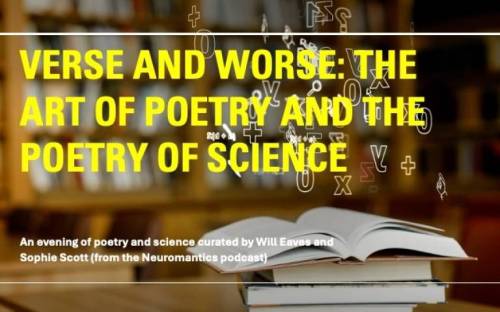
EVENT TOMORROW: Live Poetry and Live Neuroscience!

An image with an open book and text saying Verse and Worse

What happens when a poet and a neuroscientist get together to see if they can make sense of their connections?

They create an event called Verse and Worse, with Professor Sophie Scott and Will Eaves, both from the Neuromantics podcast.

On Wednesday 2nd July, at the Bloomsbury Theatre, Will and Sophie will be conducting live neuroscience experiments related to poetry. It looks like being a brilliant event, and it’s only £8, but there are lots of unsold seats at the time of writing, so book a ticket now and I’ll see you there.

~

An Astronomic look back at June

A bright meteor streaks across the nighttime sky over a river
Fireball over Chelyabinsk, Russia, in 2013 (The Planetary Society)

At June’s PubSci Stuart Eves delighted us with “How the Universe is Trying to Kill Us – and How We can Stop It” in which he considered possible mechanisms to explain the surprising periodicity of global mass extinctions, with a focus on the way our solar system moves through the warped plane of the Milky Way every 30 million years or so.

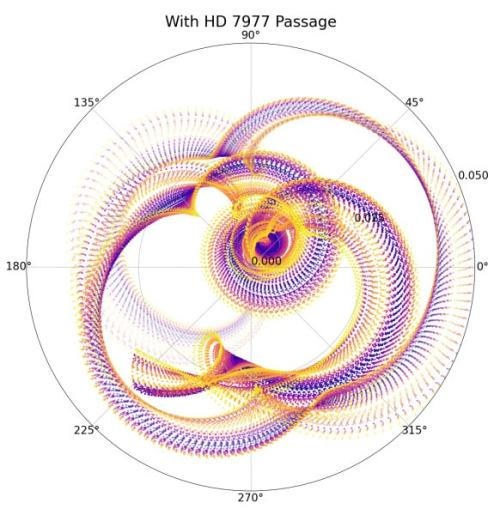
If you want to read more about the effect of distant stars on our own solar system (and by implication, what encountering more of them as the solar system passes through the galactic disk) might mean for the stability of orbits, check out this article called Passing Stars Altered Orbital Changes in Earth and Other Planets, with its lovely illustration of the uncertainty of Earth’s orbit 56 million years ago that arises from the passing of a sun-like star 2.6 million years ago (which is about when we last passed though the galactic disk).

The world’s most powerful camera captures its first images of space

The Vera C Rubin observatory in Chile, home to the world’s most powerful digital camera, has released its first images, and to quote the ‘Super Soaraway Sun‘* (sorry!: WHAT A STUNNER!

*Let’s hope it doesn’t soar away in the light of the previous topic.

Swirling clouds of interstellar gas
The Trifid and Lagoon nebulae 9,000 light years away, captured by the Vera Rubin Telescope

The observatory is tasked with detecting potentially deadly earthbound asteroids in time for us to take protective measures (if you came to June’s PubSci you’ll have some idea what these might be and what the pitfalls are). It will also be seeking concrete evidence for “dark matter” which is the standard cosmological explanation for the way galaxies spin. You can read more about that – and learn why the observatory is named after Vera Rubin – on this page.

A farewell to the world’s oldest radio astronomer

A giant dish at Jodrell Bank observatory

The former Astronomer Royal, Sir Francis Graham-Smith who died at the age of 102, was the world’s oldest active radio astronomer according to Jodrell Bank Observatory where he was director from 1982 to 1990. Graham, as he was known, was only the second director of Jodrell Bank after Lowell himself, and technically retired in 1988 but he continued working as emeritus professor of radio astronomy at The University of Manchester. Graham published his final astronomy article earlier this year. You can see Sir Francis Graham-Smith’s photo and read his obituary on the BBC New website.

HOT NEWS: Exclusive ticket discount for a talk on the aurorae of Earth and beyond

Last of the astronomy items in this edition of the PubSci blog is an exclusive discount code for a talk called Understanding the Northern Lights – From Earth to Jupiter on Saturday 5th July.

If the recent aurorae over central and southern Britain have piqued your interest, head to the Royal Institution this Saturday evening to discover what they are, how they happen, and why it’s so significant to the search for extraterrestrial life that Jupiter’s moon Ganymede experiences aurorae.

The speaker, Marina Galand, is Professor of Planetary Science at Imperial College London. I met Marina a few weeks ago and was bowled over by her knowledge, enthusiasm and energy for this subject. It’s going to be a brilliant talk and to make it even better the Ri has kindly offered PubSci a whopping 25% discount for this event with the code LIGHTS25 (feel free to share).

Book on Eventbrite via the Ri Website – your phone camera won’t even need to be in night mode!

~

At last… July’s PubSci

(To be read in the voice of Viv Stanshall on Tubular Bells, for those of a certain vintage)

Book cover for PROOF - The Uncertain science of Certainty

 The nest PubSci talk is just 2 weeks away, on Weds 16th July, and we’re delighted to welcome Professor Adam Kucharski to explore the ideas behind his latest book, Proof: The Uncertain Science of Certainty.

How can we weigh up noisy evidence to decide how safe is an autonomous vehicle or judge somebody’s guilt or innocence?

Adam will explores how scientific opinion is formed, how to convince others of the facts, and what links wine and university exams, royalty and Guinness, cricket and robot racing.

Full details and the booking link are on PubSci’s Next Event page or you can book straight away on Eventbrite.

With over 25% of tickets already snapped [now at 30%] up at the time of writing, the best way to be certain of a place is to book yours today. Copies of Proof will be on sale at the event.

1/7/25 Posted by Richard Marshall, PubSci organiser and host.

PubSci: Sipping • Supping • Science

• • •

PS In case you haven’t checked it out yet, science communicator and PubSci member, Ushashi Basu, recently wrote about PubSci in her excellent blog and interviewed me to find out how I came to be booking and introducing speakers for a public science outreach event in a pub, what led me into science communication, and what motivates me to communicate science.

It was a pleasure to chat with Ushashi over a coffee and look back at seven years of programming, promoting and hosting PubSci. You can read that interview here and see Ushashi’s other blog posts at https://ushashibasu.com/.

Hope to see you all at the Old KIng’s Head on Wednesday 16th July.

• • •

Keeping Up With Future Events

To make sure you don’t miss out on future events, subscribe to our Google Calendar to be the first to know when new talks are scheduled, and follow PubSci’s events on Eventbrite to be notified when tickets are available. You can also sign up to our own mailing list on any page on this site.

• • •

About PubSci talks

PubSci is organised and hosted by science communicator, Richard Marshall, assisted by Mike LucibellaEvents are held upstairs at the Old King’s Head, near London Bridge tube. No specialist knowledge is required, just curiosity. Doors open at 6.30pm for a 7pm start. Talks run for ~45 minutes and are followed by a Q&A session. The Old King’s Head has a happy hour before 7pm, and the kitchen serves excellent pub grub.

Support PubSci

There is no charge for attending PubSci talks, but we have a cash whip-round to cover expenses on the night – consider it “Pay What You Can Afford”. As few of us carry cash these days, you can make a donation when registering for ticketed events with Eventbrite. Please help us continue putting on events. PubSci has no other source of funding.

We aim to keep PubSci accessible for all, although it is unsuitable for under 18s as we meet in the function room of  a pub. Regrettably, there is no wheelchair access. 

You can find all our links on our LinkTree.

The evolution of humans from sitting in a chair to talking about science in a pub (after Darwin)

Address:

The Old King’s Head (upstairs room)
King’s Head Yard
45-49 Borough High Street
London SE1 1NA

September’s Event, More News and ‘Thank You’s

The shadow of Count Orlok from the 1922 film Nosferatu

Count Orlok in F.W. Murnau’s 1922 “Nosferatu”

Greetings from windy South London.

First of all, many thanks to Steph Holt for August’s PubSci talk on Gilbert White. A special shout-out to the Goth WI posse who took advantage of their month off to come to the Old King’s Head. Sorry you can’t make the next one because it’s right up your street.

You see, we’re beating the October rush by getting our spook on early this year with a September Halloween Special looking at the natural history of vampires. If you think that doesn’t sound like it would contain much science, you’ve obviously never met September’s speaker, Deborah Hyde.

Full details of the event will be published in this blog once it’s been created on Eventbrite, but you can see a preview on our regular Next Event page (or click the image above). Read on for more ways to stay informed of forthcoming PubSci events. In the meantime, put 18th September in your diary.

• • •

Good news!

Summer-Autumn 2024PubSci’s Summer and Autumn programme is now available to download or print. If you didn’t realise we even had a programme, follow that link for a preview of scheduled events to the end of the year.

Of course, you may just want PubSci events to appear in your calendar app automatically, rather than looking at a flyer pinned to your fridge. Fear not! You can view or subscribe to our Google calendar feed here. Or just click this link to subscribe in one step by downloading the .ics file.

• • •

Get with the programme!

Since we’ve got an events programme, why not share it with friends and colleagues? It takes me a while to plan and produce every quarter and I’d hate it to go unused! How about printing off a copy and pinning it on your staff noticeboard? Everybody is welcome at PubSci.

• • •

Screenshot

Follow PubSci wherever you are…

Did you know PubSci is on Facebook and Bluesky (and Twitter though I’m trying to move off that). We even have a LinkedIn group, which I’d really love you to join.

And if you want to find all the links in just one place, then you need to head to our Linktree. What’s linktree, you ask? It’s a kind of mini website that’s optimised for mobile viewing and hosts links to all your stuff. Basically it’s like an index to everything you want to put online – and it’s free. Nope, we don’t have a “partner link” or get a kickback for recommendations, I just really like it.

• • •

And finally

Roughly half of all humans experience menopause but it’s rarely talked about in public, and both policy and education are shamefully inadequate despite the efforts of a few notable voices. Research by the Fawcett Society found 80% of menopausal women feel unsupported in the workplace. Our friends at the Vagina Museum want to help set this right with an exhibition called Menopause: What’s Changed?

It’s due to open on 18th October 2024 – World Menopause Day – but over a dozen arts and heritage funders have declined to support it, so they’re running a fundraiser instead. If you want to support it, or know an organisation who would, just follow this GoFundMe link.

…aaand October’s PubSci falls just two days earlier, so we’re hosting a special talk for everybody called Menopause Demystified. Yup, that includes the blokes too.

See you in the pub!

• • •

Support PubSci

There is no charge for attending PubSci talks, but we have a traditional whip-round to cover expenses – consider it a “Pay What You Can” event. Very few of us carry cash these days, so you can contribute digitally through our TipJar [awaiting link update] or make a donation when registering for ticketed events with Eventbrite. Please help PubSci continue putting on events. PubSci has no other source of funding.

We aim to keep PubSci accessible for all, although it is unsuitable for under 18s as we meet in the function room of  a pub. Regrettably, there is no wheelchair access. 

Check out the Future Events page where you can also subscribe to our Google Calendar so PubSci events automatically appear in your own Calendar.  You can find all our links on our LinkTree.

• • •

We used to meet on the first Wednesday of the month but PubSci is now on the third Wednesday. Join us upstairs at the Old King’s Head near London Bridge Underground (Borough High Street east side exit) every month apart from December for a regular dose of Sipping, Supping & Science.

image-third-wednesdays

Address:

The Old King’s Head (upstairs room)
King’s Head Yard
45-49 Borough High Street
London SE1 1NA
Next Event, News and ‘Thank You’s

meaning-of-coincidences-dice-on

Greetings from steamy South London.

July’s event is up on Eventbrite, and whilst I will be writing a blog post about it soon, you can read the most important details and find the booking link at our regular Next Event page (or click the image above). Meanwhile, here at PubSci towers, we’re breathing a sigh of relief as the temperature slowly drops, because the heat seems to have convinced WordPress that Orange is the new Black. 

In case you’re wondering, we’ll be welcoming back Professor Chris French to talk about the science and psychology of freaky coincidences. He’ll also be offering copies of his excellent new book for sale, rather wonderfully titled, The Science of Weird Shit: Why Our Minds Conjure the Paranormal. As always it’s the third Wednesday of the month, in this case Weds 17th July.

• • •

Huge thanks, of course, to June’s speaker, Eva Amsen. Remember, next time you hear about DNA fingerprinting or genetic testing, that it’s only possible thanks to some soupy bugs living in Yellowstone’s hot springs.

• • •

Roughly half of all humans experience menopause but it’s rarely talked about in public, and both policy and education are shamefully inadequate despite the efforts of a few notable voices. In fact research by the Fawcett Society found 80% of menopausal women feel unsupported in the workplace. Our friends at the Vagina Museum (the first museum of its kind in the world, now permanently housed in Bethnal Green), want to help set this right with an exhibition called Menopause: What’s Changed?

It’s due to open on 18th October 2024 – World Menopause Day – but over a dozen arts and heritage funders have declined to support it, so they’re running a fundraiser instead. If you want to support it, or know an organisation who would, just follow this GoFundMe link.

___

Don’t forget to register for July’s PubSci talk. As always. it’s a pay-what-you-can event – please consider making a donation with your reservation to help us cover our costs.

• • •

Support PubSci

There is no charge for attending PubSci talks, but we have a traditional whip-round to cover expenses – consider it a “Pay What You Can” event. Very few of us carry cash these days, so you can contribute digitally through our TipJar or make a donation when registering for ticketed events with Eventbrite. Please help PubSci continue putting on events. PubSci has no other source of funding.

We aim to keep PubSci accessible for all, although it is unsuitable for under 18s as we meet in the function room of  a pub. Regrettably, there is no wheelchair access. 

Check out the Future Events page where you can also subscribe to our Google Calendar so PubSci events automatically appear in your own Calendar.  You can find all our links on our LinkTree.

• • •

We used to meet on the first Wednesday of the month but PubSci is now on the third Wednesday. Join us upstairs at the Old King’s Head near London Bridge Underground (Borough High Street east side exit) every month apart from December for a regular dose of Sipping, Supping & Science.

image-third-wednesdays

Address:

The Old King’s Head (upstairs room)
King’s Head Yard
45-49 Borough High Street
London SE1 1NA

A Hitchhiker’s Guide to the Solar System | Weds 18th October, with Dr Stuart Eves

On Wednesday 18th October PubSci is delighted to welcome Astrophysicist and Satellite engineer, Dr Stuart Eves, to take us on a guided tour through the wonders of the Solar System.

The eight planets lined up to compare their sizes

The eight planets and their moons (Sizes are to scale, interplanetary distances aren’t!). Courtesy of CactiStaccingCrane.

• • •

If you thought Earth was the only body in our solar system worth visiting, think again!

Join Stuart Eves for an interplanetary travellers’ guide to some of the most fascinating, beautiful, and compelling sights any tourist could wish to see in the vicinity of our star.

The colourful surface of Jupiter's Moon Io is covered with volcanoes

Jupiter’s Moon Io (NASA/JPL/UoArizona)

From the first Soviet lunar probe, Luna 1, through NASA’s Mariner and Voyager missions, to the international James Webb Space Telescope, humans have been imaging the planetary bodies of our solar system and their moons in ever-increasing detail.

But if you could hitch a ride on this space hardware, what would you see?

Instead of the barren bodies we once supposed, objects in our solar system have revealed themselves to possess stunning features reminiscent of those that make our home planet so beautiful and awe inspiring, only far, far larger: volcanoes, dust devils, geysers, liquid and frozen oceans, unexpected seasonal features… perhaps evidence of life too.

Even little Pluto turns out to be more interesting than anybody thought possible.

__

Join us upstairs at the Old King’s Head, near London Bridge station. Doors open at 6.30pm for a 7pm start. The Old King’s Head has a happy hour before 7pm, and the kitchen serves excellent pub grub.

We use Eventbrite ticketing. Reserve your place now! PubSci is free to attend but please consider making a donation with your reservation to help cover costs.

__

A photograph of Stuart Eves

Dr Stuart Eves

Dr Stuart Eves has an MSc in Astrophysics and a PhD in satellite constellation design. He has more than 30 years of experience in satellite systems and is a Fellow of both the Royal Astronomical Society and the British Interplanetary Society. In 2018 he founded his own space consultancy, SJE Space Ltd, following 16 years with the MoD and 14 years with Surrey Satellite Technology Limited.

His 2017 book “Space Traffic Control” is the standard text on protecting satellites from natural hazards and man-made threats. He serves on the Advisory Panel for the ESA Space Safety Programme, and is a founder of the GNOSIS network on sustainability in space.

Stuart is passionate about sharing his love of space. He “moonlights” as a GCSE Astronomy teacher and speaks to adults at U3A and Café Scientifique. His outreach work has been rewarded with the Arthur Clarke Award and his satellite technology has been displayed in the Science Museum. He has spoken at the Royal Institution on numerous occasions.

Don’t miss the chance to join Stuart at PubSci this October for a tour through some of the most beautiful, fascinating, and intriguing features of our own Solar System.

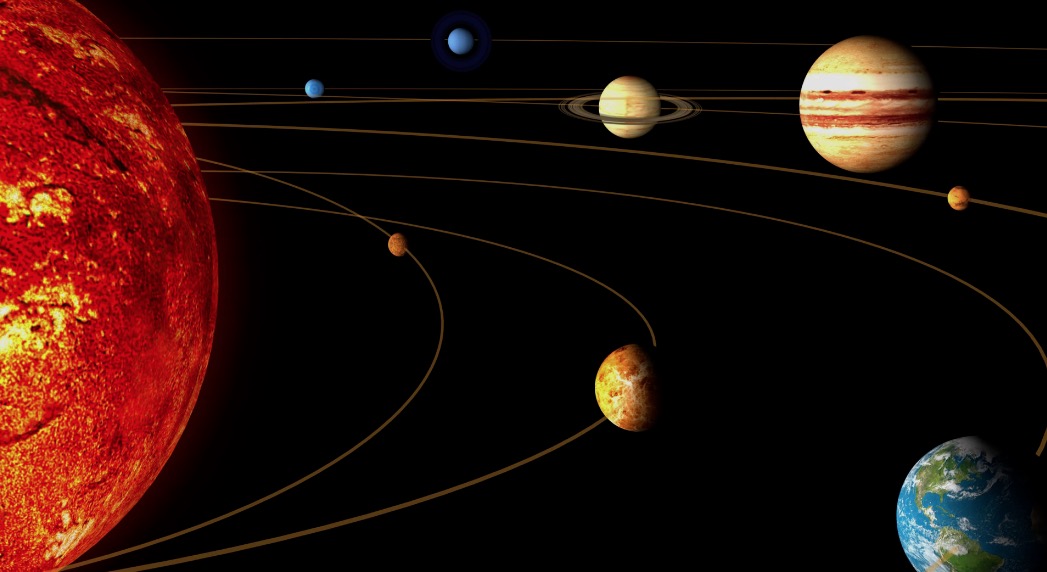
Graphic of the solar system produced by the European Space Agency

The Solar System (Credit: ESA)

• • •

Please support PubSci.

There is no charge for attending PubSci talks, but we have a whip-round to cover expenses. Because so few of us carry cash these days, you can contribute digitally too  by putting a few quid in the virtual whip-round. Please help PubSci continue to put on events.

We aim to keep PubSci accessible for all, although it is unsuitable for under 18s as we meet in the function room of  a pub. Regrettably, there is no wheelchair access. 

Please check our Future Events page where you can also subscribe to our iCal feed.  You can find all our links on our LinkTree.

__

We used to meet on the first Wednesday of the month but PubSci is now on the third Wednesday.

image-third-wednesdays

Address:

The Old King’s Head (upstairs room)
King’s Head Yard
45-49 Borough High Street
London SE1 1NA