
In this post I preview this week’s talk by Andrew Jaffe, look back at February’s unique event, review a music project celebrating ocean science, and list some of the best talks coming up at PubSci and elsewhere. Plus a scientific solstice celebration in South London.
Hello and welcome to the March blog. UK Science Week has just finished, and what a week it was! Over just four days, I delivered 17 workshops for primary school kids in and around London, on topics from light to the inner workings of the human heart. Possibly the most exhausting four days of my life, delivering show after show, but it was also incredibly rewarding. I lost count of the times kids of all ages came up to me squealing that it was the best lesson ever!
Many of us have been inspired by teachers or speakers who lit a flame for science in us, and I hope I can do the same for some of those kids. I even got a lovely shout-out from Lauren Laverne on BBC 6 Music on Thursday.
All of which is a round about way of saying, Yes, this blog post is very late — but for the best of reasons. Hope you like it.
March’s PubSci talk is here!
Is everything we know about the Big Bang wrong…? That’s the question award-winning astrophysicist Professor Andrew Jaffe will be addressing at the Old King’s Head on Wednesday 18th March. To put it another way,
does the Big Bang stand up to scrutiny from ever-better measurements, or do we need to rethink our models?
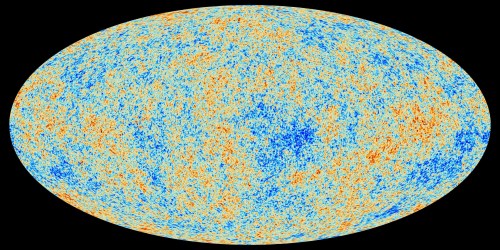
The Cosmic Microwave Background (CMB) is a low frequency hum left over from the Big Bang itself. It started out as insanely hot, high energy, high frequency gamma radiation at the moment the early universe was just cool enough for matter to form and light to be emitted around 13.8 billion years ago.
As the universe has expanded, those gamma rays cooled and stretched, expanding with the universe until today they exist only as very faint radio waves, so cold, they’re barely above absolute zero. Yet even now they retain very tiny variations (shown in the image above), and this is what we think allowed stars and galaxies to form. It was the discovery of the CMB by Penzias and Wilson in 1964 (after they had ruled out pigeons!) that established the Big Bang as a concrete scientific Theory for the origin of the universe. But the CMB isn’t the only evidence we have for an expanding universe, and that’s where the problems begin… But more of that later.
Scroll down for more on March’s PubSci and details of Andrew’s book or head straight to our NEXT EVENT page.
If you subscribe to PubSci’s calendar, you’ll have got the Eventbrite booking link as it went live. That’s probably a good thing as the event is now fully booked — but don’t worry, there’s a waitlist in case anybody drops out, and further down this blog I’m already previewing April’s PubSci, so you can put that in your diary now.
If you don’t yet subscribe, now’s a good time to do it so that PubSci events update automatically in your own calendar with the latest information and booking links as soon as they’re available. Clicking THIS link downloads a small .ics file which will add our calendar to yours once you’ve open it.
PubSci attracts the best brains
Every PubSci is a unique evening of wonder, amazement and splendid science, but I think it’s fair to say that when Prof. Mark Lythgoe came to the Old King’s Head in February, it was the most PubSci ever.
You see, Mark just happens to be the guy who rebuilt Einstein’s brain!
Not his actual, wet, preserved brain of course, but almost. In 2005 Mark and Prof Jim Al-Khalili made a documentary for Channel 4 in which they tracked down all 240 pieces of Albert Einstein’s brain which had been distributed to neuroscientists across the USA in the hope of identifying the source of his genius. As they went, they scanned them all and reassembled them in a computer model which was 3-d printed in translucent plastic resin.
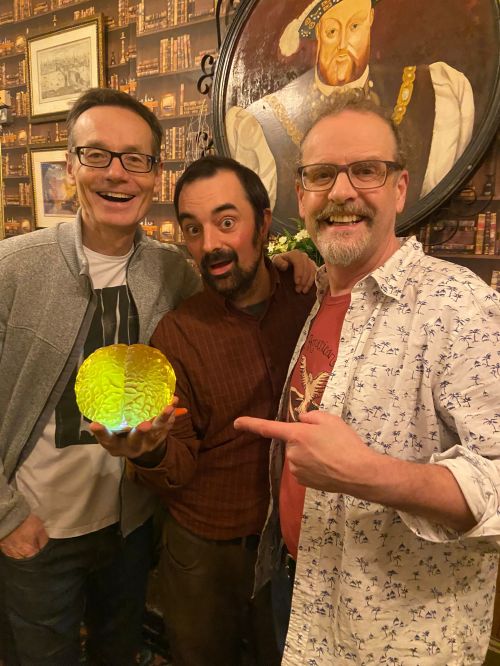
They only made one. And Mark not only brought it to PubSci – yes, the only actual model of Einstein’s brain in the world – he passed it round the whole room, to the delight of the PubSci audience. And yes, that Mark, Mike Lucibella and me holding Einstein’s “actual” brain (illuminated from below by a mobile phone). Even Henry looks intrigued.
Many thanks to Mark for a truly memorable look at the world of biomedical imaging and its amazing future. In a highly visual talk (complete with a live demonstration of optoacoustics) were treated to some incredible unpublished imaging data that Mark and his team at UCL have gathered recently.
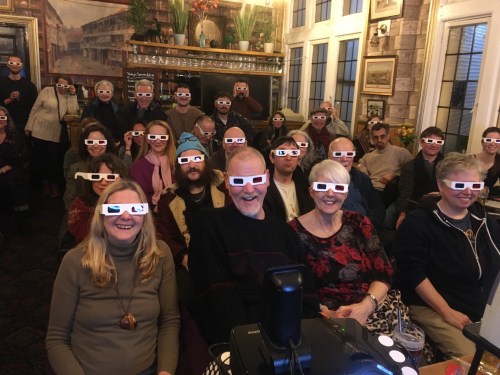
Of course I can’t show you that data, but I can show you evidence that the future of biomedical imaging is truly three dimensional. Those 3-d glasses look so good, they make a second appearance in this blog post.
The Big Bang is a sell-out!
Yes, I’m sorry to say (but also delighted, of course) that March’s event is fully booked — but the good news is that our speaker has a book that you can buy in the shops.
On Wednesday 18th March 2026, PubSci is delighted to welcome Professor Andrew Jaffe to the Old King’s Head to ask “Is everything we know about the Big Bang wrong?”
That may be a surprising talk title, given that Andrew is an award-winning astrophysicist, and the evidence for the Big Bang seems strong, but we’ll be in safe hands. The problem is as follows:
In recent years, astronomers have built ever more sophisticated astronomical telescopes, deploying them on ever more ambitious satellites while constructing others in the darkest, quietest, most remote places on earth. These instruments have enabled the most precise measurements yet of the state of the cosmos, fleshing out the details of our Big Bang model which describes the history and evolution of the Universe itself.
But, as different teams – each employing different equipment and even more different methods – characterise key measurement of how the expansion of our Universe changes over time, something seems to be amiss: different teams are getting different results.
Does this mean that our models are wrong? Is it the measurements? And, once we start pulling at one thread, might the whole tapestry of the Big Bang come apart? Or is randomness and uncertainty built in to how we understand the universe?
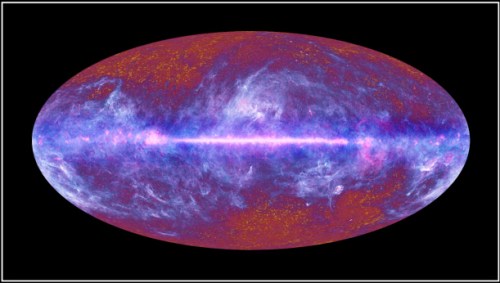
Andrew Jaffe is professor of astrophysics and cosmology at Imperial College London and director of the Imperial Centre for Inference and Cosmology. He uses powerful statistical techniques on data from the Planck Surveyor Satellite, Euclid, LISA, and The Simons Observatory to understand the evolution of the Cosmos.
Andrew’s book, The Random Universe – How Models and Probability Help Us Make Sense of the Cosmos, explores how understanding uncertainty and randomness has led to breakthroughs in our knowledge of the cosmos and demystifies the roles they play in the scientific process.
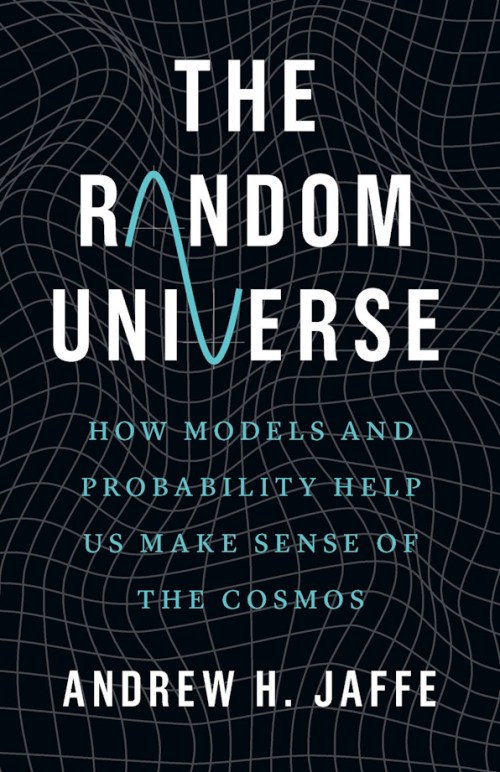
In The Random Universe, Prof. Jaffe explains how scientists create, test, and refine their models by applying those paired concepts, for example to both quantum mechanics and the birth of the universe. It’s a highly readable blend of philosophy, probability theory, and cosmology, that I’m personally happy to recommend.
The Random Universe was published by Yale University Press in November 2025 and will be available to buy at PubSci.
But if you can’t get to PubSci this month (or even if you can), what else is going on?
I’m glad you asked because there’s actually rather a lot. This coming weekend will see the spring equinox, and if you want to mark it, get yourself down to Camberwell in South London
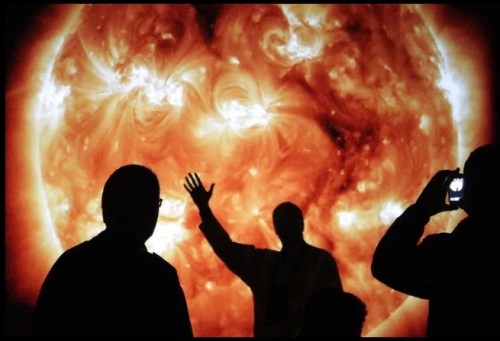
That’s where Live At St Giles presents The Sun at Night, an immersive audio-visual experience exploring our relationship with the Sun and the rhythms of its celestial life.
Created by Camberwell-based artist David Henckel, The Sun at Night takes audiences on a journey through one solar year. Using high-definition footage from NASA, this 30-minute floating installation illuminates the Sun’s living movements – from fiery flares to the subtle undulations of its surface – inviting visitors to experience the star that shapes life on Earth in a mesmerising and intimate new way. It’s only open Friday 20th to Sunday 22nd, so get your skates on.
Something else happening on Sunday is the last in the current series of Bach, the Universe, and Everything at King’s Place on York Way near King’s Cross. I mentioned BUE (as it is fondly known by regulars) on the radio show last autumn, and plugged February’s event in last month’s blog, so I won’t say much except that this month’s speaker is Emily Akkermans, Curator of Time at Royal Museums Greenwich, who’ll be talking about John Harrison, the great enlightenment thinker and creator of the first successful maritime chronometer which finally allowed accurate navigation at sea. John Harrison’s story was the topic of Dava Sobel’s best selling 1995 historical novel, Longitude.
You’ll also get some lovely baroque music and a bit of audience participation as I discovered at last month’s BUE where I spent a wonderful hour in the company The Orchestra of the Age of Enlightenment and Simon Brett, Douglas Adam’s producer for the pilot episode of the original Radio 4 series of The Hitchhiker’s Guide to the Galaxy.
Ocean Songs live – science & music album launch 24th March
A few weeks ago I had the privilege of interviewing two of the four musicians behind a fabulous new music project and album that combines music and ocean science with a wide range of cultural influences.
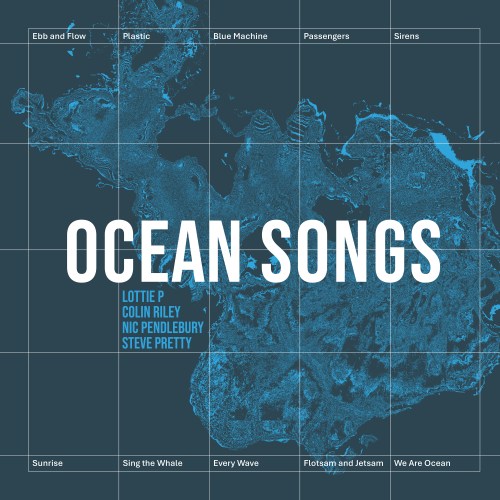
Featuring viola / violinist Nic Pendlebury, composer Colin Riley, Trumpeter Steve Pretty (Hackney Colliery Band) and Lottie P (Goat Girl), Ocean songs features 10 tracks of gorgeous compositions exploring the ocean through song, science and mythology.
What’s more, ocean scientist Helen Czerski reads extracts from her book Blue Machine and environmentalist George Monbiot talks about trophic cascades (clouds of whale poo!). You can listen to my interview with Colin and Steve on the latest episode of The Science Show, in which Steve also plays conch shells and I play excerpts from four of the tracks on the album. In fact, please do listen to that because it’s a great interview, the music is wonderful and we had great fun in the Resonance FM studio.
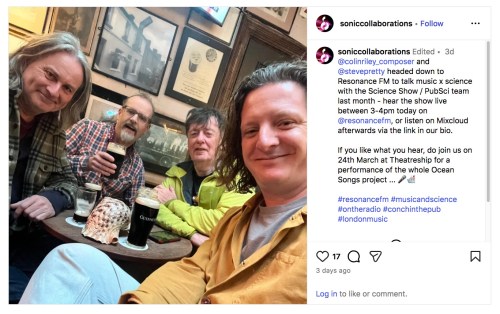
On Tuesday 24th March the band will be playing (and looping) live at Theatreship in Canary Wharf for the official album launch… aboard a ship. I’ll definitely be there. Tickets start at £8.90
Fruit Flies Like A Banana
If you’ve got kids and want something to do over the holidays, you might want look at the Royal Institution’s Easter Workshops programme. But what I’m plugging is a daytime talk by long-time friend of PubSci, Dr Erica McAlister of the Natural History Museum, AKA The Fly Lady.

Metamorphosis: Small flies, big changes is an event for the whole family starting at 2.30pm on Thursday 9th April. Tell Erica hello from PubSci if you go along, but don’t blame me if your kids want to become dipterists after Erica’s talk!
Talking of April…
Seeing as this arrives a little late to book for March’s PubSci, it seems only fair to give you a head start on April’s event when, on Wednesday 15th April, Joanna Bagniewska presents A Modern Bestiary.
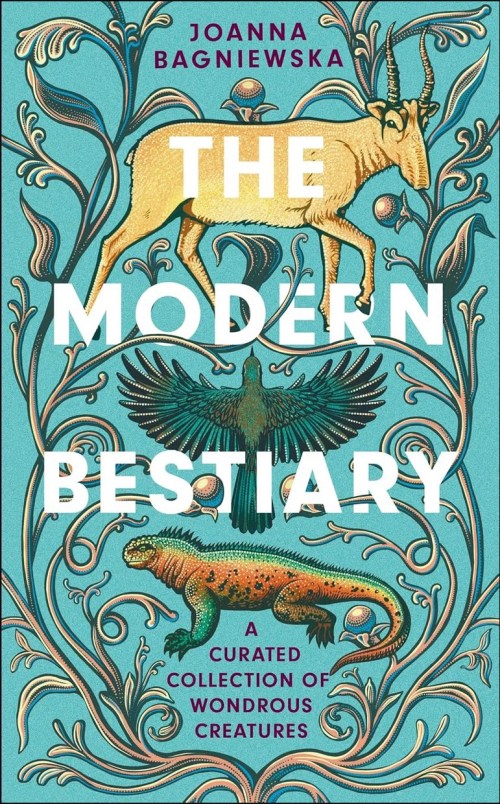
Remember those medieval bestiaries full of fantastical creatures that couldn’t exist outside the imagination…? It turns out the real world is just as weird, and Joanna Bagniewska has collected them together in a wonderful book!
From the familiar to the improbable, the gross to the endearing, Joanna introduces some of her favourite creatures – such as pyromaniac beetles, the baddest mice in the West, and sea slugs that decapitate themselves – and shares fragments from her book, The Modern Bestiary.
The booking link will go live on Eventbrite soon, so follow us there and don’t forget to subscribe to the PubSci calendar.
Space, Music (and space music) and Rainbows on the radio
My colleague Mike and I have been making a radio show and podcast since October 2025 and we’ve had a whale of a time, but Mike will be stepping down after the April episode (broadcasting on Monday 6th at 3pm). Many thanks to Mike for the hard work and the fun times we’ve had making great – possibly unique – science radio. If you haven’t listened yet, now’s the time to do so. You won’t find a similar mix of science news, events, random discussions and excellent music anywhere else.
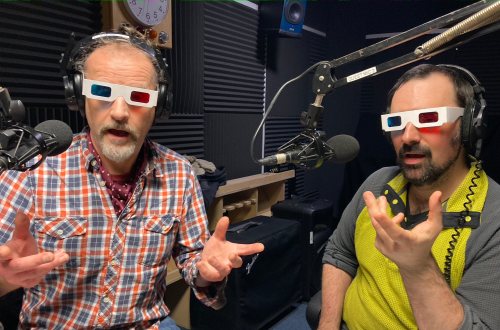
The most recent episode of The Science Show came out on 2nd March and I’d love you to give it a listen. Please send your thoughts, comments and suggestions to the email address given out at the end of the show.
We use Mixcloud for podcast hosting as it’s the only platform which automatically pays royalties to copyright holders, allowing us to play the great music we love, which makes our particular scientific miscellany so different from any other science show. Unfortunately this comes with the limitation of streaming only (no downloads) but we consider this a small price to pay for creative freedom and supporting musical artists.
You can listen live on Resonance 104.4 FM at 3pm on the first Monday of every month (also DAB, RadioPlayer, and live-streaming from the Resonance website) or catch up at time from our Mixcloud page.
Not quite lastly (and definitely not leastly), have a look at what else is coming up at PubSci this Spring!
PubSci’s latest events programme (below) covers January to May 2026 and I’m super-excited with what’s in store for PubSci in the coming months. The events programme is perfect for printing out and pinning to your work noticeboard or sticking to the fridge. It’s also available on the Current Programme page. I recommend putting the dates in your diary now. Even better, subscribe to our calendar HERE. For example this is what you’ll see for March’s PubSci when you subscribe to our Calendar.
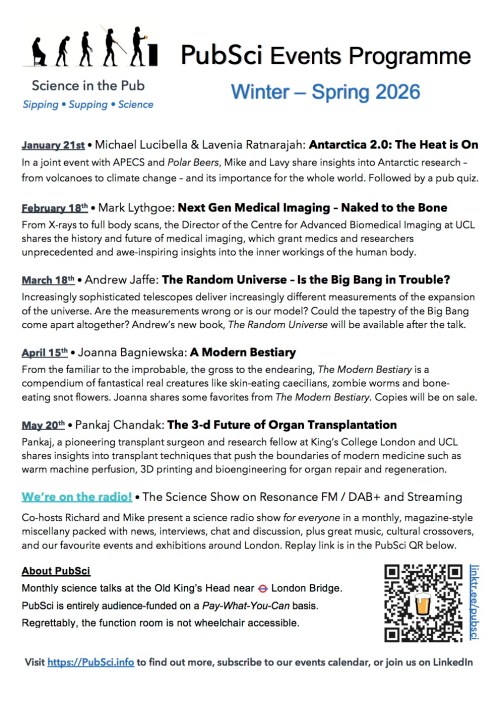
Click the image to open the programme in a new tab.
Finally, a reminder about how you can listen to a rather excellent Science Show

The Science Show on Resonance FM is co-presented by myself and Mike Lucibella. Resonance is the Arts Council-backed radio station for London, broadcastings live on good old FM. It’s also on DAB and you can livestream Resonance anywhere in the world or and on Radioplayer across the UK. Better still, listen any time here.
The Science Show is a monthly, hour long magazine programme (i.e. a show with different segments) that you can listen to in one go or break up into three easy chunks. Our fifth show went out on Monday 2nd March, and our next show goes at at 3pm on Monday 6th April.
It’s not on any podcast server, but our page on Mixcloud effectively works like one – just find the show you like the look of and click PLAY. You can let us know what you think by sending a message at our dedicated email address.
• • •
Don’t forget to grab your last minute ticket to March’s PubSci (or at least get on the waitlist), and remember to follow us on all the socials including LinkedIn to keep up to date with what we’re doing. You can find those on our Linktree.
Thanks for reading. Please feel free to email or comment in response. Hope to see you at The Old King’s Head on Wednesday.
17/03/26 Posted by Richard, PubSci programmer and host
PubSci: Sipping • Supping • Science
• • •
About PubSci talks
PubSci is organised and hosted by science communicator, Richard Marshall, assisted by Mike Lucibella. Events are held upstairs at the Old King’s Head, near London Bridge tube. No specialist knowledge is required, just curiosity. Doors open at 6.30pm for a 7pm start. Talks run for ~45 minutes and are followed by a Q&A session. The Old King’s Head has a happy hour before 7pm, and the kitchen serves excellent pub grub.
Keeping Up With Future Events
To make sure you don’t miss out on future events, subscribe to our Google Calendar to be the first to know when new talks are scheduled, and follow PubSci’s events on Eventbrite to be notified when tickets are available. You can also sign up to our own mailing list on any page on this site.
There is no charge for attending PubSci talks, but we have a cash whip-round to cover expenses on the night – consider it “Pay What You Can Afford”. As few of us carry cash these days, you can make a donation when registering for ticketed events with Eventbrite. Please help us continue putting on events. PubSci has no other source of funding.
We aim to keep PubSci accessible for all, although it is unsuitable for under 18s as we meet in the function room of a pub. Regrettably, there is no wheelchair access.
You can find all our links on our LinkTree.

Address:
The Old King’s Head (upstairs room)
King’s Head Yard
45-49 Borough High Street
London SE1 1NA
 PubSci