
In this post, I preview the next 5 months of PubSci talks (including January’s PubSci), and celebrate what we’ve achieved at PubSci and beyond.
Hey everybody, happy new year!
Thank you for following PubSci and coming to our events throughout 2025 — and a special welcome to those who joined us recently. As we kick off 2026, I want to glance back over what we’ve been up to in the last 12 months and share what we have to look forward to in the coming season’s programme.

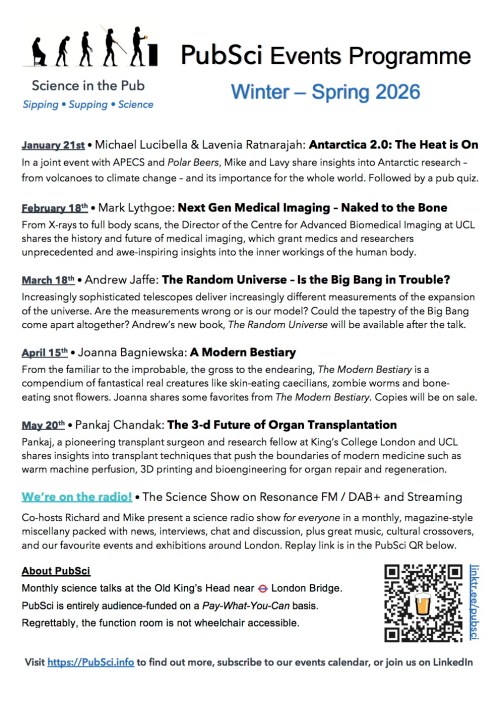
First, I’m pleased to announce that the 2026 Winter-Spring programme went up last month. Click the image on the left to view it full size or head to our Programme page where you can view and download it as a PDF which you can print to stick on your fridge or noticeboard at home and at work.
We’ve got five excellent talks lined up, looking into the Antarctic, the human body, the universe, and the natural world, concluding in May with a look at organ transplantation. I’ve already scheduled much of the rest of the year, and I can’t wait to tell you all about it, but you’ll have to wait until Spring for that.
Stream The Science Show presented by Richard & Mike (more info further down this blog post)
On 21st January we kick off 2026 with a really exciting collaboration between PubSci and Polar Beers.

Antartica 2.0: The Heat is On sees our very own Mike Lucibella returns to talk about Deception Island, an active volcano off the Antarctic Peninsula that housed three research stations until eruptions forced its evacuation yet remains a centre of vital Antarctic research. Mike will share insights from his recent Masters in History and Philosophy of Science focused on polar regions.
Joining Mike is marine biogeochemist Dr Lavy Ratnarajah, lecturer in Climate Science at the Department of Earth Sciences, UCL, who studies nutrient and carbon cycling in the Southern Ocean. Lavy will share insights from her own research into how ocean organisms – from microbes to zooplankton – interact with each other, their environment and larger, more iconic animals and how those interactions are affected by our changing climate.
As if that weren’t more than enough to get you out of the house on a winter’s evening, the event concludes with a fun Pub Quiz run by our friends at Polar Beers (part of the UK Polar Network). Don’t worry if you don’t know anything about the Earth’s polar regions, this fun quiz will test your general knowledge as well as rewarding those who paid attention during the talks — there will be prizes!

I can’t think of a better way to kick off the year than celebrating Antarctic Summer / Arctic Winter with actual polar researchers and a polar pub quiz in the comfort of the Old King’s Head.
Booking is live now and tickets are moving fast – in fact only a handful remain – so head to the Event Page for full information, or go straight to Eventbrite to reserve you place.
2025 was a great year for PubSci
We kicked off in January with Prof Rivka Isaacson who delighted us with explanations of proteins and protein folding in How AI Won a Nobel Prize in Chemistry, the highlight of which was seeing William Shakespeare’s Sonnet 18 (Shall I compare thee to a summer’s day) rendered as a protein structure in AlphaFold.

February was an explosive event in which Mark Hardman from Waltham Abbey Royal Gunpowder Mills told the history of “energetic materials” in A Brief History of Big Bangs. Anyone living by the River Lea will be relieved to know unstable nitroglycerine is no longer transported from the mills on barges!
In March, Dr Jenny Poulton posed the challenging question “Can Cells Think?“, which isn’t the trivial question it might first appear to be. We weren’t talking about cells engaging in philosophical discussions of course but examining the complex processing that cells carry out, hearing how they interact with their environment, and understanding how they can be conditioned like Pavlov’s dogs.
April saw PubSci host the London book launch of A Little History of Maths (Yale University Press, 2025) by author and maths communicator Snezana Lawrence who shared her writing process and some highlights from this wonderful little book spanning millennia of maths history in easily digestible chapters with charming illustrations.
The Royal Institution of Great Britain came to PubSci in May – or at least their world famous demonstration team did in the person of Michael Cutts (accompanied by Head of Collections, Charlotte New, and Harvard Innovator in Residence, Prof David Ricketts) – to present some live science demos in Science Goes Pop! celebrating 200 years of Live Science at the *Ri
* Yes that’s the correct abbreviation — not RI but Ri, like a chemical symbol

June saw the return of our favourite space scientist Dr Stuart Eves who talked about Why the Universe is Trying to Kill Us – and how we can stop it! It turns out there’s a pattern behind the arrival of large asteroids and other major events which have led to global mass extinctions, and astronomers may turn out to be saviours of the human race.
July was another book event when superstar statistician and Professor of Infectious Diseases and Epidemiology, Adam Kucharski, shared highlights from his book, Proof — The Uncertain Science of Certainty (Profile Books, 2025). Does wine-buying budget really predict university grades? Do we really know how scientific opinion is formed? And what does tea-making have to do with the standards for medical trials?
In August we were teated to the inside track on AI – what it is, what it isn’t, and what it can and can’t do – by PubSci regular Dr Ruth Stalker-Firth, in Demystifying AI. Whilst AI is developing all the time, we learnt that it’s important to look behind the curtain and not confuse the appearance of intelligence with actual intelligence, especially when many AI services are augmented by human activity.
There was Much Ado About Numbers in September when author and maths populariser Rob Eastaway came to the Old King’s Head to talk about the maths in Shakespeare’s day – and in his plays – as featured in his latest book (Allen & Unwin, 2024). Of course, our pub is a stone’s throw from Bankside where Shakespeare acted and showed his plays at the Rose and Globe theatres. Rob wins the best/worst pun of the year for ending his highly entertaining talk with one about pencil lead and the Bard’s famous line from Hamlet…

October saw a return to PubSci from cell biologist and author Professor Jenny Rohn in Antimicrobial Resistance – How do we beat the silent pandemic? Jenny gave us the history of modern antibiotics before sharing sobering facts about the rise in antimicrobial resistance and the almost non-existent pipeline for developing new antimicrobials. Fortunately it wasn’t just doom and gloom — new approaches are on the horizon, including the use of machine learning AI and viral bacteriophages (a topic Michael Byford spoke about for us about in 2019).
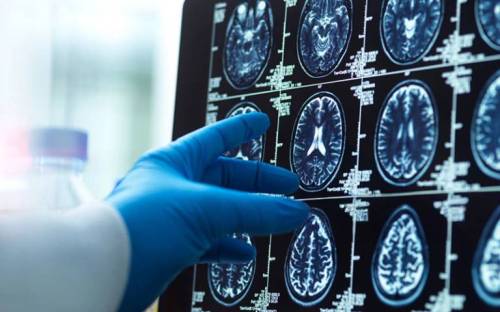
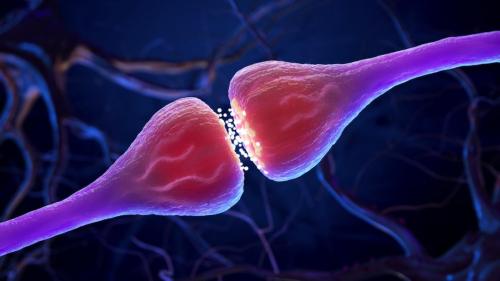
We ended 2025’s programme in November with a fascinating talk on dementia by Dr Emma Clayton. In Lost in Translation? Why Brain Cells Stop Communicating in Dementia Emma looked at the processes and early indicators of dementia before sharing the work her lab at UK Dementia Research Institute is doing to better understand what causes dementia and how it can be treated or even prevented.
On a show of hands, around 60% of the audience said they were touched by dementia in their family or social circles. and it was truly heartening to hear about the compassionate determination of scientists dedicated to understanding this condition which effects 1 in 3 people over their lifetime.
We even got to see cellular processes modelled as Lego bin men in a possible science communication first. Many thanks to Emma for rounding off our year with a great talk on a difficult topic.

We’re on the Radio!
In October 2025 Mike and Richard started co-hosting a monthly science show that broadcasts on the radio in London and can be streamed all around the world!
The Science Show – why call it anything else? – is a one hour magazine format programme that’s been described as a “joyous miscellany packed with news, interviews, chat and discussions, plus great music, cultural crossovers, and events and exhibitions happening around London”. We’d love it if the PubSci family would give it a listen and share it with your science-loving friends.
Listen live on 104.4 FM at 3pm on the first Monday of the month , or stream it on Mixcloud.
It’s not on any podcast server, but our page on Mixcloud effectively works like one – just find the show you like the look of and click PLAY. You can let us know what you think by sending a message at our dedicated email address.
PubSci went to the IoP
On Wednesday 19th November, Mike and I attended the Institute of Physics Outreach and Communicators Conference. With the theme focused on reaching audiences outside formal settings, I gave a short presentation on PubSci titled “Taking Science to the People”.
Luckily nobody shouted “Scampi and Chips!” in the middle of my talk…

• • •
Don’t forget to grab your last minute ticket to January’s PubSci, and remember to follow us on all the socials including LinkedIn to keep up to date with what we’re doing. You can find those on our Linktree.
Thanks for reading. Please feel free to email or comment in response. Hope to see you at The Old King’s Head on Wednesday 21st January
15/01/2026 Posted by Richard Marshall, PubSci programmer and host
PubSci: Sipping • Supping • Science
• • •
About PubSci talks
PubSci is organised and hosted by science communicator, Richard Marshall, assisted by Mike Lucibella. Events are held upstairs at the Old King’s Head, near London Bridge tube. No specialist knowledge is required, just curiosity. Doors open at 6.30pm for a 7pm start. Talks run for ~45 minutes and are followed by a Q&A session. The Old King’s Head has a happy hour before 7pm, and the kitchen serves excellent pub grub.
Keeping Up With Future Events
To make sure you don’t miss out on future events, subscribe to our Google Calendar to be the first to know when new talks are scheduled, and follow PubSci’s events on Eventbrite to be notified when tickets are available. You can also sign up to our own mailing list on any page on this site.
There is no charge for attending PubSci talks, but we have a cash whip-round to cover expenses on the night – consider it “Pay What You Can Afford”. As few of us carry cash these days, you can make a donation when registering for ticketed events with Eventbrite. Please help us continue putting on events. PubSci has no other source of funding.
We aim to keep PubSci accessible for all, although it is unsuitable for under 18s as we meet in the function room of a pub. Regrettably, there is no wheelchair access.
You can find all our links on our LinkTree.

Address:
The Old King’s Head (upstairs room)
King’s Head Yard
45-49 Borough High Street
London SE1 1NA



 PubSci