Tag Archives: science in the pub

Weds 19th April | PubSci Restart Event: A Celebration of Science

On Wednesday 19th April 2023 we’re enormously excited to be returning to in-person events, three years after we paused due to the pandemic. This will be a celebratory evening of science communication and socialising: Four different speakers on four different topics to make you laugh, cry, gasp, and ask “Just how close is the bar?”Announcement Banner

Please join us for an evening to remember:

  • Kate Viscardi considers standards and deviations in “How Long Is a Piece of String?
  • George Holdaway discusses “Islamic Art: The Quest for the Quasi Crystal”
  • Mike Lucibella asks “What’s the Deal with Antarctica?”
  • Richard Marshall presents “The Levitating Hamster and Other Definitely True Stories”

• • •

This event will be a social one as well as a SciCom one. In a change from the usual ~45-minute talk followed by questions, there will be more bar breaks and we’ve included extra time for catching up with friends old and new. Let’s celebrate getting together again!

 __

  • Kate Viscardi is a senior lecturer at LSBU and previously headed their Women in Engineering Centre.
  • George Holdaway is a polymath who tutors in STEM topics.
  • Mike Lucibella edited the newspaper of the US Antarctic Programme before joining UCL.
  • Richard Marshall has been programming and hosting PubSci since 2018.

Join us upstairs at the Old King’s Head, near London Bridge station (see below). Doors open at 6.30pm for a 7pm start. The Old King’s Head has a happy hour before 7pm to get you in the mood, and the kitchen serves excellent pub grub.

• • •

As usual the event is free, but we will have a whip-round to cover expenses. As so few of us carry cash now, you can contribute digitally too. This event will not be livestreamed.

We aim to keep PubSci accessible for all, although it is unsuitable for under 18s as we meet in the upper room of a pub. Regrettably, there is no wheelchair access. We tried very hard to find an accessible venue.

Please check our Future Events page where you can also subscribe to our iCal feed. The Spring/Summer talks programme will also be announced at this event. You can find all our links on our LinkTree.

__

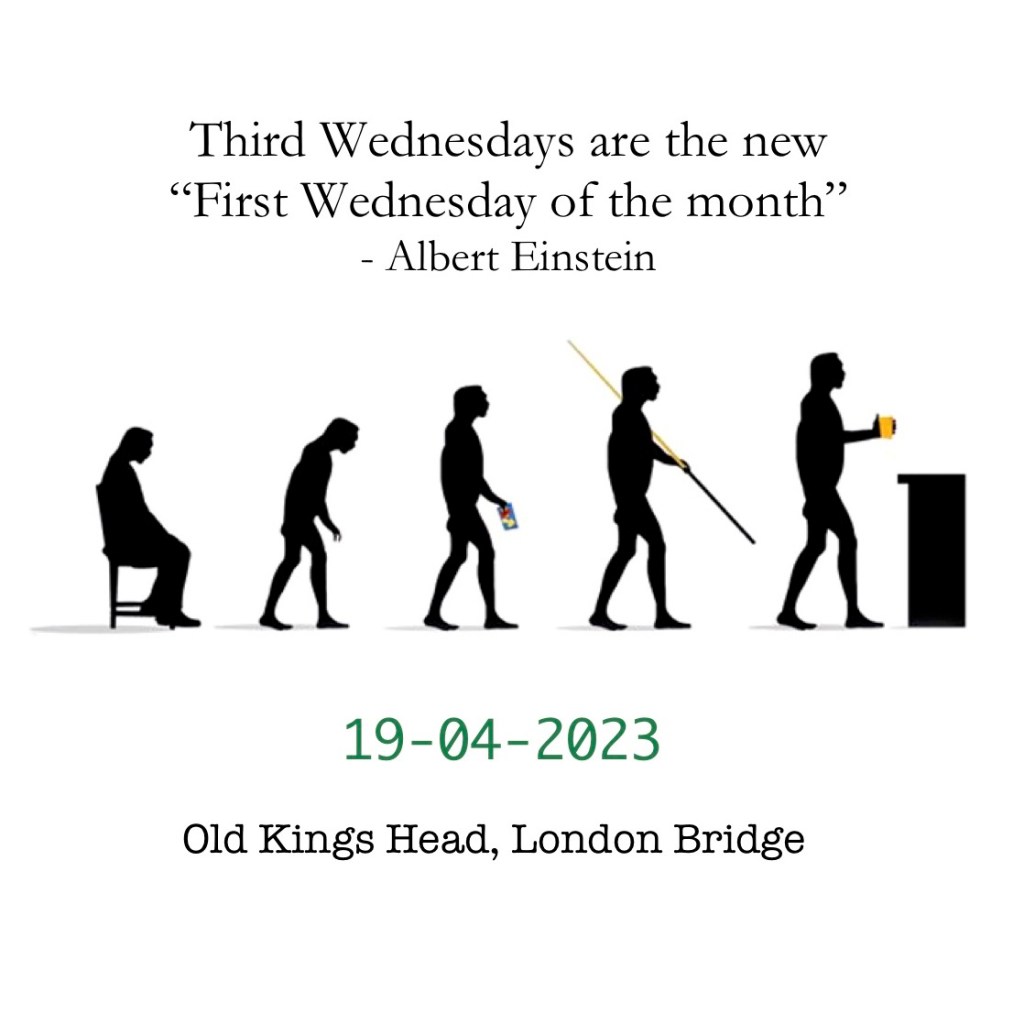
NB We used to meet on the first Wednesday of the month but PubSci is now on the third Wednesday.

image-third-wednesdays

Address:

The Old King’s Head (upstairs room)
King’s Head Yard
45-49 Borough High Street
London SE1 1NA
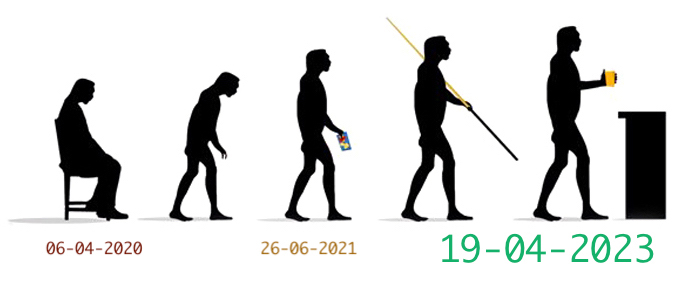
PubSci Returns: 19th April 2023 | Old King’s Head Pub

The rumours are true: PubSci is back!

Three years after the pandemic halted live events, PubSci returns to its familiar home near London Bridge for a cornucopia of science talks in the comfort of the Old King’s Head (OKH). 

On Wednesday 19th April PubSci presents our Restart Special: A Celebration of Science.

Four Speakers in One Night

The PubSci Restart Special will be an evening of entertaining short talks on fascinating science topics. Some will make you laugh. Some will make you think. Some might turn you to drink. After the main event, you’ll have time to catch up with old friends, space to make new friends, and the opportunity to chat with your kind of people over a drink or two.

Save the date now and look out for the full event announcement in early April.

The OKH has a well-stocked bar, a happy hour from 5-7pm (we start at 7), and a great range of pub grub. The landlord has kindly agreed to keep the kitchen open for us, so you can satisfy your physiological and intellectual appetites at the same time.

Third Wednesday of Every Month

Looking ahead, we have a constellation of fantastic speakers lined up, including some all-time PubSci favourites. Don’t forget, we’ve moved from the first Wednesday of the month to the third, so please put third Wednesdays in your diary, beginning with 19th April 2023.

I’ll be announcing the spring/summer programme at the Restart Special before posting it on our website. While there, you can subscribe to the PubSci calendar to be notified as events are scheduled. Don’t forget to join our email list to receive the full monthly update.

PubSci remains free to attend. We pass round a beer mug at each event on a pay-what-you-can basis to cover costs such as speakers’ expenses and AV equipment. 

See you on the 19th!

Richard


PS  You can follow us on social media too.

Twitter   Facebook   Youtube

Regretably, the upstairs room at the OKH is not wheelchair accessible.

• • •

What’s the future of PubSci Online?

Running PubSci via Zoom while we were unable to get together in person was a great experience, despite the additional costs. Creating a Virtual Pub with Real Science ™ allowed me to invite speakers from the USA, and gave us the chance to widen the PubSci community without geographical limits. We haven’t forgotten you!

Whilst PubSci is about in-person science communication at heart, returning to live events doesn’t mean the end of the wider PubSci community. The April event will be IRL only, but we hope to begin live-streaming later in the spring. Once live events are up-and running I will work on the logistics and set about finding volunteers to record and stream live talks. If you come to PubSci regularly and have experience with OBS, please get in touch!

If you’ve never been to PubSci, our YouTube channel has recordings of our online talks during lockdown


Image

Remember when PubSci used to meet in an actual pub…?

PubSci Update

It’s been a while since my latest communication, so it’s time for an update.

We’re working on restarting PubSci soon and have got some fantastic speakers lined up for the next season of talks, including some you may know from TV and radio, but we don’t yet have a venue. I was hoping to get live events running this autumn – but we had a setback that probably delays it to early next year.

I had found a pub that ticked all the boxes: A separate function room available free of charge, wide and not-too-steep stairs for better access, good beers, great food, located near tube and mainline stations, in-house AV (so I don’t need to set-up a projector and screen every time), WiFi so we could livestream… and management who loved the idea of hosting a SciComm event. So what went wrong?

We planned a test event in September and a full restart in October, but UK energy price rises started affecting their costs, and we had the conversation I was dreading: “I’m sorry, but we can no longer host events without charging for the room.”

While this was deeply disappointing, it’s also a great excuse for a pub crawl of potential venues, so every cloud has a silver lining… Watch this space! And if you know of the ideal venue feel free to email us here at PubSci Towers.

I’ll be back when I have any substantial news, but in the meantime, please continue to follow and engage with PubSci on Facebook and Twitter, and don’t forget that you can always watch some of our past events on the PubSci YouTube Channel.

Stay safe, stay healthy, stay curious, and – to quote our friends at science fact-checking website Metafact.io “May the facts be with you!”

Richard

Hope to see you in the pub

Robson & Viscardi – Dead or alive?

On Wednesday 2nd November we will have a talk by the founders of PubSci, James Robson and Paolo Viscardi. Both work with animals, but James curates live collections, while Paolo curates dead ones: so which collections are the most interesting – dead or alive?

James Robson is the new Curator of the Sea Life London Aquarium, bringing experience of working with a huge range of live animals from all over the world to London. While he’s busy ensuring the health and welfare of his aquatic charges, he’s also undertaking a PhD on jellyfish. He will be explaining why he thinks live collections are so awesome.

Sarlac Jellyfish by James Robson

Sarlac Jellyfish by James Robson

Paolo Viscardi is currently the Curator of the Grant Museum of Zoology, but is about to depart for the Emerald Isle to become the Curator of Zoology at Dublin’s Dead Zoo. He’ll be arguing why he thinks dead collections are even more awesome than the living ones.

Dublin's Dead Zoo by Paolo Viscardi

Dublin’s Dead Zoo by Paolo Viscardi

This will be the last London PubSci hosted by the original organisers, but a team of enthusiastic regulars are planning to keep things running in 2017 and an end-of-year quiz is ready for December, so fear not!

Join us upstairs at the Old King’s Head, near London Bridge station. Doors open at 6pm for a 7pm start and as usual the event is free, but we will have a whip-round to cover costs – we hope to see you there!

Dr Ruth Siddall – Pigments of our imagination

On Wednesday 5th October we’re delighted to have Dr Ruth Siddall of UCL talking about the colourful topic of pigments.

Ruth is a co-author of The Pigment Compendium and works on the characterisation, synthesis and history of use of pigments, particularly in Roman period painting.

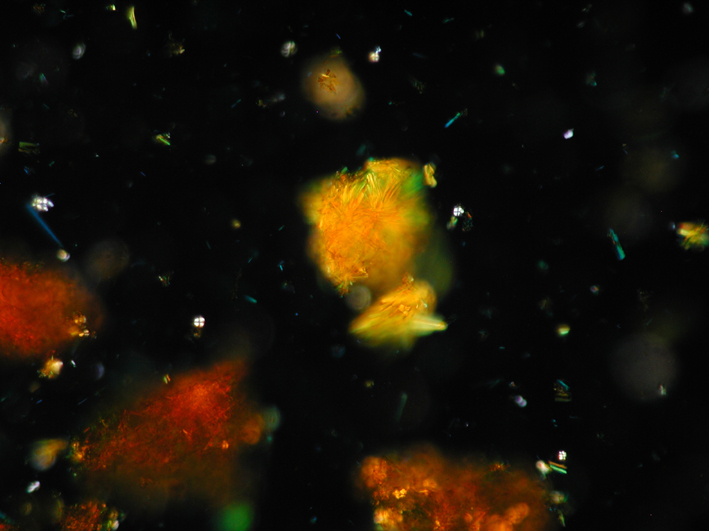
Photomicrograph of the pigment Indian Yellow in cross-polarised light

Photomicrograph of the pigment Indian Yellow in cross-polarised light

Pigments are the materials which give colour to paints. We’ve all heard about yellow ochre and ultramarine, but there are many weird and, to be honest, totally unacceptable materials used out there for pigments. Artists and painters have been incredibly resourceful in finding and creating new colours over the last 40,000 years of experimentation, and new pigments such as Vanta Black and YinMin Blue are still being introduced today. Pigments can be derived from minerals and also dyes extracted from plants and animals, but a number of more unexpected sources of pigments have been used. If it’s coloured, someone has painted with it.

This talk will explore the analytical techniques used to identify pigments in paintings and the stories behind paints such as Indian Yellow, Emerald Green, Turacine and Mummy Brown.

Join us upstairs at the Old King’s Head, near London Bridge station. Doors open at 6pm for a 7pm start and as usual the event is free, but we will have a whip-round to cover costs – we hope to see you there!

Dr Steven Le Comber – Maths, murder and malaria

On Wednesday 7th September we’re delighted to welcome Dr Steven Le Comber from Queen Mary, University of London. Steve’s research covers a wide range of subjects within evolutionary biology, including mathematical and computer models of molecular evolution.

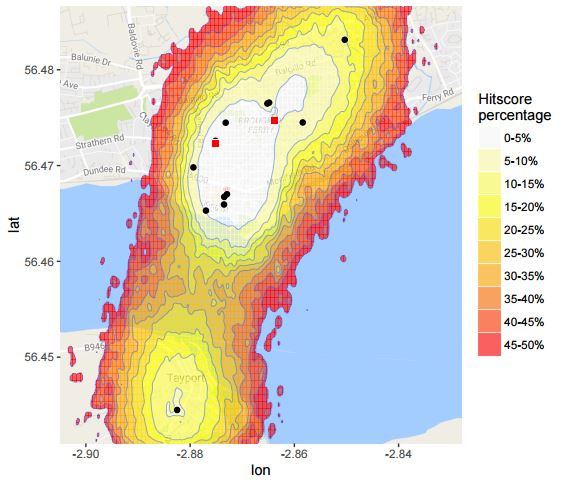
Much of this work focuses on the mathematics of spatial patterns, and in his talk he will explain how he has pioneered the introduction of geographic profiling – a statistical technique originally developed in criminology to prioritise the investigation of serial murders – to biology, for example, trying to find the breeding sites for mosquitoes that spread malaria.

SteveLeComber

In a talk spanning mathematics, Jack the Ripper, great white sharks and the Gestapo, Steve will explain how he used geographic profiling to investigate the identity of the artist Banksy and how he reanalysed a Gestapo case from the 1940s that formed the basis of a famous novel.

Join us upstairs at the Old King’s Head, near London Bridge station. Doors open at 6pm for a 7pm start and as usual the event is free, but we will have a whip-round to cover costs – we hope to see you there!

Dr Helen Mayfield – can artificial intelligence save the rainforest?

On Wednesday 3rd August we’re pleased to welcome Dr Helen Mayfield, who has a PhD in mapping science and comes from an IT background, with an active interest in conservation and environmental issues. Her broad research interests are in how computer science and technological advances can help us solve or better understand environmental problems.

Helen Mayfield

We are entering the Anthropocene, a new geological age characterised by mass extinctions and unprecedented pressures on our natural resources.  At the same time technology is progressing at full speed, providing us with a whole new set of tools to help us navigate this brave new world. Yet many environmental management practitioners still rely on the tried and trusted methods that they’re comfortable with.

Helen’s work looks at how we can use machine learning to help us solve environmental management problems. We aim to shed some light on artificial intelligence and demystify a few of the common machine learning techniques, discussing  how they might serve us better than the standard statistical models that are so commonly used (no formulas, promise!). To keep the balance we will also look at some of the pitfalls of techniques such as artificial neural networks to help us consider when NOT to use them.  Being both one of the biggest environmental threats we face, as well as a terribly complicated issue, deforestation analysis provides the perfect case study for doing this.  By taking advantage of the plethora of free datasets that are becoming increasingly available (just look at Google Earth!) we can test out some of these methods to see whether computers can indeed help save the rainforest.

Join us upstairs at theOld King’s Head, near London Bridge station. Doors open at 6pm for a 7pm start and as usual the event is free, but we will have a whip-round to cover costs – we hope to see you there!


Dave Hone – Tyrannosaurs: Fact vs Fiction

On Wednesday 6th July we’re pleased to welcome back palaeontologist, lecturer and writer Dr David Hone, who will be sifting the facts from the fiction about everyone’s favourite dinosaur – Tyrannosaurus.

Dave1

Dave with Tyrannosaurus in Tokyo

Dave is a lecturer at Queen Mary University of London, writer for the Guardian and author of the recently published Tyrannosaur ChroniclesHe’s worked on dinosaurs and pterosaurs all over the world and is a great proponent of scientists engaging the public with their work – especially when it comes to how we know what we we know and how that changes with new evidence.

So unleash that 7 year old inside and revel in the terrified joy that only a gigantic, prehistoric, meat-eating monster can bring and join us upstairs at the Old King’s Head, near London Bridge station. Doors open at 6pm for a 7pm start and as usual the event is free, but we will have a whip-round to cover costs – we hope to see you there!

Katrina van Grouw – A Very Fine Swan Indeed: Art, Science & The Unfeathered Bird

On Wednesday 1st June we’re very pleased to have Katrina van Grouw speaking at PubSci.

KvG-Katrina van Grouw low res

Katrina inhabits that no-man’s land, slap bang between art and science. A graduate of the Royal College of Art, her formal education was in Printmaking and Natural History Illustration, but she’s also a dedicated ornithologist, a former Natural History Museum curator, a qualified bird ringer, and an experienced preparator of natural history specimens.

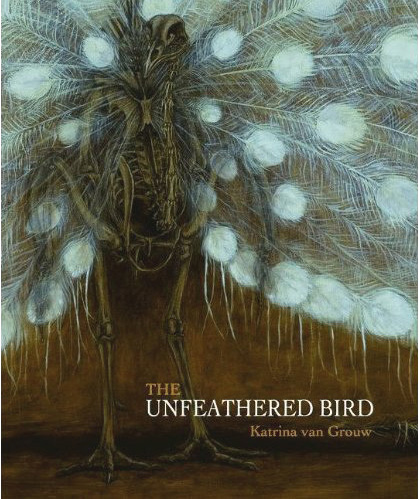
KvG-book cover

The book, The Unfeathered Bird, is a magnum opus twenty five years in the
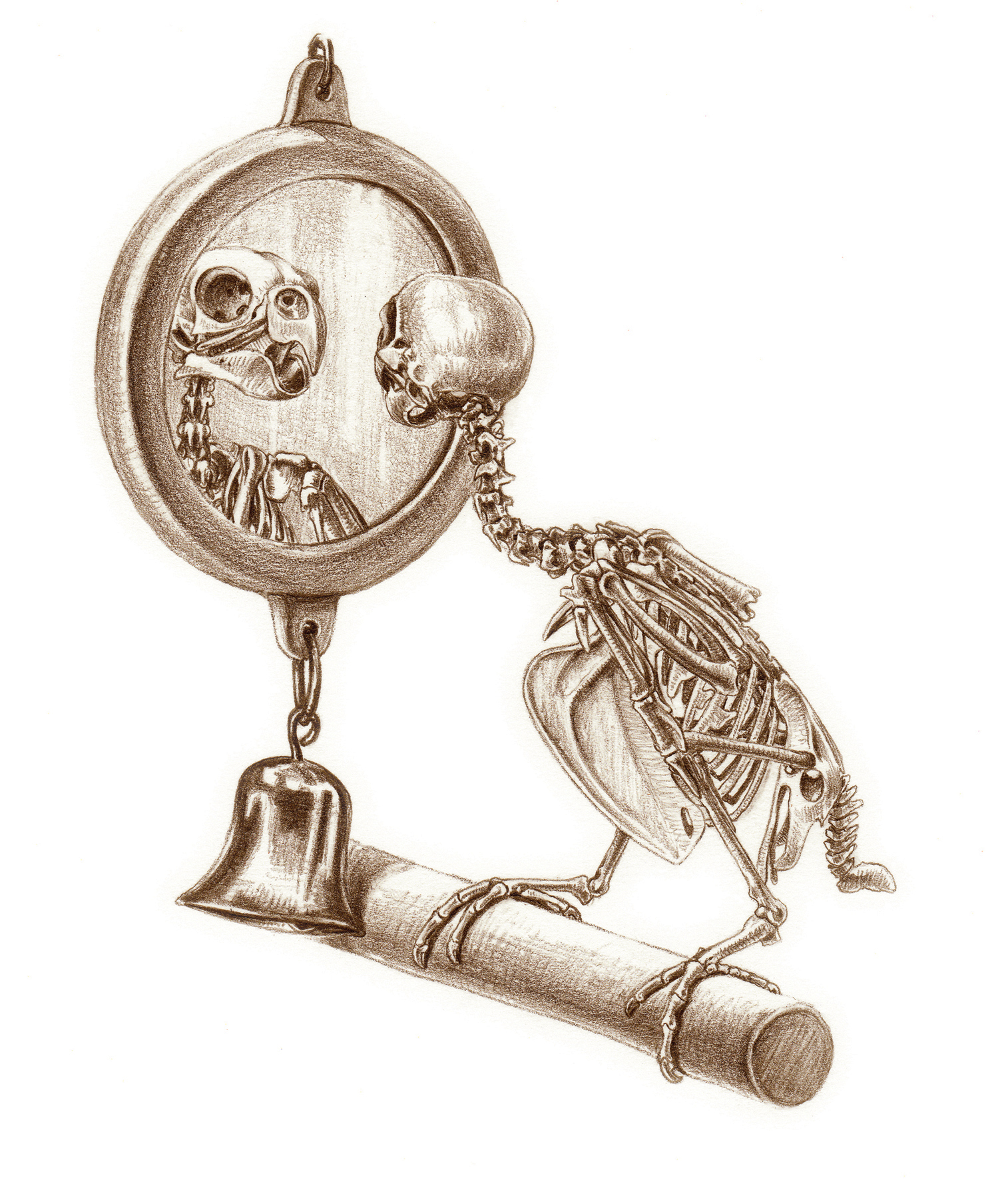
making, and was originally intended as a manual for bird artists. It was only much later that it blossomed into something far more ambitious. A world away from textbooks and diagrams, this is a work equally intended for scientists and artists, indeed anyone with an appreciation of birds or an interest in their adaptations and behaviour. It includes no fewer than 385 illustrations of 200 species, all made from actual specimens, many of which are shown in lifelike positions. Virtually all the complete skeletons were prepared and reconstructed at home from specimens donated from zoos, wildlife hospitals and conservation charities.

KvG-budgie skeletonKvG-great hornbill skeleton small

Join Katrina as she explains her aims and inspirations, shares her insights about birds beneath their feathers, and relates how her home was turned upside down as more and more specimens joined the queue.

Doors open at 6pm for a 7pm start upstairs at the Old King’s Head, near London Bridge station. As usual, the event is free, but we will have a whip-round to cover costs – we hope to see you there!