
It’s time for the final PubSci talk of the year (we take a break in December) – and we have a great one for you… especially if you enjoyed the TV show ‘Detectorists.
On Wednesday 20th November PubSci is delighted to welcome archaeologist Line Ravnsgaard, who is travelling from Aarhus in Denmark to talk about citizen science in archaeology, and the relationship between detectorists and archaeologists.
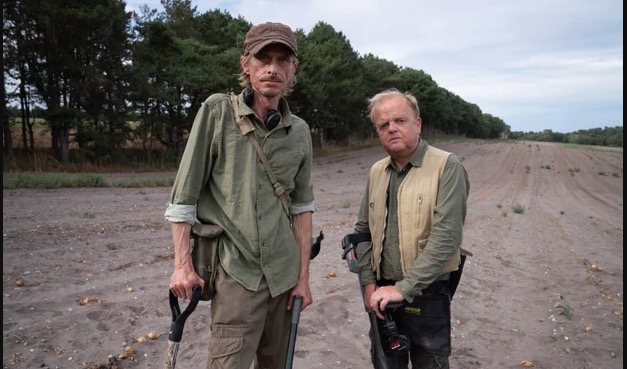
Mackenzie Crook and Toby Jones as Andy and Lance in Detectorists © BBC
BBC TV’s ‘Detectorists’ is now ten years old, and metal detecting is more popular than ever, but is it a danger to our undiscovered past? At November’s PubSci we address this vital question. So, can detectorists and archaeologists work together? Are there other ways to be a citizen archaeologist? And how does modern technology help anyone get involved?
Line Ravnsgaard is a Danish archaeologist specialising in community engagement, and she argues that detecting is valid citizen science. At PubSci, Line will talk about citizen archaeology, discussing how detectorists work with scientists to further our understanding of the past.
She’ll also look at other examples of citizen science in archaeology and propose ways that you, the audience, can become active citizen archaeologists, without even leaving home.
Tickets, as ever, on Eventbrite for no fixed charge. Book now to avoid missing out.
More information on the talk and speaker details below.

Part of a Norman coin hoard found by detectorists in 2019. (© Pippa Pearce)
• • •
What if your hobby had the potential to make you rich, add to the body of human knowledge, or even rewrite history?
Ten years ago the gentle comedy-drama Detectorists launched on British TV, quickly becoming a UK favourite as it followed two middle aged men and their shared passion for metal detecting in the Suffolk countryside while discussing the previous evening’s University Challenge.
Citizen science can take many forms but few of us would think to include metal detectorists and mudlarkers in the category. Nonetheless, many stunning archaeological discoveries only come to light thanks to the professionalism and integrity of such hobbyists. For example, a 22-year old archaeology student recently discovered seven stunning silver bracelets from the early Viking age, now on display in Mosegaard Museum.
In the UK metal detecting has grown rapidly in popularity, both as a result of the TV show and Covid lockdown. The National Council for Metal Detecting has around 40,000 members in England and Wales, while a 2023 a UK government report suggested almost 70,000 people had been metal detecting in the past year. In 2022, a staggering 53,000 finds were reported to the Portable Antiquities Scheme run by the British Museum. 94% of these were made by detectorists, with the vast majority being reported voluntarily.
This suggests both a very active population of metal detectorists and a healthy relationship between those hobbyists and the archaeologists. However, just as in Detectorists, the TV series, there will always be Nighthawks: those who care little for archaeology, history or recording of artefacts, regarding their finds only as a source of self-enrichment, and depriving the nation of its rich archaeological heritage.
So how do detectorists and archaeologists work together and how do we ensure vital cultural heritage is not lost, while engaging the interested public in this tangible scientific endeavour? Danish archaeologist Line Ravnsgaard specialises in the cultural meeting point between scientists and the public in ways that encourage both active citizen science and wider public engagement with archaeology.
At November’s PubSci, Line will talk about citizen archaeology in the UK and Denmark, discussing how Detectorists work with scientists to further our understanding of the past. She’ll also look at other examples of citizen science in archaeology and propose ways that the audience can get involved as citizen archaeologists.

1,200 year old Viking Bracelets (© Mosegaard Museum)
___
Join us upstairs at the Old King’s Head, near London Bridge tube. Doors open at 6.30pm for a 7pm start. Talks run for ~45 minutes and are followed by a Q&A session. The Old King’s Head has a happy hour before 7pm, and the kitchen serves excellent pub grub.
Reserve your place now! PubSci is a pay-what-you-can event – please consider making a donation with your reservation to help us cover our costs.
We use Eventbrite to manage numbers. Subscribe to be notified of forthcoming talks
• • •
About the speaker

Line Ravnsgaard
Line E. Ravnsgaard is an archaeologist, citizen science activist, and alumnus of Aarhus University in Denmark who takes an active interest in involving local people in the preservation and study of their heritage.
She takes a data-driven and politically aware approach to promoting public engagement practices and ideals within archaeology and the resulting public initiatives.
Line has worked closely with metal detector hobbyists to understand the role of detectorists in Danish archaeology and the potential that population represents for citizen science as a core part of archaeology.
Her practice focuses on finding the cracks in the policy foundation and proposing solutions. This recently took Line to the UK to study the political and social differences that fostered such a wealth of public engagement initiatives here. The resulting comparative study of archaeological public engagement practices in the UK and Denmark became Line’s Masters thesis with the title:
“Citizen science as a cultural heritage innovator – treasure troves and detector archaeology as collaborative research and source for new knowledge” (translated from Danish).
Line recently discovered the joys of BBC TV’s Detectorists and now considers herself a fan!
Don’t miss the chance to join Line at PubSci this November for a Treasure Trove of citizen science.
___
There is no charge for attending PubSci talks, but we have a traditional whip-round to cover expenses – consider it a “Pay What You Can” event. Very few of us carry cash these days, so you can contribute digitally through our TipJar or make a donation when registering for ticketed events with Eventbrite. Please help PubSci continue putting on events. PubSci has no other source of funding.
We aim to keep PubSci accessible for all, although it is unsuitable for under 18s as we meet in the function room of a pub. Regrettably, there is no wheelchair access.
Check out the Future Events page where you can also subscribe to our Google Calendar so PubSci events automatically appear in your own Calendar. You can find all our links on our LinkTree.
• • •
We used to meet on the first Wednesday of the month but PubSci is now on the third Wednesday. Join us upstairs at the Old King’s Head near London Bridge Underground (Borough High Street east side exit) every month apart from December for a regular dose of Sipping, Supping & Science.

Address:
The Old King’s Head (upstairs room)
King’s Head Yard
45-49 Borough High Street
London SE1 1NA

 PubSci