On Tuesday 15th May we will be celebrating the first anniversary of Science in the Pub with Dr. Michael Byford who will be exploring the science of Star Trek.
Star Trek forms a comprehensive and surprisingly coherent story arc, encompassing five linked TV series and a profitable movie franchise.
Many of the developments postulated by its writers have been brought into being whereas others are so fanciful that they are at best most unlikely or at worst simply impossible.
We will explore the scientific basis of Star Trek, real or imagined, always with the deepest respect for the impressive powers if imagination demonstrated by its writers, directors and producers.
The talk will start at 7:30pm but the venue (Upstairs at the Ritzy) will be open from 6pm for those who want food, a drink and a chat. Hope to see you there!
After what has been a series of confusing changes to dates this month we though it would be best to clarify again, as nothing is on the date it was originally o!
Tonight (23rd April) will be a talk on 5 things worse than being eaten by a shark at Upstairs at the Ritzy in Brixton – link to event
Debora Hydes talk on Demons and Nightmares for Hackney Skeptics is now on the 30th of April – link to event
We hope to see you for both events, normal service will renew after this months craziness!
From predictions of sin, fire and brimstone in ancient stories, to asteroids, viruses and climate change in films today, the human race has long speculated – and dramatized – about how it will all end.
Yet no matter how creative our stories are, science, Alok Jha will tell us, offers us even weirder possibilities.
Some of them are cosmic in origin, such as a monstrously large magnetic storm from the Sun; or from the Earth itself, such as a catastrophic volcano or a reversal of our magnetic field. Others are due to the human race’s own advancements: drugs, terrorism, cyborgs – or even some of these combined, such as a solar storm affecting our communications and electrical technology. Or, if we’re really unlucky, we might wander too near a black hole or a (so far) hypothetical particle called the strangelet, which is able to turn all particles it encounters into a copy of itself – and could do this to everything on the Earth over a matter of hours.
Is this anything to worry about? Alok Jha has spoken to various people who think it might be. 99% of species that have ever lived on Earth are now extinct – and the Sun itself will become a red giant one day. “Humanity as a whole does not invest much in improving its thinking on how to enhance its own survival,” he reports. Come and hear how, if we can’t put off The End, it might at least be a lot more interesting than we thought.
You will be able to buy a copy of Alok’s new book and he has kindly agreed to sign them – an oportunity not to be missed! there will also be a chance to win a signed copy in a raffle
Anne-Maria is a Principal Lecturer in Bioscience and Forensic Biology at London South Bank University. One of her many activities (besides music and co-writing the definitive entry textbook on Ecology) has been to organise, chair and present at conferences for the British Science Association on the Muslim contribution to science.
Islamic heritage in the sciences is a fascinating area that has sometimes been the subject of a form of cultural amnesia – why not join us to find out more about the causes, consequences and cures?
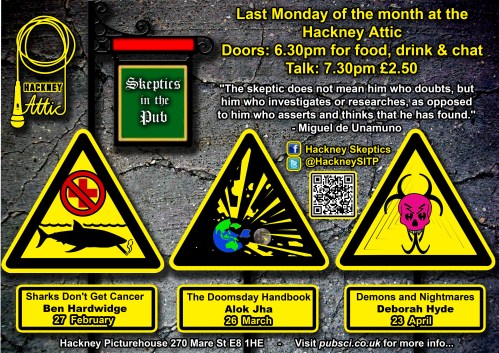
Tonight is the night of Ben Harwidges talk on the “sharks don’t get cancer” myth, it’s the first of a stella line up of talks which will hopefully inform and dispel in equal measure. Worried how the world might end in 2012? Alok Jha will take us through what the real doomsday scenarios are, and as I understand it none involve Justin Beiber (yet). If that doesn’t help you sleep at night, im sure Deborah Hyde’s talk on Demon and Nightmares will rock you calmly off to sleep with out having to check under the bed first.
Its going to be a fun few months, I hope to see you there!
Next CineSci6 screening: Memento 12 February, 2:30pm
The world doesn’t just disappear when you close your eyes. But for Leonard Shelby (Guy Pearce) it does. After witnessing the violent death of his wife, he is hell-bent on revenge, but the event has triggered short-term memory loss.
To get by, Shelby has to take Polaroid pictures and copious notes, even having memos tattooed on his body as reminders.
Christopher Nolan’s highly acclaimed and inventive thriller subverts movie narrative convention, as we follow Shelby trying to unravel the mystery surrounding his wife’s death, the last clear memory he has.
The film was inspired partly by case study of patient H. M., who developed severe anterograde amnesia after surgery to control his epileptic seizures. Many experts say that Memento has one of the most realistic and accurate depictions of anterograde amnesia in films.
These issues will be discussed after the screening by Hugo Spiers, who researches spatial cognition, memory and goal-directed behaviour at UCL, and Mo Costandi, blogger at Neurophilosophy, which appears on the Guardian Science blogs.
Make sure you come along, it’s the last CineSci6 for now, but we’ll have news of future screenings so keep checking the blog. For previous screening Q&As, you can listen to the podcasts brought to you by the Pod Delusion.
Paolo Viscardi will lead the celebrations with a talk on Darwin’s life, his evolutionary ideas and their lasting legacy. Then we can get down to the serious business of discussion about some of the issues raised over a beer.
Join us from 6pm if you want to get food, drink and conversation. The more formal bit won’t start until 7:30pm and the talk will probably kick off at 8pm. Oh, and as always, PubSci is free!
Next CineSci6 screening: Robocop Sunday 8 January, 2:30pm
Date: Sometime in the future. All Detroit has a cancer, and the cancer is crime. A policeman killed in the line of battle becomes resurrected as a half-human, half-robot supercop. The indestructible law enforcer successfully wipes crime from the mean streets of Detroit, but his human side is tortured by his past, and he wants revenge on the criminals who killed him. The question is how important will be the glitch programmed into RoboCop by the security company that created him.
Bold, funny and violent, director Paul Verhoeven’s first US feature film is definitely not for the faint-hearted, but it mixes all-out destruction with an intelligent plot. After the screening we’ll be discussing scientific/moral issues surrounding future robotics technologies with Dr Peter Bentley from the Department of Computer Science, University College London, and a contributing editor to Wired UK.
So what better way to enter into 2012 than with this ’80s classic followed by drinks and discussion afterwards? We’ll even give you more than 20 seconds to comply.
Ah… Weird Science… The film that made nerds cool. Almost. Two geeks, hapless with members of the opposite sex, and desperate for peer approval, decide to create the ideal woman on their computer. Thanks to a bit of hocus-pocus and a convenient lightning storm, the horny young Frankensteins’ implausible plan comes to life, in the form of Lisa, as played by Kelly Le Brock.
Part sex object, part mother, part fairy godmother with extraordinary powers, Lisa turns her two creators’ lives around by making them popular with the cool kids and providing them with some much needed self-esteem. The path from to losers to confident men is far from smooth, though, especially when they get cocky and try to create another woman.
On 11 December, we’ll be re-living this John Hughes teen comedy in all its big-haired, shoulder-padded glory, and after the screening there will be a Q&A with Justin Hancock, trainer and consultant at Bish Training, a sex and relationships website for teenagers.
It’s an unapologetically ‘80s film complete with the obligatory “Valuable Lesson Learned” that was so of its time it is now back in fashion. So, does LeBrock still rock? Is the theme tune really by Oingo Boingo? Could that possibly be Robert Downey, Jr? Come and find out. As the film’s tagline says “It’s all in the name of science. Weird Science.”
For December’s Science In The Pub there will be a science-themed pub quiz hosted by Kash Farooq and James Longstaff. The usual PubSci hosts Paolo and James get a night off – as they will be taking part in the quiz.
And, thanks to our good friends at the British Science Association, there will be some appropriately geeky/sciencey prizes that we will dish out as we see fit!
We suggest that you form teams of 3 or 4 people. Don’t worry if you don’t have have enough people – just turn up. We’re a friendly bunch and we’re sure we can get everyone into a team.
It might also be a good idea to “mix disciplines” when forming a team – each round will have questions from various areas of science. We’ve been busy thinking up questions for a few weeks now and have come up with a fairly wide variety.
To give you a clue of the sort of questions to expect, here are the categories we came up when we were thinking up questions:

.jpg "USS_Enterprise_(NCC-1701-A)")




 PubSci