Category Archives: Science Communication

July Blog Post: Asteroids, Astronomy, Science Photography and Poetry plus July’s PubSci and discount tickets to a talk on the Northern Lights

In this post, I preview July’s PubSci talk (now booking) and other great science events coming up, we reflect on June’s PubSci and share details of a ticket offer for the coming weekend. Read on!

Our next event is only 2 weeks away

Microscope, books, magnifying glass: The search for proof
On 16th July, PubSci explores how scientific truth emerges and why it sometimes falters.

July’s PubSci talk is booking up fast, with 25% of places already snapped up – head to the booking page now if you don’t want to miss out – but before looking in more detail, we’ll serve up some other science-based goodies. There’s lots of science poetry in this edition of the PubSci blog, some great events, some sad astronomy news and some good astronomy news, a look back at June’s topic and an exclusive discount code for a super astronomy talk at the Royal Institution on Saturday 5th July.

~

Art meets science in words and images

Traditionally dressed Peruvian women look at a small handheld device while a man looks on from behind a clump of grass
Peruvian women test water pH from a melting glacier. © Ciril Jazbec / Wellcome Photography Prize 2025

Last month we previewed a botanical photography exhibition at Ken Artspace and I’ve found another super photo exhibition for you this month. Since 1997 Wellcome Photography Prize has been celebrating compelling imagery that captures stories of health, science and human experience. This year the winners will be announced on 16th July (the same day as PubSci) and the top 25 images will be on show at The Francis Crick Institute close to London’s King’s Cross from 17th July until 18th October. The Crick is worth a visit just for the fabulous modern architecture and a very nice cafe.

The Poetry of Science and the Science of Poetry

This is a bumper season for poetry and science. The Brilliant is an annual competition celebrating poetry which expresses scientific wonder through verse. Alas, entries closed at the end of June for this year’s competition but you can read last year’s shortlisted entries and the 2024 winners here.

If you’d like to try your hand at writing poetry with a science theme, perhaps with a view to entering next year’s competition, I strongly recommend signing up for the CPD short course on Science Communication Through Poetry run by Sam Illingworth. It’s delivered live via Zoom over four Wednesday lunchtimes and costs just £50. There’s even a bursary for those on low income. Sam, a professor at Edinburgh Napier University, is also one of the judges for The Brilliant competition and has written several books on science and poetry including The Poetry of Physics published earlier this year. I’m hoping to tempt Sam down south for a PubSci event before too long.

A banner for Consilience Journal

If you enjoy the crossover between science and poetry and/or science and art, I recommend looking into a beautiful online journal called Consilience (referring to the convergence of thought between different disciplines). Consilience is free to read but you can support it by subscribing to their Substack. If you’re already a science poet or artist, and looking for somewhere to publish, Issue 22 of Consilience is now open for submissions of poetry and art exploring the scientific topic of ‘Waves’ – but do hurry, submissions for the coming issue close at noon on Sunday 6th July.

EVENT TOMORROW: Live Poetry and Live Neuroscience!

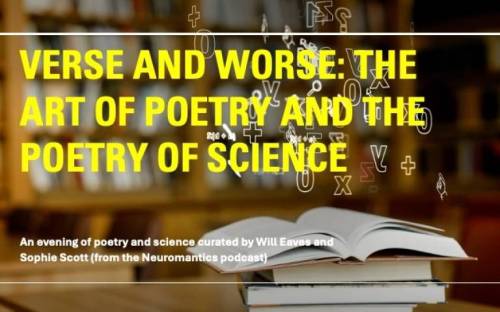
An image with an open book and text saying Verse and Worse

What happens when a poet and a neuroscientist get together to see if they can make sense of their connections?

They create an event called Verse and Worse, with Professor Sophie Scott and Will Eaves, both from the Neuromantics podcast.

On Wednesday 2nd July, at the Bloomsbury Theatre, Will and Sophie will be conducting live neuroscience experiments related to poetry. It looks like being a brilliant event, and it’s only £8, but there are lots of unsold seats at the time of writing, so book a ticket now and I’ll see you there.

~

An Astronomic look back at June

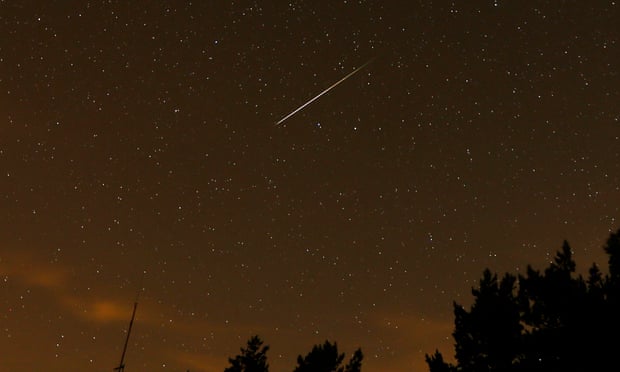
A bright meteor streaks across the nighttime sky over a river
Fireball over Chelyabinsk, Russia, in 2013 (The Planetary Society)

At June’s PubSci Stuart Eves delighted us with “How the Universe is Trying to Kill Us – and How We can Stop It” in which he considered possible mechanisms to explain the surprising periodicity of global mass extinctions, with a focus on the way our solar system moves through the warped plane of the Milky Way every 30 million years or so.

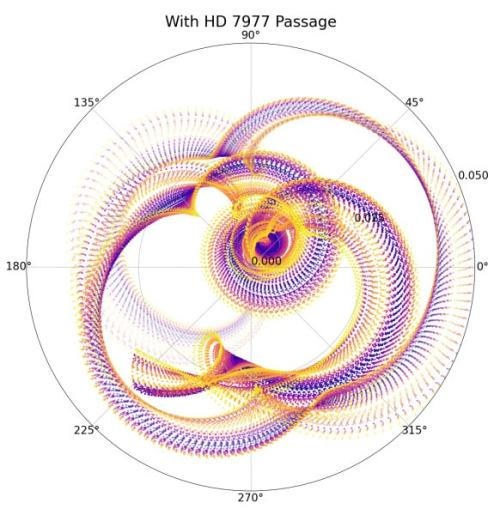
If you want to read more about the effect of distant stars on our own solar system (and by implication, what encountering more of them as the solar system passes through the galactic disk) might mean for the stability of orbits, check out this article called Passing Stars Altered Orbital Changes in Earth and Other Planets, with its lovely illustration of the uncertainty of Earth’s orbit 56 million years ago that arises from the passing of a sun-like star 2.6 million years ago (which is about when we last passed though the galactic disk).

The world’s most powerful camera captures its first images of space

The Vera C Rubin observatory in Chile, home to the world’s most powerful digital camera, has released its first images, and to quote the ‘Super Soaraway Sun‘* (sorry!: WHAT A STUNNER!

*Let’s hope it doesn’t soar away in the light of the previous topic.

Swirling clouds of interstellar gas
The Trifid and Lagoon nebulae 9,000 light years away, captured by the Vera Rubin Telescope

The observatory is tasked with detecting potentially deadly earthbound asteroids in time for us to take protective measures (if you came to June’s PubSci you’ll have some idea what these might be and what the pitfalls are). It will also be seeking concrete evidence for “dark matter” which is the standard cosmological explanation for the way galaxies spin. You can read more about that – and learn why the observatory is named after Vera Rubin – on this page.

A farewell to the world’s oldest radio astronomer

A giant dish at Jodrell Bank observatory

The former Astronomer Royal, Sir Francis Graham-Smith who died at the age of 102, was the world’s oldest active radio astronomer according to Jodrell Bank Observatory where he was director from 1982 to 1990. Graham, as he was known, was only the second director of Jodrell Bank after Lowell himself, and technically retired in 1988 but he continued working as emeritus professor of radio astronomy at The University of Manchester. Graham published his final astronomy article earlier this year. You can see Sir Francis Graham-Smith’s photo and read his obituary on the BBC New website.

HOT NEWS: Exclusive ticket discount for a talk on the aurorae of Earth and beyond

Last of the astronomy items in this edition of the PubSci blog is an exclusive discount code for a talk called Understanding the Northern Lights – From Earth to Jupiter on Saturday 5th July.

If the recent aurorae over central and southern Britain have piqued your interest, head to the Royal Institution this Saturday evening to discover what they are, how they happen, and why it’s so significant to the search for extraterrestrial life that Jupiter’s moon Ganymede experiences aurorae.

The speaker, Marina Galand, is Professor of Planetary Science at Imperial College London. I met Marina a few weeks ago and was bowled over by her knowledge, enthusiasm and energy for this subject. It’s going to be a brilliant talk and to make it even better the Ri has kindly offered PubSci a whopping 25% discount for this event with the code LIGHTS25 (feel free to share).

Book on Eventbrite via the Ri Website – your phone camera won’t even need to be in night mode!

~

At last… July’s PubSci

(To be read in the voice of Viv Stanshall on Tubular Bells, for those of a certain vintage)

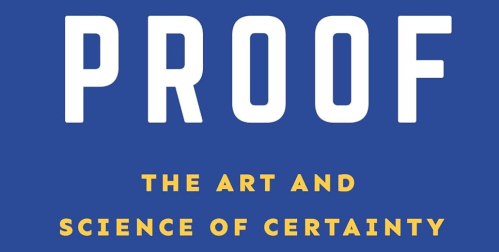
Book cover for PROOF - The Uncertain science of Certainty

 The nest PubSci talk is just 2 weeks away, on Weds 16th July, and we’re delighted to welcome Professor Adam Kucharski to explore the ideas behind his latest book, Proof: The Uncertain Science of Certainty.

How can we weigh up noisy evidence to decide how safe is an autonomous vehicle or judge somebody’s guilt or innocence?

Adam will explores how scientific opinion is formed, how to convince others of the facts, and what links wine and university exams, royalty and Guinness, cricket and robot racing.

Full details and the booking link are on PubSci’s Next Event page or you can book straight away on Eventbrite.

With over 25% of tickets already snapped [now at 30%] up at the time of writing, the best way to be certain of a place is to book yours today. Copies of Proof will be on sale at the event.

1/7/25 Posted by Richard Marshall, PubSci organiser and host.

PubSci: Sipping • Supping • Science

• • •

PS In case you haven’t checked it out yet, science communicator and PubSci member, Ushashi Basu, recently wrote about PubSci in her excellent blog and interviewed me to find out how I came to be booking and introducing speakers for a public science outreach event in a pub, what led me into science communication, and what motivates me to communicate science.

It was a pleasure to chat with Ushashi over a coffee and look back at seven years of programming, promoting and hosting PubSci. You can read that interview here and see Ushashi’s other blog posts at https://ushashibasu.com/.

Hope to see you all at the Old KIng’s Head on Wednesday 16th July.

• • •

Keeping Up With Future Events

To make sure you don’t miss out on future events, subscribe to our Google Calendar to be the first to know when new talks are scheduled, and follow PubSci’s events on Eventbrite to be notified when tickets are available. You can also sign up to our own mailing list on any page on this site.

• • •

About PubSci talks

PubSci is organised and hosted by science communicator, Richard Marshall, assisted by Mike LucibellaEvents are held upstairs at the Old King’s Head, near London Bridge tube. No specialist knowledge is required, just curiosity. Doors open at 6.30pm for a 7pm start. Talks run for ~45 minutes and are followed by a Q&A session. The Old King’s Head has a happy hour before 7pm, and the kitchen serves excellent pub grub.

Support PubSci

There is no charge for attending PubSci talks, but we have a cash whip-round to cover expenses on the night – consider it “Pay What You Can Afford”. As few of us carry cash these days, you can make a donation when registering for ticketed events with Eventbrite. Please help us continue putting on events. PubSci has no other source of funding.

We aim to keep PubSci accessible for all, although it is unsuitable for under 18s as we meet in the function room of  a pub. Regrettably, there is no wheelchair access. 

You can find all our links on our LinkTree.

The evolution of humans from sitting in a chair to talking about science in a pub (after Darwin)

Address:

The Old King’s Head (upstairs room)
King’s Head Yard
45-49 Borough High Street
London SE1 1NA

Books, Bards, Brilliant Demos and a Blast Off!

In this edition of the PubSci blog: Looking back over April, something to do this weekend, details of May’s PubSci, and something to do at the end of the month.

Spring has sprung, the grass is ris’ – and last month I began our interstitial blog post with the words: “The sun is out, the trees are in blossom, and the PubSci blog is bursting with wonderful things to do…”

I can reuse that for today’s today’s post, although the warmest Mayday on record is of course a cause for concern within the context of shifting climate patterns and rising global average temperature.

On a lighter note, if you came to the Ig Nobel Awards tour on Sunday 6th April you might have seen me dressed as a banana for reasons that made sense at the time but are now difficult to explain. Blame the Annals of Improbable Research. Photos exist but have been hidden to protect the innocent.

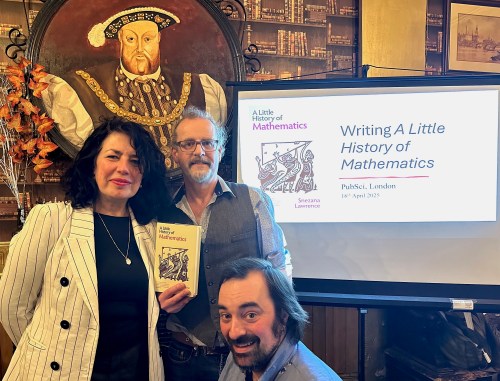
A woman and two men

April’s speaker, Snezana Lawrence (https://x.com/mathshistory) with PubSci Hosts Richard and Mike

We had a wonderful evening in the company of Snezana Lawrence at April’s PubSci, hearing about the writing process and contents of her beautifully illustrated new book A Little History of Mathematics. It was great to see so many new faces among the regulars and the Q&A was really engaged.

William Shakespeare

The Royal Institution gets a double mention in this month’s post, firstly because I’m event managing a brilliant talk there this coming Saturday 3rd May. In the Mathematical Life of Shakespeare, award-winning author Rob Eastaway (Why Do Buses Always Come in Threes?) explores the surprising ways that maths and numbers crop up in Shakespeare’s plays. With historical asides about games, optics, astronomy, music and magic, you’ll never think about maths or Shakespeare the same way again. Suitable for adults and anyone aged 8 and above.

If you stay for the evening event, I’ll also be hosting How Physics Connects Our Universe when theoretical physicist Chris White presents a new hypothesis linking quantum mechanics and general relativity.

But enough about them, what about us…?

Next PubSci: Wednesday 16th April | Science Goes Pop!

From Faraday to Van Tulleken, The Royal Institution of Great Britain – known by its chemical symbol, Ri – has been The Home of Science since 1799 and is famous for its public demonstrations which bring science to life. On Wednesday 21st May we bring the wow of live science to The Old King’s Head for a special event celebrating 200 years of Ri monthly Discourses and annual Christmas Lectures.

Royal Institution Christmas Lectures 2024 (Photo: Paul Wilkinson)

Michael Cutts from the Ri’s renowned demonstration team has designed, built, and showcased science demos at the Ri and around the world. He’ll take us through the history of live science and the importance of showing as well as telling. There may even be a few live demos suitable for a pub setting.

Doors 6.30 for 7pm start. Book your place on Eventbrite ASAP – tickets are going fast. As usual, you can make a contribution to PubSci’s costs via Eventbrite (minimum £1) or in cash on the night. Help PubSci keep science live. Hope to see you there!

• • •

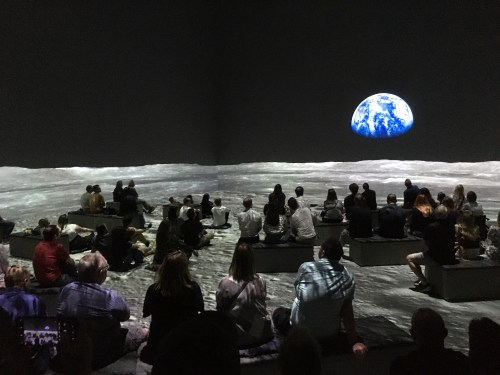
Finally, last weekend I went to Moonwalkers at Lightroom in Kings Cross, and I can’t recommend it enough. I paid full price (£29.50) which feels rather steep, but you can book through TimeOut for £19 if you plan your visit better than we did.

People watching an immersive projection of the moon

Blending archive footage and stills with brilliant graphics and a powerful soundtrack, Moonwalkers tells the story of the Apollo moon landings and looks forward to NASA’s Artemis mission planned for November 2025. It’s movingly narrated by Tom Hanks, who was involved in every stage of its making and shares his personal passion for spaceflight that began with watching Apollo 11 land on the moon in 1969. Highly recommended.

Moonwalkers plays in rotation with other events at Lightroom, next showing over the last week in May.

• • •

Keep Up With Future Events

Dd you know PubSci has an online calendar where you can view future events?

Event titles and dates go in the calendar several months in advance, along with a brief outline of the talk. If you subscribe to our calendar, PubSci events will automatically appear in your own calendar.

We also publish a programme of PubSci events three times a year which you can view online or download for printing. The latest edition has just been uploaded. Why not print it out and put a copy on your work fridge for everyone to see!

Posted by Richard Marshall, PubSci organiser and host.

PubSci: Sipping • Supping • Science

• • •

The evolution of humans from sitting in a chair to talking about science in a pub (after Darwin)

• • •

About PubSci talks

PubSci meets upstairs at the Old King’s Head, near London Bridge tube. No specialist knowledge is required, just curiosity. Doors open at 6.30pm for a 7pm start. Talks run for ~45 minutes and are followed by a Q&A session. The Old King’s Head has a happy hour before 7pm, and the kitchen serves excellent pub grub.

We use Eventbrite booking to manage numbers. Follow us on Eventbrite to be notified when new tickets become available.

Support PubSci

There is no charge for attending PubSci talks, but we have a cash whip-round to cover expenses on the night – consider it “Pay What You Can Afford”. As few of us carry cash these days, you can make a donation when registering for ticketed events with Eventbrite. Please help us continue putting on events. PubSci has no other source of funding.

We aim to keep PubSci accessible for all, although it is unsuitable for under 18s as we meet in the function room of  a pub. Regrettably, there is no wheelchair access. 

You can find all our links on our LinkTree.

• • •

We meet on the third Wednesday of the month, upstairs at the Old King’s Head near London Bridge Underground (Borough High Street east side exit). Join us every month apart from December for a regular dose of Sipping, Supping & Science.

Address:

The Old King’s Head (upstairs room)
King’s Head Yard
45-49 Borough High Street
London SE1 1NA

‘Science in Unexpected Places’ | 19th June, Eva Amsen

What do rubber ducks at sea have in common with edible art and a Japanese TV show?

On Wednesday 19th June PubSci is delighted to welcome celebrated science writer and blogger, Dr. Eva Amsen, to share favourite episodes from her entertaining new book, “Hey, There’s Science in This“.

Several yellow plastic ducks

Ducks Ahoy! (Image: Gaetan Lee – Creative Commons)

Real science can be found in the most unlikely places, and Eva Amsen has collected some of the best and funniest examples in her book, Hey, There’s Science in This.

For tonight’s talk, Eva has selected her favourite amusing stories from the book to delight, entertain and enlighten us as she explores the connections between hot springs and genetics, the psychology behind your study playlist, hiking trail geology and much more.

Hey There’s Science in This is an approachable and fun read that has garnered five star reviews since its publication on 28th March. Copies will be available to purchase at the event.

Come to June’s PubSci and discover the fun science behind the most unexpected things.

Places for this popular talk are very limited. Book yours on Eventbrite now for an entertaining evening that’s bound to satisfy everyone’s inner nerd. Copies of Eva’s books will be on sale after the talk.

A book cover

“Hey, There’s Science in This” was published in March to five star reviews.

          Book Cover for Biology - 100 ideas in 100 words

Join us upstairs at the Old King’s Head, near London Bridge tube on Wednesday 19th June.

Doors open at 6.30pm for a 7pm start. Talks run for ~45 minutes and are followed by a Q&A session. The Old King’s Head has a happy hour before 7pm, and the kitchen serves excellent pub grub.

Reserve your place now!  PubSci is a pay-what-you-can event – please consider making a donation with your reservation to help us cover our costs.

We use Eventbrite to manage event numbers. Subscribe to be notified of forthcoming talks

• • •

About the speaker

EVA-AMSEN-Donna-Ford2023-9 crop

Photo Credit: Donna Ford

Eva Amsen is a science writer based in London specialising in the interface between science and culture. She has written about science and scientists for numerous publications, including Nature, the British Medical Journal, Undark, Hakai, and the Forbes website, where she has a regular column.

Eva began her writing career with a science blog during her Biochemistry PhD at the University of Toronto. Some of those blog posts were collected into her first book, Hey, There’s Science in This, published in March 2024. She still blogs regularly via her Substack called Mixture.

Eva’s second book, Biology: 100 Ideas in 100 Words, allows readers to understand the most important concepts in biology through concise, easy-to-read summaries. Part of a cutting-edge series in partnership with The Science Museum, it was published by DK in May 2024.

PubSci is delighted to welcome Eva to the latest in our series of monthly talks.

___

Support PubSci

There is no charge for attending PubSci talks, but we have a traditional whip-round to cover expenses – consider it a “Pay What You Can” event. Very few of us carry cash these days, so you can contribute digitally through our TipJar or make a donation when registering for ticketed events with Eventbrite. Please help PubSci continue putting on events. PubSci has no other source of funding.

We aim to keep PubSci accessible for all, although it is unsuitable for under 18s as we meet in the function room of  a pub. Regrettably, there is no wheelchair access. 

Check out the Future Events page where you can also subscribe to our Google Calendar so PubSci events automatically appear in your own Calendar.  You can find all our links on our LinkTree.

• • •

We used to meet on the first Wednesday of the month but PubSci is now on the third Wednesday. Join us upstairs at the Old King’s Head near London Bridge Underground (Borough High Street east side exit) every month apart from December for a regular dose of Sipping, Supping & Science.

image-third-wednesdays

Address:

The Old King’s Head (upstairs room)
King’s Head Yard
45-49 Borough High Street
London SE1 1NA

News, ‘Thank You’s and Forward Views to 2024

There’s no December PubSci, so here are a few seasonal goodies to keep you going

covid-19-4961257-1920-3_1595238814208_x2Welcome to PubSci’s year-end blog post.

If you’re new to PubSci, welcome! You can find out more about Science In The Pub at the bottom of this post. You also can subscribe to this blog to keep up with PubSci events by submitting your email address on any page, or follow us on social media (including our LinkedIn group) via these links.

 •    •    •

2023 …and we’re back in the room!

We’ve had a great year in PubSci, finally returning to live events in the spring, three years after the April 2020 talk was cancelled due to the Covid-19 pandemic. Little did I know how long it would be before we could run live events again.

It was quite an uphill battle to restart. Several  beloved venues closed their doors for good and many surviving ones began charging eye-watering prices for room hire in the face of skyrocketing energy prices. I had a super venue lined up in September 2022, which sadly fell through when their room-hire price went through the roof.

In the end, we were delighted to return to our longstanding home at the Old King’s Head in Borough where the beer is good and the staff are friendly and helpful. Sadly the meeting room is up narrow stairs, meaning we remain inaccessible to people with limited mobility but the alternative was not to restart at all.

Huge thanks to Greg the landlord for welcoming PubSci back and opening the kitchen for us midweek. We also learnt that the pizzeria next door is truly excellent and Greg is happy for us to bring them in on the rare occasions the kitchen is closed due to staff shortage.

A massive thank you to all our speakers this year. See below for links to the entries for all their talks. We don’t livestream or record PubSci. If you’ve never been to an event and would like to know what we’re about, check out these videos of some “Virtual PubSci” events held during lockdown.

Of course none of this would mean anything if it weren’t for you, the friends, followers and audience of PubSci. And it wouldn’t be possible to host PubSci without on-the-night and behind-the-scenes assistance from the PubSci regulars.

 •    •    •

In The News

November’s talk was the last event of the year, and happened to be attended by Eva Amsen who writes about science and culture for Forbes. After the talk, Eva interviewed November’s speaker, Briony Marshall, writing about Briony’s work in Forbes and mentioning PubSci. Eva was kind enough to link to PubSci again in her personal blog post about it on SubStack. I highly recommend subscribing to Eva’s SubStack (called Mixture), “where science meets creativity, culture and curiosity”. If you see this, Eva, sorry about your meagre supper of crisps! Greg tells me the chef called in sick at the last minute.

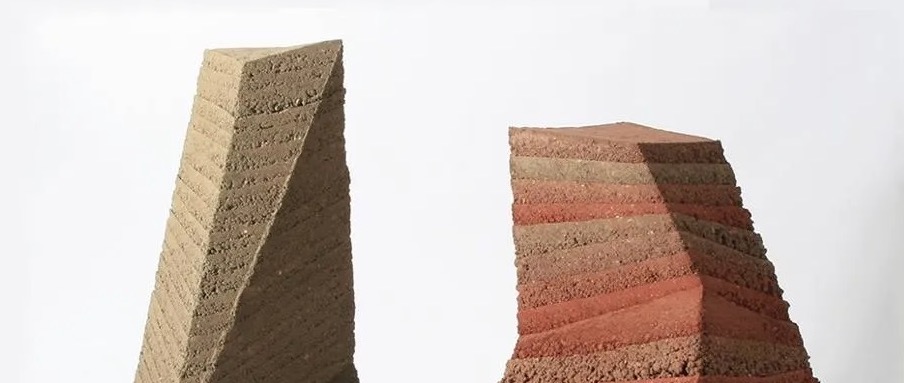
Two geometric rammed earth sculptures

“Earth Time and Disruption” (detail) by Briony Marshall

This was also the year PubSci made a great connection with the Royal Institution of Great Britain, home of the famous Christmas Lectures, a tradition begun by Michael Faraday in 1825. It was watching Prof Eric Laithwaite’s Christmas lectures in the 1970s that inspired my own love of STEM. If you see Ri events mentioned in a PubSci blog post from, not only are these events I personally recommend, there may be special ticket deals for PubSci’s friends and followers. Twice this year the Ri has recommended PubSci events to readers of its own, extensive mailing list.

 •    •    •

2023 in Review

PubSci relaunched live events on Weds 19th April with a joyous celebration of STEM comprising short talks by Kate Viscardi, George Holdaway, Mike Lucibella and myself. We heard about standards and deviations, quasicrystals and Islamic art, Antarctic science, genius cats and levitating hamsters. A huge thank you to Kate, George and Mike for helping me get us off to such a great start.

Our next speaker was unwell, so in May I dived into the world of misinformation with Falsehoods and Fallacies – Framing COVID-19 in the misinformation pandemic.

In June we were honoured to host US-based maths communicator, Eugenia Cheng, who slotted PubSci into her UK book tour for Is Maths Real? with a talk which left many visibly moved by Eugenia’s humanistic take on maths education.

July saw the return of a PubSci favourite, Prof. Chris French, with Putting Paranormal Claims to the Test, in which he detailed his department’s investigation of purported paranormal abilities.

IMG_0039

R to L: James, Mike, Richard with James’ amazing neutrino mass-state demonstration (and beer).

In August, award-winning science writer James Riordon flew over to talk about how neutrinos could answer the biggest questions in the universe in Ghost Particle (the day before giving a more family-friendly version of his talk at the Ri).

In September we’d hoped to welcome our great friend, NHM’s Dr Erica McAlister, but academic commitments meant she had to reschedule for 2024. Erica’s replacement, Dr Michal Williamson of IoZ, London didn’t disappoint, with an utterly fascinating talk on The Weird and Wonderful World of Eels! 

October saw Dr Stuart Eves treat us to a whistle-stop tour of planetary bodies in A Hitchhikers’ Guide to the Solar System and we hope Stuart will return to talk about moons of the solar system before we complete another circuit of the sun.

The eight planets lined up to compare their sizes

The eight planets and their moons (Courtesy of CactiStaccingCrane).

2023’s programme concluded in November with Briony Marshall (no relation) talking about Art and Science in the Age of Climate Fear. You can get an idea about Briony’s talk by reading this Forbes article about her work.

p04lccx7

In December it was always our tradition to host the PubSci Christmas Quiz featuring the famous “Name that Christmas Spirit” round, courtesy of Christmas cake-baker extraordinaire, Kate Viscardi.

Alas, moving to the third Wednesday of the month makes that impractical this year, so we’re skipping December and looking forward to January.

• • •

Looking forward to 2024

MikeWe kick off the new year with somebody who will be familiar to attendees: our very own Mike Lucibella. Mike spent five seasons in Antarctica as editor and photographer of The Antarctic Sun, official paper of the US Antarctic Program.

On Wednesday 17th January Mike will give the full version of the short talk he gave us in April about the vital research carried out at Antarctic stations and what it can tell us about the future of our fragile planet.

Following that that we can look forward to talks on Maths, Magic, Menopause, and Murder, not forgetting Flies, Flight and Fusion.

Until then everyone at PubSci Towers wish you Happy Saturnalia, Yule, Christmas, Hanukah, Eid al-Fitr, Diwali, Kwanzaa, Bodhi, Ōmisoka…

See you in 2024.

Richard Marshall, programmer, producer and host of PubSci

• • •

About PubSci

Science in the Pub (PubSci) is a STEM outreach initiative for scientists, the sci-adjacent and the sci-curious alike. Events are held in non-traditional venues such as a pub meeting room. Our current home is the Old King’s Head near London Bridge Station.

PubSci is entirely voluntary run and audience-funded – there is no other funding source. Nonetheless, we don’t charge for tickets so that our talks are accessible to all. See below for ways to support PubSci.

PubSci: Science, Sipping, Supping.

https://linktr.ee/pubsci

Join us upstairs at the Old King’s Head on the third Wednesday of the month. Doors open at 6.30pm for a 7pm start. The pub has a happy hour before 7pm, and the kitchen serves excellent pub grub.

• • •

Support PubSci.

There is no charge for attending PubSci talks, but we have a whip-round to cover expenses. Since few of us carry cash now, you can contribute digitally by putting a few quid in the virtual whip-round or make a donation when registering for a free event ticket. Please help PubSci continue to put on events.

We aim to keep PubSci accessible for all, although it is unsuitable for under 18s as we meet in the function room of a pub. Regrettably, there is no wheelchair access. 

Please check our Future Events page where you can also subscribe to our iCal feed. You can find all our links on our LinkTree.

• • •

image-third-wednesdays

Address:

The Old King’s Head (upstairs room)
King’s Head Yard
45-49 Borough High Street
London SE1 1NA
‘Art and Science in the Age of Climate Fear’ | 15th November 2023 | Briony Marshall

How can art contribute to a public understanding of science in an era of existential threats?

On Wednesday 15th November PubSci is delighted to welcome award-winning sculptor, Briony Marshallwho draws on a Masters degree in biochemistry to create science-inspired sculptures and installations. In this talk she will explore the role of art in communicating science and the place of science in understanding art.

[Free to attend but donations to running costs are greatly appreciated]

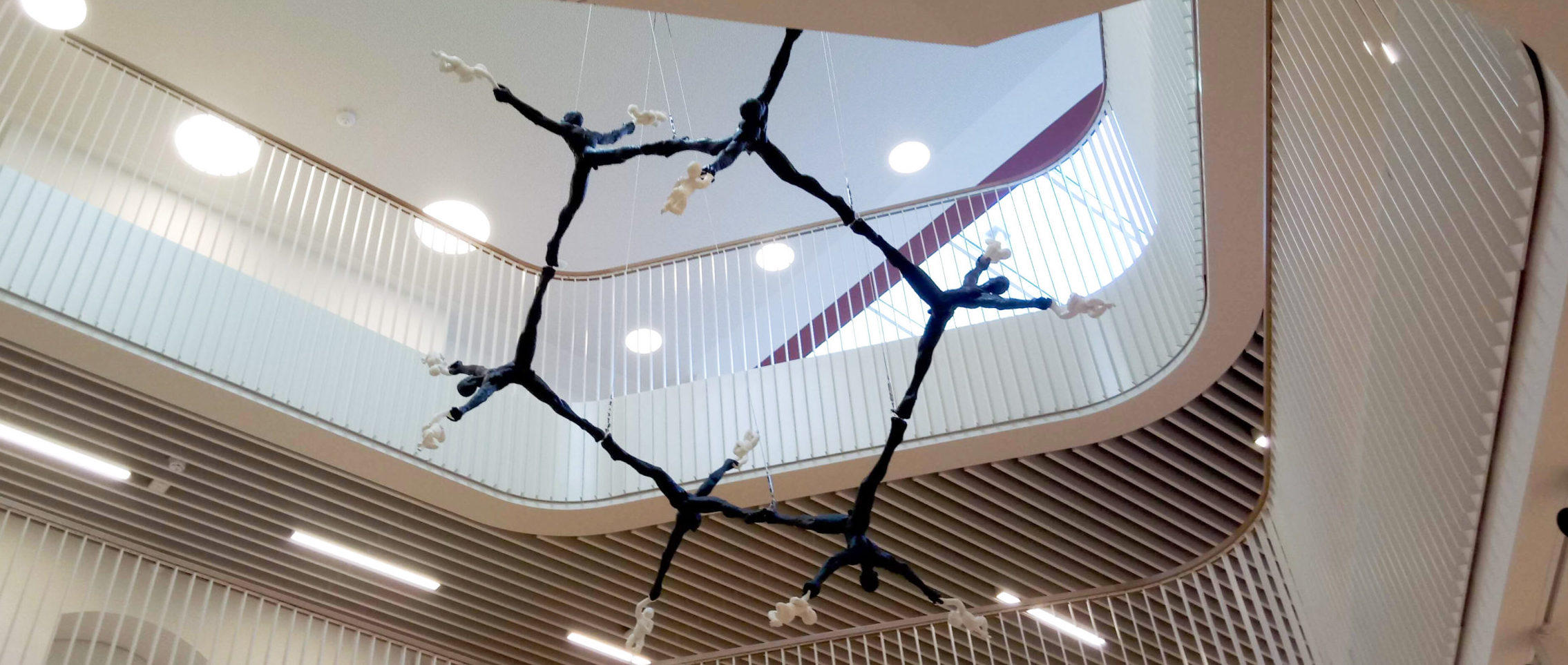
Sculpture of a hexagonal molecule made from human figures cast in bronze

Sculpture of the cyclohexane molecule at Tonbridge School (Credit: Briony Marshall)

Good sci-art goes beyond simply illustrating a topic, it offers insights into the deeper meanings behind (and implications of) its subject matter. Blending an Oxford science background with a fine art training, Briony sees art practice as a form of research and asks what artists can contribute that goes beyond traditional scientific methodology.

So, is “Sci-Art” just science-as-art or can it also be art-as-science? Is it possible to combine art and science without compromising either? Briony believes it is not only possible, it is essential to do so.

Briony’s latest public artwork, Plastic Mountain, was created with schools, volunteers and other members of the community in West Norwood to highlight the persistence of microplastic waste in the environment. It remains on public view outside West Norwood Library and Picture house until mid November. See it if you can – details here.

• • •

A monolithic sculpture, made from layers of compacted earth, resembles a geological section as it stands out against the night sky

Layers of Bournemouth. Briony Marshall

For this talk, Briony will look at neuroaesthetics from an artist’s point of view and consider how art can contribute to the public understanding of, and respect for, science. She will also share her own experiences as an artist deciding what projects to work on in our age of complex and existential threats.

Once again we’ll be using Eventbrite ticketing for this event. Book early to avoid disappointment.

Don’t forget that PubSci doesn’t charge an entry fee as such, but we rely entirely on attendee contributions to cover the cost of running these events.

___

Join us upstairs at the Old King’s Head, near London Bridge station. Doors open at 6.30pm for a 7pm start. The Old King’s Head has a happy hour before 7pm, and the kitchen serves excellent pub grub.

• • •

About the speaker

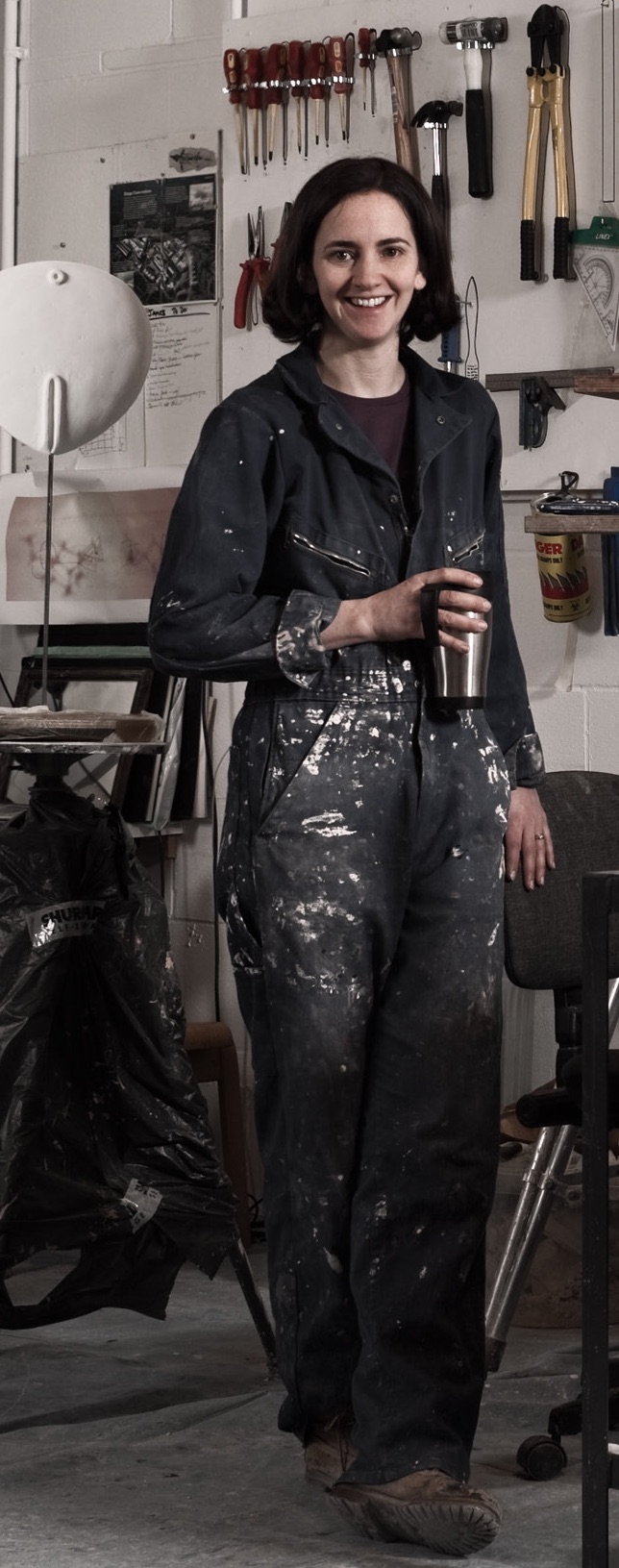
A female sculptor wearing paint-spattered overalls in her studio

Briony in the sculpture studio at Pangolin London

Briony Marshall MRSS is a professional sculptor and installation artist who finds solace and meaning in science. To quote her heroine, Rachel Carson: “Those who contemplate the beauty of the earth find reserves of strength that will endure [a lifetime].”

She has a Masters in Biochemistry from Oxford University and a diploma in Fine Arts from The Art Academy where she is now Head of Professional Development as well as pursuing her own sculpture practice from her London studio.

While at Oxford she was editor of both The Oxford Student and ISIS.

In 2021 she founded Planet STEAM to help people of all ages and backgrounds understand and appreciate science by creating public artworks which explore today’s world and the complicated threats and opportunities faced by society.

She has been a member of the Royal Society of Sculptors since 2008 and in 2016 she became one of the ‘175 Face of Chemistry’ in celebration of the 175th anniversary of the Royal Society of Chemistry.

Her latest public art commission, Plastic Mountain, juxtaposes society’s addiction to disposable plastics with the geological ages of the Earth. It remains on show outside West Norwood Library until mid-November and has attracted local and national media interest.

Briony is currently campaigning for a public sculpture in honour of Kathleen Lonsdale, the pioneering pacifist, prison reformer and X-ray crystallographer who proved the structure of the Benzene ring and gave the world 3-d molecular models using ping pong balls!

Don’t miss the chance to join Briony at PubSci this November at ‘Art and science in an age of fear’

[Don’t forget to set a featured image to replace the default one (in the “Post” settings on the right), add categories and Tags, and write a brief summary in the Excerpt box]

___

Support PubSci.

There is no charge for attending PubSci talks, but we have a whip-round to cover expenses. Because so few of us carry cash these days, you can contribute digitally too  by putting a few quid in the virtual whip-round. Please help PubSci continue to put on events.

We aim to keep PubSci accessible for all, although it is unsuitable for under 18s as we meet in the function room of  a pub. Regrettably, there is no wheelchair access. 

Please check our Future Events page where you can also subscribe to our iCal feed.  You can find all our links on our LinkTree.

• • •

We used to meet on the first Wednesday of the month but PubSci is now on the third Wednesday.

image-third-wednesdays

Address:

The Old King’s Head (upstairs room)
King’s Head Yard
45-49 Borough High Street
London SE1 1NA