Category Archives: ecology

October blog: Two coming PubSci Events and Things To Do in London.

In this post: Details of October’s PubSci on Darwin’s botanical obsessions; The Science Show podcast delves into the miasma, and what to see in Regents Park this month if you love science and art.

First of all, huge thanks to scientific tour guide Laurence Stiles of Laurence’s walks for last month’s PubSci looking back at roughly 3,000 years of engineering history in Great Engineering Leaps – Archimedes to Brunel and Beyond.
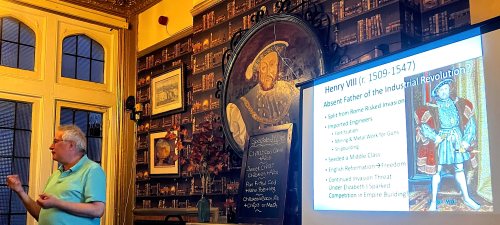
A man in a pub. A portrait of henry VIII and projected image of henry
Henry VIII got a look-in, which was nice

Probably none of us had considered that, despite the amazing technical achievements of the Roman and early medieval period, very few purely engineering advances were made! It certainly provoked lively discussion, which always makes for a good evening. And who among us had ever considered Henry VIII as the “absent father of he industrial revolution”? Laurence certainly made a good case for it, while Henry looked on approvingly.

Beauty, Sex and Death at Down House

That’s not the title of a murder mystery, but a reference to this month’s PubSci when Sheila Poole from the Down House visitor outreach team delves into the great naturalist’s obsession with orchids and insect-eating plants on Wednesday 21st October, in Beauty, Sex and Death – Charles Darwin on botanical deception and carnivory.

If you’re reading this on Tuesday, the event is tomorrow. It’s hugely popular and fewer than 10 tickets remain, so get your skates on if you want to grab a place. You can read more about it here or go straight to the booking page here.
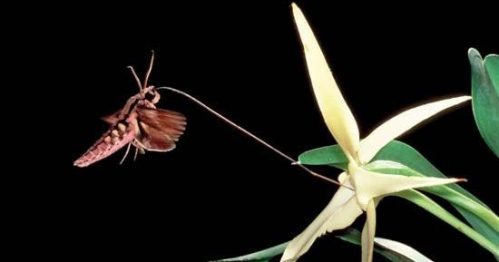
A moth with a long tongue feeding on a white, star-shaped orchid
Sphinx moth feeding on Darwin’s Orchid

The venue is PubSci’s regular home, The Old King’s Head near Borough Market, which offers a great range of drinks, has a happy hour before 7pm, and opens the kitchen serving classic pub grub especially for us. Doors open at 6.30 for a 7pm start. Talks generally run for ~45 minutes and are followed by a Q&A session. Full address on the booking page.

As most of you know by now, PubSci talks are pay-what-you-can: You can make a contribution when booking on Eventbrite. We have no other source of funding. There are two ticket options:

Book for one + Support PubSci (max 1 ticket) if you prefer to contribute when booking – this option also reserves you one spot at the event. You may need to scroll down to see this option on Eventbrite.

Book without donating (max 4 tickets) if you prefer to put cash in the pot on the night.

Advance News of November PubSci

If you’ve checked out our current events programme, you’ll have noticed that November’s talk is a bit special.

The speaker will be Oxford professor of mathematics and holder of the Simonyi Chair in the Public Understanding of Science, Marcus du Sautoy. We’ve been in discussion since late last year, and I’m delighted we were able to find a date for Marcus to come to the Old King’s Head onWednesday 18th November.
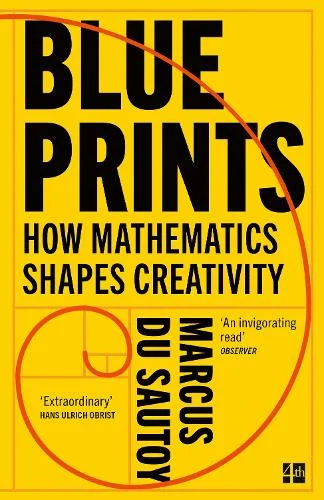
Marcus is a regular guest on BBC Radio 4’s In Our Time and anybody listening to the Today Programme on Radio 4 on Monday 19th October will have heard him give his response to the huge AI backlash from some leading mathematicians. Marcus is also my interview guest for next episode of The Science Show, to be broadcast on Monday 2nd November. We’ll be looking at some of the nine popular science & maths books he’s published, discussing AI in maths, and exploring the amazing maths that subtly underpins much of art and creativity. This was the topic of his latest book, Blueprints – now out in paperback – which he’ll be signing after November’s talk.

Art, Science and Worms

If you fancy getting outside this month, here are a couple of great science-related things to explore.

Worm Weekend at Down House, Charles Darwin’s family home in Kent, takes place this coming weekend, 24th – 25th October when you can Learn about different types of earthworm and take part in hands-on worm sampling in the beautiful gardens at Down House.

Darwin was himself rather obsessed with earthworms. He studied them over 40 years, tried to charm them by playing the piano and the bassoon at them – despite apparently having no skill in bassoon playing – and declared that no other animals have played “so important a part in the history of the world“. Find out why at Down House. It’s free to join in the events with a ticket to the English Heritage house and gardens.

Earthworms were the subject of Darwin’s final scientific book, The Formation of Vegetable Mould Through the Action of Worms, published in October 1881, just six months before his death. His most famous book, On The Origin of Species was published on 24 November 1859, and that will be celebrated at Down House with a weekend of special events on 21st – 22nd November.

Artist Conrad Shawcross is well known for creating art inspired by science. His piece Ringdown featured in the Science Gallery’s Quantum Entangled exhibition which ran from October 2025 to March 2026. He’s also exhibiting a piece in Frieze Sculpture 2026, the annual open air sculpture trail in London’s Regents Park. His piece ‘Eye of the Needle (Time Pebble (E30A13))’ was inspired by a 2008 visit to the Holmdel Horn Antenna in New Jersey, USA, which is the historic instrument that identified cosmic microwave background radiation and confirmed the Big Bang theory in 1964.

You can see Eye of the Needle (Time Pebble (E30A13)), along with 10 other sculptures throughout Regent’s Park until Sunday 1st November. There’s even a video of the artist discussing how his sculpture relates to cosmic time and the limits of human understanding on the Frieze website.

The Number 1 Science Podcast – again!

The Science Show is a magazine-style miscellany packed with news, interviews, chat and discussions, plus great music and cultural crossovers. Episode 11 was broadcast on Monday 5th October and is available to stream or download on Mixcloud.

Deborah Rowe joins me to discuss OpenAI solving one of the hardest problems in maths, worth $1 million (or did it…), Stanford University’s apparent claim that the brain evolved from two separate organs, the death of the Leap Second, and El Niño continuing to break records. Danielle Green joined me for a Random Walk though the history of miasma, mosquito borne diseases, gin and tonic, and a Soho water pump. And historian of mathematics (and former PubSci speaker) Snezana Lawrence discusses how future historians might look back on the AI explosion currently causing ructions in the maths world.

Episode 11 of The Science Show hit the top spot in Mixcloud’s science chart within a day of release, and broke into the Top 10 of the overall Podcast and Talk charts for the first time. I’m delighted by this unexpected success but what matters more is what you think of it. Please give it a listen and follow the show. If you like it, do please tell your friends!


Well that’s it for this post. Hope to see you at the Old King’s Head on 21st October, and don’t forget to put Wednesday 18th November in your diary.

Richard (Science communicator and PubSci organiser/host)

19th October 2026

October Blog: Antimicrobial Resistance, the Passing of Two Greats, a New Science Show on the Radio, and a World of Maths

In this post I preview October’s PubSci (Wednesday 15th!), celebrate maths and poetry, promote a science radio show close to my heart and mark the passing of two very different legends.

Apologies for the extreme tardiness of this blog post. If you rely on my blog for event updates you’ll be biting your nails by now. Head to the Next Event page and grab you ticket ASAP. As I explain later, I’ve had my head in a rather wonderful project, that I hope you’ll enjoy. Remember, if you subscribe to PubSci’s calendar, events in your calendar will update automatically.

But first…

Dr Jane Goodall 1934 - 2025
Dr Jane Goodall 1934 – 2025 (© Jane Goodall Institute)

It would be absurd to begin this blog with anything other than the death of conservation and primatology legend, Dr Jane Goodall — and it would be almost impossible to overstate her impact.

To quote the BBC: “Goodall discovered that chimps used tools, created complex societies and could be so aggressive they could even kill one another. This suggested that chimps and humans are likely to have common ancestors – and was ground-breaking information. Her work made waves amongst her fellow researchers, and the public enthusiastically responded to her revelations.

The idea that chimps and humans were related spurred debates about what it means to be human, inspiring a rethink on animal rights. Her books were so widely read that when one of Jane’s subjects Flo died in 1972, The Sunday Times ran an obituary.“

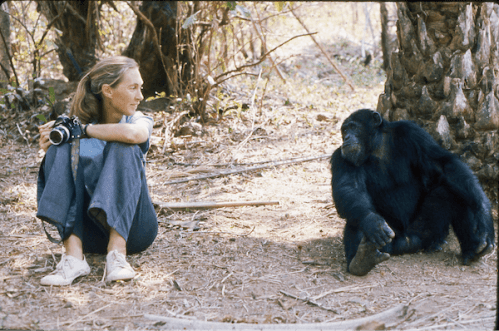
A Young woman with a camera looks ta a chimpanzee which looks back at her
Photo: ​​© the Jane Goodall Institute/By Derek Bryceson

Not only was Jane Goodall a pioneering primatologist and powerful advocate for conservation and habitat protection, she was also an inspirational humanitarian and a role model for young women — so much so that she was immortalised as a Barbie in their Inspiring Women series and as a Lego Minifigure, in both cases accompanied by chimps.

Tireless Goodall died at the age of 91 in the middle of a US speaking tour and left behind a final message for the world, a message of personal and environmental hope for these times:

“I want you to understand that we are part of the natural world. And even today, when the planet is dark, there still is hope...”

You can read the full text here and watch the video of Dr Goodall delivering her final message to the world here.

October’s PubSci is upon us – book now on Eventbrite!

October’s PubSci is on Wednesday 15th October, which means it’s today if you’re reading this the same day it appears in you mailbox, so I’ll keep this brief.

Have you ever wondered what the world would be like without antibiotics…? 100 years ago, infections we consider almost trivial today frequently led to lasting illness or death until penicillin was commercialised. The shocking reality, however, is that bacteria and other microbes are developing resistance to antimicrobial drugs faster than we are developing new antimicrobials.

Strips of antibiotic pills
What will we do when the drugs don’t work?

With drug resistant infections costing the NHS £180 million a year, it’s more important than ever to understand how microbes become resistant, what we can do about it, and what options are out there if antibiotics fail us altogether. This month at PubSci, Professor Jenny Rohn from UCL explores what happens when the antibiotics stop working, why antimicrobial resistance matters, and what scientists are doing to stop us returning to the days when even a scratch could be fatal.

You can get full details, as ever on PubSci’s Our Next Event page until it’s updated for November, but why not head straight to Eventbrite and grab one of the few remaining tickets.

Much To Do About Numbers?

Last month’s PubSci was all about the clever ways William Shakespeare used maths in his plays, and the speaker, Rob Eastaway, is involved with the launch of Maths World, only a stone’s throw from Shakespeare’s Globe. Maths World is new discovery centre for London which aims to do for mathematics what the Science Museum and Natural History Museums do for their fields; think immersive and interactive exhibits, puzzles, AI, code-breaking etc. Wonderfully it’s located in Bankside, part of the historic Liberty of Southwark, as it was known in Shakespeare’s day.

Lots of colourful activities for children
Get hands-on with maths in London’s Bankside

Maths World is located at 6 Burrell St, SE1 0UN, near the Tate Modern. Expect much ado about numberphiles when it officially opens on 13th November.

Rob’s talk on Shakespeare’s Maths was such a great hit that he ran out of books to sell. Apologies to those who didn’t manage to get a signed copy of Much Ado About Numbers. You can always grab a copy in the shops or via the link on Rob’s website and bring it to one of his events to be signed at a later date. I once took a copy of Connections [the book of the 1978 BBC TV series] to a talk by James Burke to get it signed by him some 30 years after it was published — which he most graciously did!

Talking of Connections…

Looking further back to Augusts’ PubSci, I was delighted to discover that August’s speaker, Ruth Stalker-Firth had written a super blog post about PubSci ahead of her talk. You can read it (and find the rest of Ruth’s website) here where there’s also a follow up post with event photos. She’s even kindly linked back to last month’s PubSci blog. If you’re a blogger, vlogger, influencer, broadcaster, or whatever, please let us know if you happen to mention PubSci so I can add it to our archive.

A young woman at an old fashioned wireless
Tune in to science radio

And on the Subject of Broadcasting…

What kept me rather busy of late was recording, producing and editing my first ever radio show! The Science Show is co-presented by myself and Mike Lucibella on Resonance FM, the Arts Council funded community radio station for London. Yes it broadcasts live on FM in London, and you can livestream it anywhere in the world or get it on Radioplayer across the UK.

The show is a monthly one hour magazine programme (ie with several different segments) that you can listen to in one go, or break up into three easy chunks. So far we’ve made a pilot show (with some technical limitations) but the station was so excited by the early test recordings that they’ve given us a regular slot: 5pm on the fourth Tuesday of the month, beginning 28th October, with a repeat at 10am the following Sunday.

The pilot episode went out live on Thursday 9th October and you can listen to it here:

A radio player for 9 October 2025 (The Science Show) non Resonance
Listen to The Science Show pilot episode on Mixcloud

Please let us know what you think by sending us a message at our dedicated email address.

Return of the IgNobels

With the 2025 Nobel Awards announced over the past week or so, it’s easy to forget their lighthearted counterparts. The Ig Nobels recognise research that makes you laugh and then makes you think – much as good comedy does. Last year I was dressed as a banana as part of the Royal Institution‘s Ig Nobels Live night. This year I’m event managing the evening so I might get away without skinning up as a banana — but then again, I might not!

A Greek philosopher on his back with his feet in the air

This year’s special event on Friday 31st October is called IgNobels Face-To-Face at which prize winners and some of the leading minds in science will explore how research on the unlikeliest of subjects can have real world implications. Expect a night of hilarious and enlightening stories from some of the strangest and most intriguing scientific research in recent years! And if you enjoy a Halloween party, you’ll still have time to go out and do something spooktacular afterwards. Book with the Ri at https://www.eventbrite.com/e/ig-nobels-face-to-face-tickets-1489016060119

Shall I Compare Thee to a Synaptic Junction?

No, I’m not trying to wax poetical about neurones (although the neuroscience of dementia is the topic of our November talk by Dr Emma Clayton)*, nor am I alluding to Rob’s Shakespeare talk. Science is traditionally communicated in precise language but there are times when evocative imagery is the most powerful medium for scientific ideas. Prof Sam Illingworth’s CPD course on Science Communication through Poetry sets out to do exactly that, and it’s back for the third year.

Four interactive sessions explore how poetry can bring science to life and connect with audiences in fresh, creative ways. It doesn’t matter whether you’re a scientist, a poet, or an enthusiastic amateur. I participated a couple of years ago and enjoyed it greatly. Sessions take place online over consecutive Tuesday lunchtimes, beginning 21st October and there are a few paces left.

Find out more and book here.

Farewell to John Searle

Another great mind left us last week: American Philosopher John Searle died at the age of 93.

Searle contributed to the philosophy of language, philosophy of mind, and social philosophy, and he is best known for philosophy concerning Artificial Intelligence. Searle’s most celebrated contribution is the 1980 thought experiment known as The Chinese Room which holds that a computer executing a program cannot have a mind, understanding, or consciousness, regardless of how intelligently or human-like the program may make the computer behave. ChatGPT users take note! In 2015 Searle was invited to address Google in a talk titled “Consciousness in Artificial Intelligence”.

A greay haired man
John Searle speaking at Google in 2015 (Photo: FranksValli)

Searle called his philosophical position “biological naturalism” which insists that consciousness and understanding require a specific biological machinery found in brains: “Brains cause minds”. I won’t go into it here, but the Wikipedia page (linked above) gives a good account of the Chinese Room and what Searle inferred from it.

The next few decades may show Searle to be right in insisting consciousness and understanding are biological phenomena, or they may show his opponents in the Strong AI camp to be right (which is what the loud tech bros tell investors) — but a third possibility is that John Searle’s famous thought experiment presents an opportunity to reassess how we understand ourselves first and foremost, just as profoundly as meeting a “conscious AI” would do. Or indeed looking into the eyes of a great ape and recognising an ancient shared lineage which tells us we are more connected than we dare admit in this fragile world.

A chimpanzee looks into the camera
Jamie © Chimpanzee Sanctuary Northwest

~

Don’t forget to grab your last minute ticket to October’s PubSci, and remember to follow us on all the socials including LinkedIn to keep up to date with what we’re doing. You can find those on our Linktree.

* Please note that our November 2025 talk is on Wednesday 26th November, which is the fourth Wednesday. We had to move it from the previous week because Mike and I will both be at the IoP Communicators and Outreach conference on 19th and will be giving a short talk about PubSci.

Thanks for reading. Please feel free to email or comment in response. Hope to see you at The Old King’s Head on Wednesday 15th October.

15/10/2025 Posted by Richard, PubSci programmer and host

PubSci: Sipping • Supping • Science

• • •

The Summer / Autumn Programme

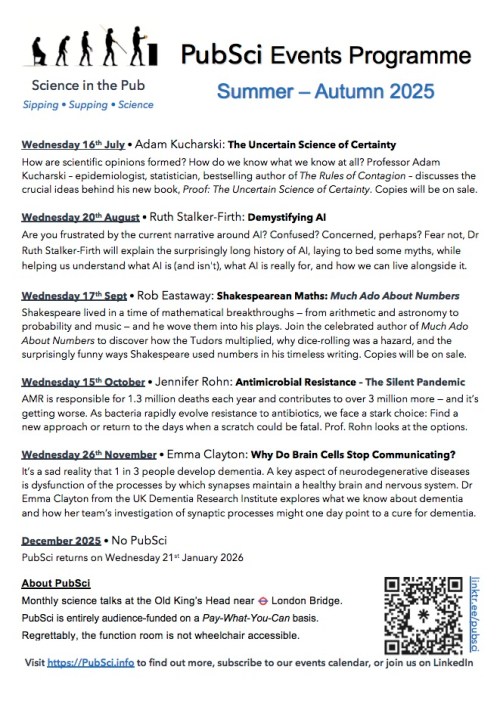
PubSci’s latest programme runs from July to November (there’s no event in December) and is perfect for printing out and pinning to your work noticeboard or sticking to the fridge, It’s always available on the Current Programme page, along with past event programmes, and you can link to the image below on your own website.

Click the image to open the programme in a new tab.

• • •

Keeping Up With Future Events

To make sure you don’t miss out on future events, subscribe to our Google Calendar to be the first to know when new talks are scheduled, and follow PubSci’s events on Eventbrite to be notified when tickets are available. You can also sign up to our own mailing list on any page on this site.

• • •

About PubSci talks

PubSci is organised and hosted by science communicator, Richard Marshall, assisted by Mike Lucibella. Events are held upstairs at the Old King’s Head, near London Bridge tube. No specialist knowledge is required, just curiosity. Doors open at 6.30pm for a 7pm start. Talks run for ~45 minutes and are followed by a Q&A session. The Old King’s Head has a happy hour before 7pm, and the kitchen serves excellent pub grub.

Support PubSci

There is no charge for attending PubSci talks, but we have a cash whip-round to cover expenses on the night – consider it “Pay What You Can Afford”. As few of us carry cash these days, you can make a donation when registering for ticketed events with Eventbrite. Please help us continue putting on events. PubSci has no other source of funding.

We aim to keep PubSci accessible for all, although it is unsuitable for under 18s as we meet in the function room of  a pub. Regrettably, there is no wheelchair access. 

You can find all our links on our LinkTree.

Three pictures of a woman at different ages
Jane Goodall 1934 – 2025
The evolution of humans from sitting in a chair to talking about science in a pub (after Darwin)

Address:

The Old King’s Head (upstairs room)
King’s Head Yard
45-49 Borough High Street
London SE1 1NA

August PubSci: “Gilbert White, The Once and Future Ecologist” with Steph Holt, 21/8/24

On Wednesday 21st August PubSci is delighted to welcome Steph Holt from London’s Natural History museum to talk about a pioneering 18th century naturalist now regarded as the first ecologist.

a man with animals

Illustration courtesy of Gilbert White House and Gardens

Gilbert White was a country parson with a fascination for nature. In 1789 he published The Natural History and Antiquities of Selborne, a groundbreaking work whose importance is difficult to overstate.

Charles Darwin credited it with sparking his own fascination for nature, and White’s work paved the way for Darwin to develop his Theory of Evolution by Natural Selection.

White’s understanding that humans, nature and the environment are all inextricably linked have led to him being celebrated as the first ecologist.

White was frequently referenced by veteran ecologist Richard Maybe, author of over 30 books (including Food For Free which kicked off the 1970s “self sufficiency” movement and inspired The Good Life TV sitcom).  Gilbert White also inspired the author of The Once And Future King – known by many through the Disney classic, The Sword In the Stone – who has Merlin the Magician quote Gilbert White on the topic of birds. Curiously the novelist’s name was T.H. White.

Our talk title, “The Once and Future Ecologist“, not only honours Gilbert White’s novelist namesake but reminds us that he was the first to truly understand how important the link is between living things, including humans, and our physical environment – a message which becomes increasingly urgent as we look to the future of this planet.

• • •

PubSci is delighted to welcome Steph Holt from London’s Natural History Museum to talk about this fascinating and truly inspirational figure. Book now on Eventbrite.

More information below

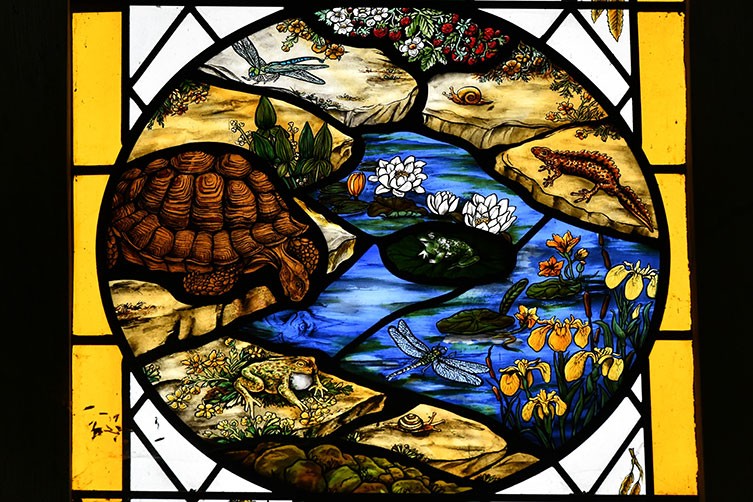
A stained glass window depicting a tortoise, frog and dragonfly

Stained glass commemorating White, St. Mary’s church, Selborne

___

Join us upstairs at the Old King’s Head, near London Bridge tube. Doors open at 6.30pm for a 7pm start. Talks run for ~45 minutes and are followed by a Q&A session. The Old King’s Head has a happy hour before 7pm, and the kitchen serves excellent pub grub.

Reserve your place now!  PubSci is a pay-what-you-can event – please consider making a donation with your reservation to help us cover our costs.

We use Eventbrite to manage event numbers. Subscribe to be notified of our forthcoming talks.

• • •

About the speaker

Steph HoltNatural Historian and ecologist Steph Holt has been fascinated by the wildlife of the British Isles for as long as she can remember.

She is passionate about the intersection of ecology and history, and is an accomplished communicator of her field. After working in ecology in local government, consultancy, NGOs, and academia, Steph Joined the Centre for UK Nature at London’s Natural History Museum in 2014. As UK Biodiversity Training Manager at NHM, she now helps ecologists develop careers with organisations such as Wildlife Trusts, Natural England and RSPB.

Steph is a Fellow and trustee of the British Naturalists Association, Associate Editor of Archives of Natural History (the journal of the Society for the History of Natural History), Fellow of the Linnean Society of London, and member of the Chartered Institute of Ecology and Environmental Management.

She has an MSt in Historical Studies, and is embarking on a DPhil at University of Oxford focusing on natural history in the late 18th Century, and its influence on networks of naturalists in modern amateur natural history.

Steph was recently awarded the David Bellamy Award for ‘Exceptional Field Naturalist’ by the British Naturalists Association.

PubSci is delighted to welcome Steph to the latest in our series of monthly talks.

___

Support PubSci

There is no charge for attending PubSci talks, but we have a traditional whip-round to cover expenses – consider it a “Pay What You Can” event. Very few of us carry cash these days, so you can contribute digitally through our TipJar or make a donation when registering for ticketed events with Eventbrite. Please help PubSci continue putting on events. PubSci has no other source of funding.

We aim to keep PubSci accessible for all, although it is unsuitable for under 18s as we meet in the function room of  a pub. Regrettably, there is no wheelchair access. 

Check out the Future Events page where you can also subscribe to our Google Calendar so PubSci events automatically appear in your own Calendar.  You can find all our links on our LinkTree.

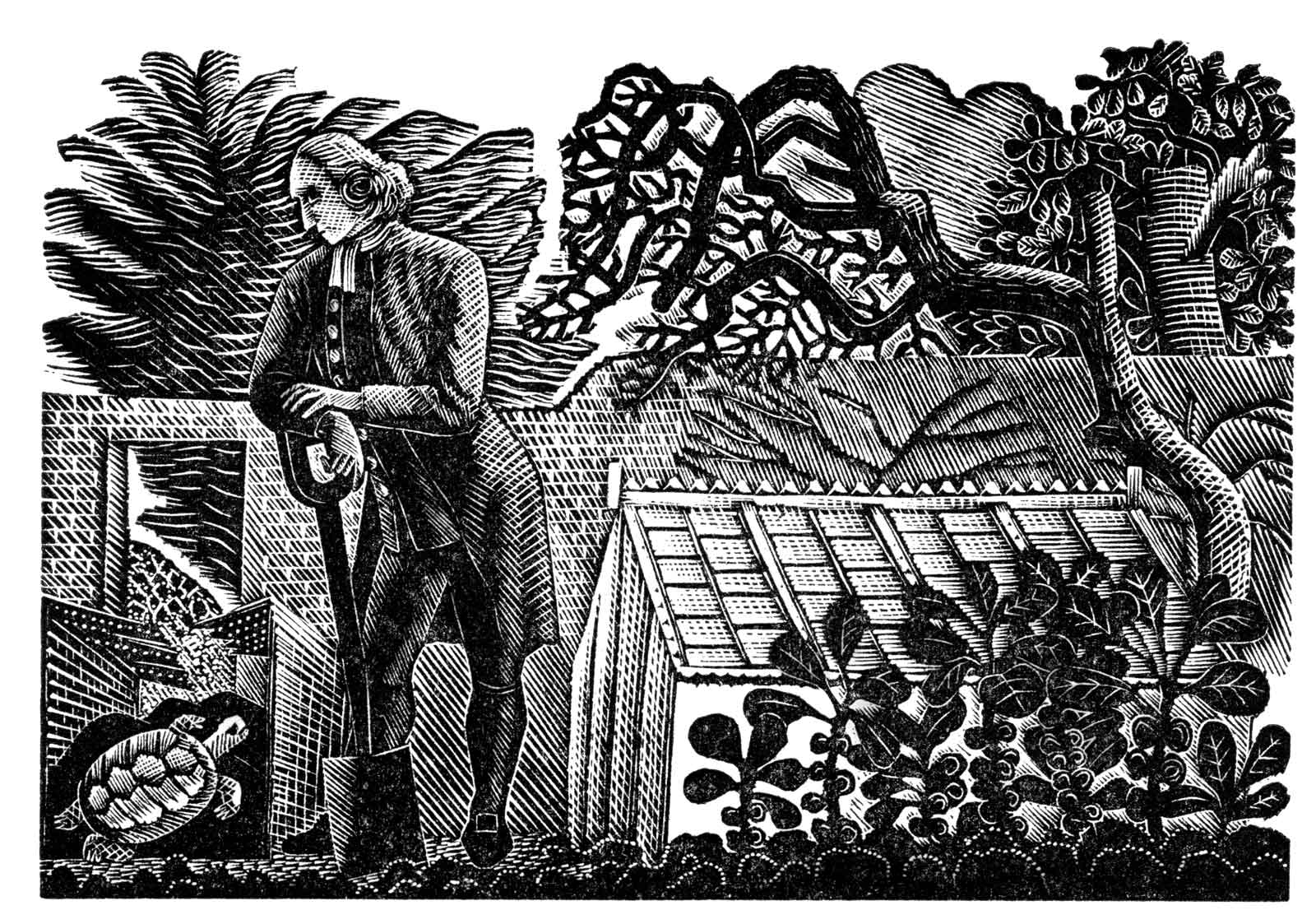
A print by Eric Ravillious of a man with a spade and a tortoise

Wood engraving of Gilbert White by Eric Ravillious

• • •

We used to meet on the first Wednesday of the month but PubSci is now on the third Wednesday. Join us upstairs at the Old King’s Head near London Bridge Underground (Borough High Street east side exit) every month apart from December for a regular dose of Sipping, Supping & Science.

image-third-wednesdays

Address:

The Old King’s Head (upstairs room)
King’s Head Yard
45-49 Borough High Street
London SE1 1NA