Category Archives: Events

September PubSci: Physics Special

Symmetry, singularities & string theory

On Tuesday 18th September we will have PubSci regular Dr. John Hamilton guiding us on a tour of why physicists always bang on about symmetry, and how it fits in to theoretical physics.

A simulated event in the CMS detector, a collision in which a micro black hole may be created.

You may have encountered John if you’ve been to PubSci  before, he’s the one who has clearly explained the answers to really interesting questions like “what are the LHC and the Higgs Boson all about?” and “what does it mean if neutrinos travel faster than the speed of light?”

John will be talking mainly about symmetry, touching on singularities and string theory (and why it’s probably wrong) along with all sorts of exciting concepts that we’ve heard about thanks to the enthusiastic outpourings of Prof. Brian Cox.

In short, it’ll be an evening of really complicated science made really interesting and understandable. Plus beer.

So why not join us at the Brixton Ritzy Upstairs Bar from 18:45ish for food, drink and a chat, ready for an 19:45ish start?

Oh yes, and as always it’s free!

August PubSci: Pub Quiz

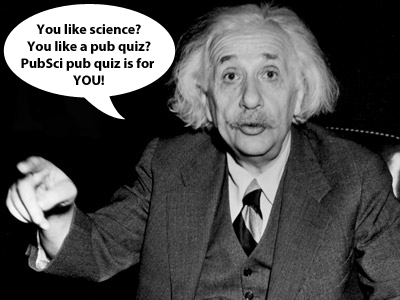
Science Pub Quiz

On Tuesday 28th August we will be making the most of the new expanded floor space Upstairs at the Brixton Ritzy by holding a science pub quiz. Ten rounds of questions intended to put your general scientific knowledge to the test.

You won’t need to be Einstein to have some fun and maybe win some prizes, so why not join us for a fun evening of fun science facts and a light smattering of science fiction?

We suggest you try to arrive by 7pm to get food and drink ready for a 7:30pm start. Don’t worry if you don’t have a team to bring, there’s a friendly crowd and there will be other people happy to join forces. We look forward to seeing you on the night!

July PubSci: Terrible Table Manners

The Feeding Habits of Carnivorous Dinosaurs

On Tuesday 17th July Tuesday 24th July we will be finding out more about dinosaur behaviour with Dr. David Hone.

Understanding the diet and feeding habits of long extinct species is a challenge, but it can provide an insight into predator-prey relationships, ecosystem structure and animal behaviour in past environments.

Majungatholus atopus feeding. Artwork by Demetrios M. Vital

Majungatholus atopus feeding. Artwork by Demetrios M. Vital

Dave  is the founder of Ask A Biologist, he runs an excellent blog and he is one of the latest additions to the Guardian’s science blogging stable. He is also an active vertebrate palaeontologist involved in some really interesting research on dinosaurs, pterosaurs and birds. That means he isn’t just reporting on this topic – you’ll be hearing about the research, results and the fossils from the source.

Why not join him for an insight into the science used to explore the feeding habits of the mighty meat-eating dinosaurs – you may never see T. rex and Velociraptor in quite the same way again!

The talk will start around 7:45pm, but the venue (Upstairs at the Ritzy) will be open from 6pm for those who want food, a drink and a bit of geeky chat. Hope to see you there!

Oh yes, and it’s FREE!

May PubSci: The Science of Star Trek

To Boldly Go… to Brixton

On Tuesday 15th May we will be celebrating the first anniversary of Science in the Pub with Dr. Michael Byford who will be exploring the science of Star Trek.

USS Enterprise (NCC-1701-A)

Star Trek forms a comprehensive and surprisingly coherent story arc, encompassing five linked TV series and a profitable movie franchise.

Many of the developments postulated by its writers have been brought into being whereas others are so fanciful that they are at best most unlikely or at worst simply impossible.

We will explore the scientific basis of Star Trek, real or imagined, always with the deepest respect for the impressive powers if imagination demonstrated by its writers, directors and producers.

The talk will start at 7:30pm but the venue (Upstairs at the Ritzy) will be open from 6pm for those who want food, a drink and a chat. Hope to see you there!

A confusing series of events

After what has been a series of confusing changes to dates this month we though it would be best to clarify again, as nothing is on the date it was originally o!

Tonight (23rd April) will be a talk on 5 things worse than being eaten by a shark at Upstairs at the Ritzy in Brixton – link to event

Debora Hydes talk on Demons and Nightmares for Hackney Skeptics is now on the 30th of April – link to event

We hope to see you for both events, normal service will renew after this months craziness!

The Doomsday Handbook: 50 Ways to the End of the World!

From predictions of sin, fire and brimstone in ancient stories, to asteroids, viruses and climate change in films today, the human race has long speculated – and dramatized – about how it will all end.

Yet no matter how creative our stories are, science, Alok Jha will tell us, offers us even weirder possibilities.

Some of them are cosmic in origin, such as a monstrously large magnetic storm from the Sun; or from the Earth itself, such as a catastrophic volcano or a reversal of our magnetic field. Others are due to the human race’s own advancements: drugs, terrorism, cyborgs – or even some of these combined, such as a solar storm affecting our communications and electrical technology. Or, if we’re really unlucky, we might wander too near a black hole or a (so far) hypothetical particle called the strangelet, which is able to turn all particles it encounters into a copy of itself – and could do this to everything on the Earth over a matter of hours.

Is this anything to worry about? Alok Jha has spoken to various people who think it might be. 99% of species that have ever lived on Earth are now extinct – and the Sun itself will become a red giant one day. “Humanity as a whole does not invest much in improving its thinking on how to enhance its own survival,” he reports. Come and hear how, if we can’t put off The End, it might at least be a lot more interesting than we thought.

You will be able to buy a copy of Alok’s new book and he has kindly agreed to sign them – an oportunity not to be missed! there will also be a chance to win a signed copy in a raffle

Monday, March 26 2012 at 7:30PM at the The Hackney Attic

No booking required. £2.50 per head.

Check out the Hackney skeptics link for further details

March PubSci: 1000 Years of Cultural Amnesia

On Tuesday 6th March at 7:30pm Upstairs at the Brixton Ritzy we will be exploring science in the context of Arabic with Dr Anne-Maria Brennan.

Anne-Maria is a Principal Lecturer in Bioscience and Forensic Biology at London South Bank University. One of her many activities (besides music and co-writing the definitive entry textbook on Ecology) has been to organise, chair and present at conferences for the British Science Association on the Muslim contribution to science.

Islamic heritage in the sciences is a fascinating area that has sometimes been the subject of a form of cultural amnesia – why not join us to find out more about the causes, consequences and cures?

Hackney Skeptics trio


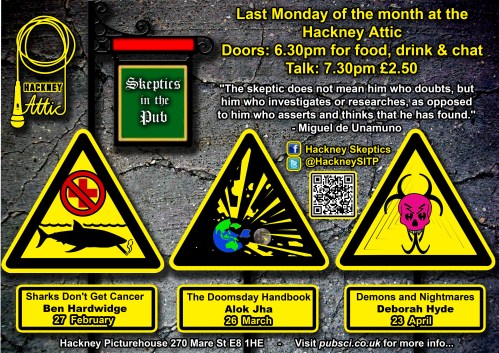
Tonight is the night of Ben Harwidges talk on the “sharks don’t get cancer” myth, it’s the first of a stella line up of talks which will hopefully inform and dispel in equal measure. Worried how the world might end in 2012? Alok Jha will take us through what the real doomsday scenarios are, and as I understand it none involve Justin Beiber (yet). If that doesn’t help you sleep at night, im sure Deborah Hyde’s talk on Demon and Nightmares will rock you calmly off to sleep with out having to check under the bed first.

Its going to be a fun few months, I hope to see you there!

CineSci6: Memento

Next CineSci6 screening: Memento 12 February, 2:30pm

The world doesn’t just disappear when you close your eyes. But for Leonard Shelby (Guy Pearce) it does. After witnessing the violent death of his wife, he is hell-bent on revenge, but the event has triggered short-term memory loss.

To get by, Shelby has to take Polaroid pictures and copious notes, even having memos tattooed on his body as reminders.

Christopher Nolan’s highly acclaimed and inventive thriller subverts movie narrative convention, as we follow Shelby trying to unravel the mystery surrounding his wife’s death, the last clear memory he has.

The film was inspired partly by case study of patient H. M., who developed severe anterograde amnesia after surgery to control his epileptic seizures. Many experts say that Memento has one of the most realistic and accurate depictions of anterograde amnesia in films.

Memento (film)

These issues will be discussed after the screening by Hugo Spiers, who researches spatial cognition, memory and goal-directed behaviour at UCL, and Mo Costandi, blogger at Neurophilosophy, which appears on the Guardian Science blogs.

Make sure you come along, it’s the last CineSci6 for now, but we’ll have news of future screenings so keep checking the blog. For previous screening Q&As, you can listen to the podcasts brought to you by the Pod Delusion.

For tickets, visit the Clapham PictureHouse website.

Post written by Simon Frantz, posted by PaoloV

February PubSci: Darwin Day

On Tuesday 7th February we will be celebrating Darwin Day Upstairs at the Brixton Ritzy.

Paolo Viscardi will lead the celebrations with a talk on Darwin’s life, his evolutionary ideas and their lasting legacy. Then we can get down to the serious business of discussion about some of the issues raised over a beer.

Join us from 6pm if you want to get food, drink and conversation. The more formal bit won’t start until 7:30pm and the talk will probably kick off at 8pm. Oh, and as always, PubSci is free!

We hope you can make it!