Tag Archives: legal high

June Event Update: Tickets On Sale and Going Fast

Tickets for June’s PubSci have been available on Eventbrite for a week, and 50% have been snapped up already.

At June’s PubSci, Senior Lecturer in Pharmacology & Toxicology and Director of the National Programme on Substance Use Mortality at King’s College, London, Dr Caroline Copeland will talk about the tensions between the epidemiology, pharmacology and toxicology of recreational drugs and the laws that regulate public access to them.
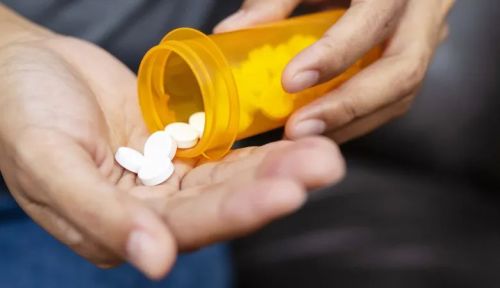
Somebody shaking round, white pills out of a bottle

On Wednesday 17th June, Caroline will examine to what extent drugs policy is really informed by the science, and consider how a truly data-driven policy might differ from the UK’s current laws. Full information is on our Next Event page – or you can just head straight to Eventbrite to book your place ASAP.

Yellow smiley face

Note, England’s first football World Cup [men’s] game takes place the same night, but only kicks off at 9pm, after PubSci finishes. We’ll aim to wrap up by 8.45 so footy fans can be downstairs in time for the kick-off.

Another radio show to delight your ears

Episode #8 of The Science Show was broadcast on Monday 1st June and is available to stream now as a podcast. In this show:

• George Holdaway joins me to discuss the latest science news including: How fungi can trigger ice and rain; the perilous state of Antarctic ice; NASA’s moon base plans; Pluto and Plutino; and String Theory emerging from nowhere

• George and I take a Random Walk from Mercury to Murder via Evangelista Torricelli, Toxic Hats, and Tycho Brahe.

Dr Parry Hashemi from Imperial College London talks neurotransmitters, brain organoids, and turning serotonin into music.

• Plus details of the best science-related events in London and beyond – including this weekend’s Great Exhibition Road Festival where Dr Hashemi’s team has an amazing interactive installation that allows you to listen to happiness in the brain! – and, as always on the truly unique Science Show, we throw in some excellent music for good measure.

Stream it here https://tinyurl.com/TheScienceShow-Episode-8

And I’m delighted to say that, within days up release, Show 8 has shot to the top of the Science charts and is ranked 31 among all podcasts on Mixcloud! A huge Thank You to those who listen in live or stream the podcast. If you haven’t yet, you can find out what you’ve been missing at https://www.mixcloud.com/The_Science_Show/

July’s PubSci

The first World Cup semi-final kicks off on Wednesday 15th July at 8pm – bang in the middle of PubSci. Unfortunately this means there will be no PubSci at the Old King’s Head on 15th July 2026. It’s only fair to our accommodating landlord Greg as he can pack 60 more footy fans into the the upstairs room and they’ll spend even more than PubSci does — especially if England reaches that semi-final.

I’ve been working on a fantastic event at an alternative venue later in July, but comms have gone a bit quiet on that so I can’t promise anything yet. Hopefully I’ll have some good news for you by 17th June though. These changes and uncertainties are the reason I haven’t published a new events programme, but rest assured, I’ll be putting everything in PubSci’s events’s calendar in good time and will get a programme out when I have a moment of time. (In case anybody isn’t aware, running PubSci isn’t a paid role – and there’s no external funding – so me earning a living has to take priority at times!).

Anyhoo, I’ll be back with an update soon. Meanwhile, I hope to see you all on 17th June.

Richard (Science communicator and PubSci organiser/host)
Designer Drugs 101: a Review

Many people say that the UK has some very strange, outdated laws – citing anecdotal examples involving Welshmen in Chester after sun-down. I don’t think you need to go much farther than our drugs legislation to find really loony stuff:

Last night I attended a talk by Dr James Moffat of St. George’s University on the subject of Pharmacology. Dr Moffat opened by stating that he is a cardiovascular specialist and that there will definitely be some questions raised by his talk that require a neurobiologist, or a lawyer, or a politician to give us the sort of detail we are looking for.

He started off by showing us a line of powder on a mirror and asking us to identify it. Naturally the consensus was Cocaine but the photograph was of Salbutamol (commonly known as “Ventolin”) which saves more lives than Cocaine will ever take.

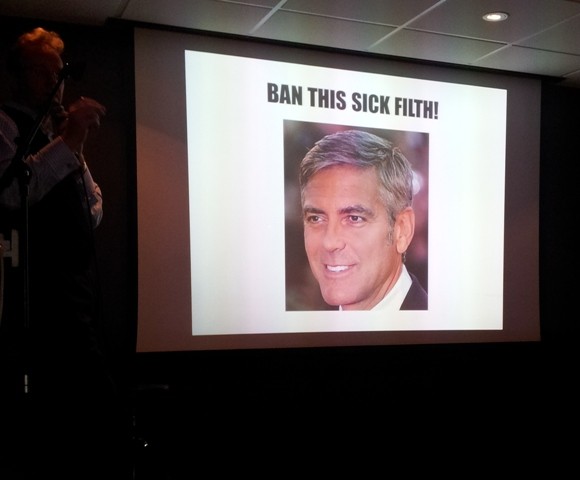
He explained that the brain works by pattern recognition and that it determines what it has taken by which receptors the chemical has triggered. He demonstrated this by asking us to imagine that our brains were simplified and had 1 receptor for each celebrity. Our eyes receive parts of these celebrities and our ‘celebrity receptors’ tell us who they have seen. We were shown a slide of George Clooney’s mouth, and another with Angelina Jolie’s eyes. In both cases the audience as a unit managed to identify the celebrities. Dr. Moffat then unveiled his scariest slide of all: an amalgam of Clooney and Jolie (“Georelina Cloolie”?). He explained that the brain receives the effects of chemicals in the same way: if a drug is designed to affect two receptors, we’ll recognise both at once with different parts of our brain.

Designer drugs target receptors in the brain responsible for releasing neurotransmitters, the key compounds targeted are: serotonin, which induces the happy response; dopamine, responsible for the reward response and addictive qualities; and noradrenalin, the effects of which are complex and still being discovered. The experience you get from taking the substance is based on the extent to which the substance interferes with normal brain activity in the receptors.

Substances such as caffeine, nicotine, and alcohol also interfere with the natural function of the brain in very similar ways. Why are they legal and other drugs aren’t? Also, what about ‘legal highs’ purchased in new age shops? These aren’t FDA approved drugs that get criminalised when new evidence comes to light: these have never been through any kind of official regulatory body whatsoever, nor do they need to have undergone any testing whatsoever. As Dr. Moffat puts it: “‘legal highs’ are an experiment on the general public done by scumbags”.

Let me stop for a moment and point something out here: an English establishment can be shut down for continuing to sell food where the ingredients are listed only in a foreign language because there is a good chance the consumer won’t know what they are consuming, and yet there is little to no regulations on the sale of substances for which the molecular structure is completely unknown. Something is very clearly wrong here.

The criminalisation of substances can, in some cases (such as in Phenethylamines), lead to the outlawing wholesale of any substance which contains the same molecular structure as the banned substance (except where it already has proven medicinal benefits, such as Bupropion). We are at a point now where we ban imaginary drugs and make life difficult for medical researchers without actually hindering the manufacturers of ‘legal highs’ – all they need to do is change a single atom in the molecule and the substance is unknown again. The legislation does not work as intended for anyone.

The questions section was the longest I had ever witnessed in a PubSci event. Even so, I came away from this talk with more questions:

  • How can we get accurate data on the harmful effects of narcotics in isolation? In the real world we don’t get someone admitted with just one thing in their system and to do so as a controlled experiment would be completely unethical.
  • Can we justify banning anything when alcohol abuse is filling our A&E wards on a regular weekly basis? On the one hand it feels a little bit like removing the brakes because road accidents are inevitable; On the other hand, I know of at least one case where a person refused medical attention for a copiously bleeding injury because he didn’t want to be ‘outed’ with substances in his system.
  • Does more money need to be spent on neurological research to remove the faulty parts of our brain that choose the reward response regardless of the cost to ourselves and others? I ask this as an unrepentant caffeine addict who is strongly opposed to drugs and tobacco. I fear the law may need to be made by more logical brains than we can offer it.
  • Who do I talk to about criminalising George Clooney’s eyes?

I don’t know who can answer these questions. Maybe you can help.

The PubSci organisers would like to thank Palaeosam for writing this review – check out his blog for other reviews and interesting stuff!