In this blog post: July’s PubSci; Listen to the Number 1 Science Podcast, and what to do this summer
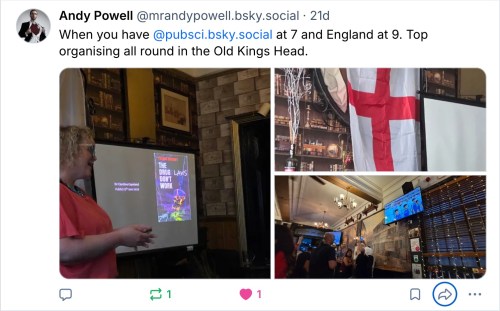
First of all, huge thanks to Caroline Copeland from King’s College London for June’s PubSci when she talked about the problems with how government drugs policy is made in England and Wales (compared to what the science tells us) in The Drugs [laws] Don’t Work. Once again the room was packed and even with a really engaged Q&A session, we managed to get the room turned around in time for England’s first World Cup match (against Croatia) at 9pm, which our hosts at The Old King’s Head really appreciated.
July’s PubSci is booking fast
As mentioned in my previous blog post, on Wednesday 22nd July, PubSci is delighted to welcome Dr Parry Hashemi from Imperial College London to talk about the “happiness molecule” in The Sound of Serotonin – Listening to Brain Cells.
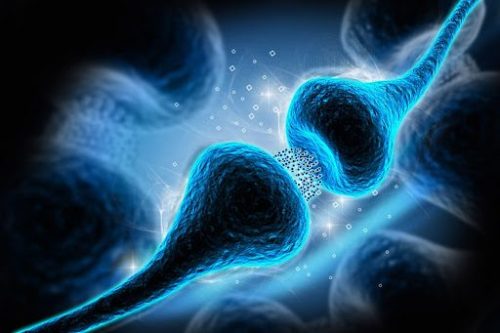
Serotonin’s relationship with depression is complex, and assessing neurotransmitter levels in living brains remained a challenge for years. Now Dr Hashemi’s team has developed a revolutionary, non-invasive technique for tracking serotonin levels in real time and even turning the results into music.
With 2/3 of tickets already snapped up at the time of writing, this could be one of our most popular talks ever. Don’t miss the chance to reserve a place — head over to the Eventbrite booking page ASAP, where you’ll find full details, ticket info, and a link to reserve your spot.
The venue is PubSci’s regular home, The Old King’s Head near Borough Market, which offers a great range of drinks, has a happy hour before 7pm, and opens the kitchen serving classic pub grub especially for us. Doors open at 6.30 for a 7pm start. Talks generally run for ~45 minutes and are followed by a Q&A session. Full address on the booking page.
As most of you know by now, PubSci talks are pay-what-you-can: You can make a contribution when booking on Eventbrite. We have no other source of funding. There are two ticket options:
Book for one + Support PubSci (max 1 ticket) if you prefer to contribute when booking – this option also reserves you one spot at the event. You may need to scroll down to see this option on Eventbrite.
Book without donating (max 4 tickets) if you prefer to put cash in the pot on the night.

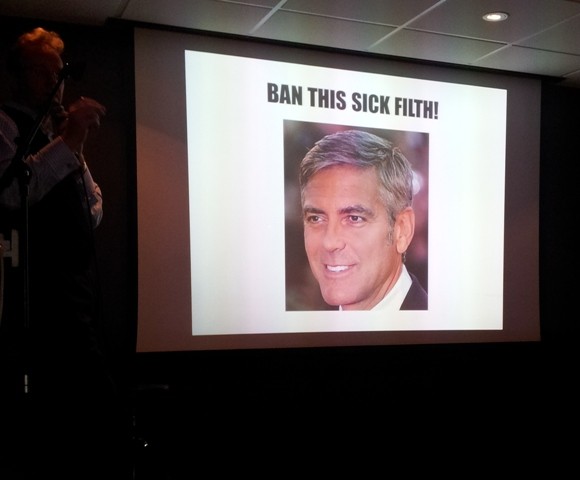
I used this Smiley for last month’s talk on recreational drugs and government policy and it seems appropriate for a talk on serotonin too!
Of Levitating Hamsters and Other Animals
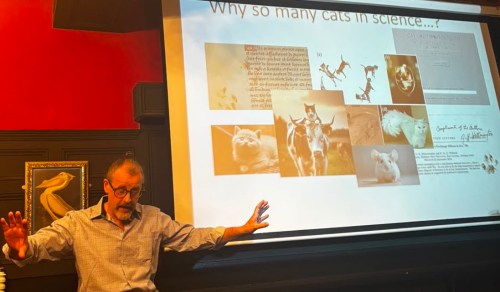
Many thanks to those of you who helped to pack out my humorous-but-fact-filled science talk at London Fortean Society on the final day of June.
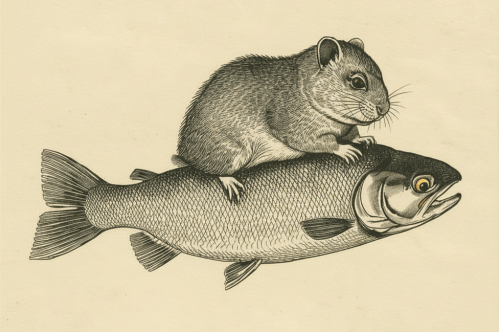
The Levitating Hamster and the Salmon of Doubt went down a storm, it seems – I certainly had a great time, even if the levitation demo didn’t go quite as well as in rehearsal – and somebody picked up a pub quiz-winning animal fact that came in handy the following day at April PubSci speaker, Joanna Bagniewska’s Pint of Knowledge talk about animal butts!
No PubSci in August (but there is an eclipse)
It’s official, there’s no PubSci in August. I’m giving myself a little holiday and going to sSpain to see the total eclipse of the sun on 12th August. The path of totality won’t pass over the UK. It begins in northern Russia, loops round the Arctic circle to pass through Greenland and the west coast of Iceland before touching land again at the northwest corner of Spain where it passes diagonally to the south west and over the Balearic islands before finishing in the Mediterranean sea.
The tip of Cornwall will see around 96% totality (96% of the sun covered by the new moon) but even the remaining 4% of the sun – if visible in a cloudless sky – will remain intensely bright and must not be looked at directly except with special eclipse viewing specs. It’ll be interesting but it won’t be an eclipse. To experience an eclipse, over 99.5% coverage is required. I wrote about some of the experiences of seeing an eclipse in my 2024 blog piece after the four minute long Mexican eclipse.
Those lovely folk at Royal Museums Greenwich (AKA Greenwich Observatory) have put together an eclipse guide for anybody wondering what to expect from a partial eclipse of the sun. Talking of eclipses, perhaps nobody did more to bring them to public consciousness than the late, great, laryngitic Welsh singer Bonnie Tyler who sadly died yesterday. Feel free to indulge in her 5 1/2 minute, Meat Loaf-inspired peak ’80s power ballad (no, I don’t understand the video either, nor do I want to).
Anyhoo…talking of actual eclipses, George Holdaway and I take a deep dive into the science, culture, and history of total eclipses of the sun in…
The Number 1 Science Podcast
The Science Show is a magazine-style miscellany packed with news, interviews, chat and discussions, plus great music and cultural crossovers. This month’s show discusses recent findings about dark energy, looks at the weirdest sourdough ever baked, dives into eclipses and shares some of the best science-related things to do in London this summer, including art and theatre.
I’m particularly chuffed that, within a day of launching Episode 9 of The Science Show, it hit the top spot in MIxcloud’s science chart and zoomed into the Top 20 of the overall Podcast and Talk charts!
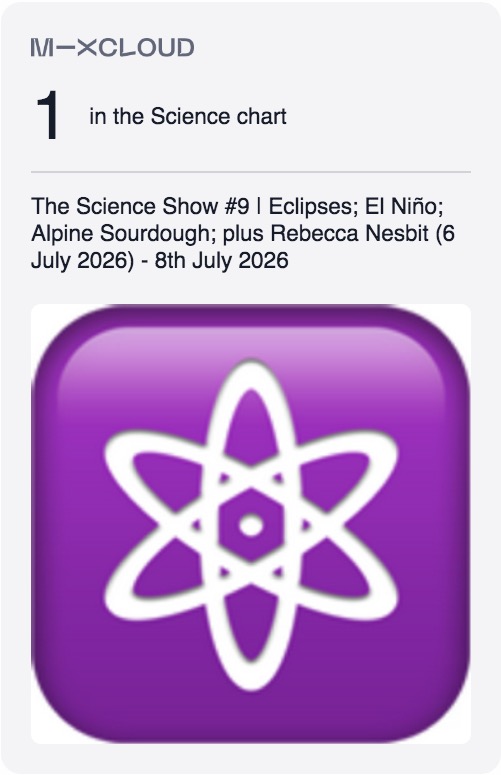
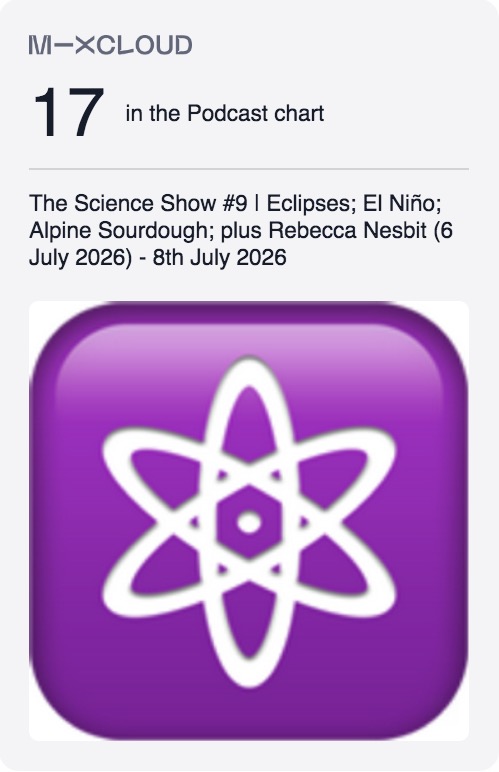
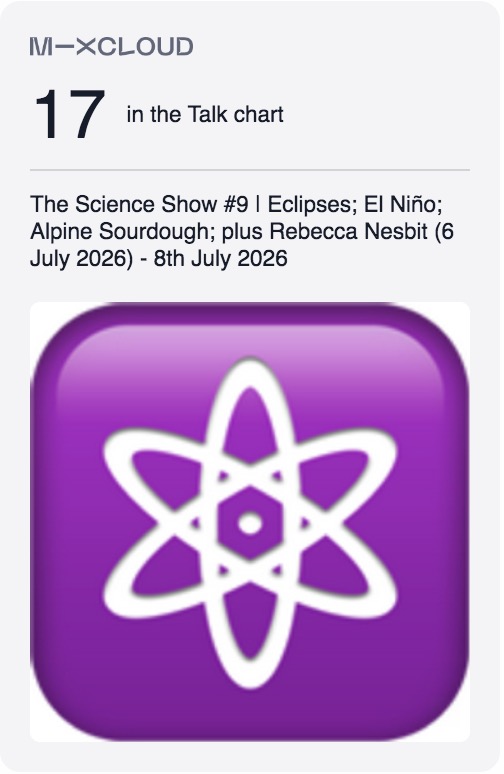
And that’s not even the best bit… Our show is currently rated above four top notch, highly professional, and long-established podcasts — including Neil deGrasse Tyson. I knoooow. Consider my mind well and truly blown.
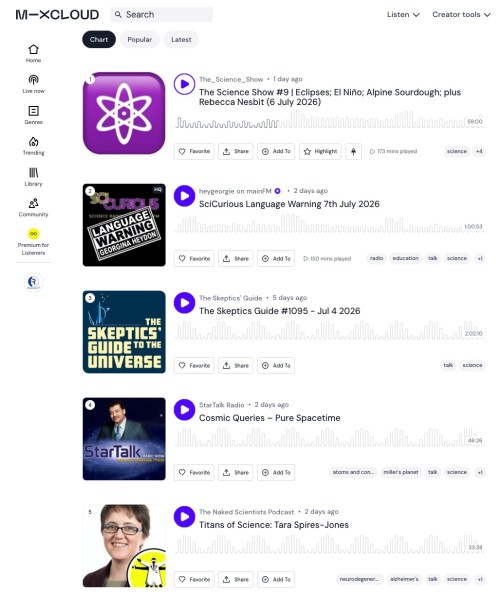
We’d love you to give it a listen and push it even further up the podcast charts before Tuesday when they reset.
I know What You Should Do This Summer
So there’s no PubSci in August, both Wimbledon and the footy and will be finished, and the eclipse is only 2 minutes long at best, so how are you going to spend your free time in London? Fear not, The Science Show podcast is here! I won’t give you the hard sell again, but it really is packed with science news and some brilliant science-related events happening from late July through to September, including a highly creative musical about Laika the first dog in space and some major exhibitions with scientific content.
However, there were a couple of things we couldn’t fit in, so I’ll share those with you here:
A friend recently decided to start his quest for astrobiology by visiting the London Wetlands Centre to go birdwatching, on the basis that he needs to train his eyes and brain to recognise unfamiliar life forms on Earth before turning his attention towards space. I don’t know if that’s how everybody gets into astrobiology, but on Friday 24th July, Astronomer Royal, Michele Dougherty, looks at the icy moons of Jupiter and Saturn and asks whether Ganymede, Callisto or Europa could host life entirely separate from what we find on Earth. Information and booking here.
On Friday 31st July at 6.30 pm join author and astrophotographer Josh Dury for an evening talk exploring the importance of preserving dark skies , hosted by the astronomers of the Royal Observatory Greenwich in the National Maritime Museum.
Copies of Josh’s book, 52 Assignments: Night Photography, will be on sale on the night and available as an optional addition to the event ticket. Tickets are just £10 (students £9), available here.
Centre of the Cell at Queen Mary University, London (Whitechapel) has lots of family-friendly events in July and August. Learn about your body’s largest organ in Skin Deep, step into the past, present, and future of cell biology in CELLebration, or build a brain to understand how AI works in Artificial Intelligence – but where is the intelligence?
Mostly aimed at children aged 7-11 and their adults, tickets start at £7.50 details of all events can be found at https://www.centreofthecell.org/whats-on/events/
And talking of activities to keep any young people in your life busy over the summer, lots of institutions and museum have a programme of activities during the school holidays and you could do worse than checking out the Royal Institution’s summer workshop programme (where you might even bump into me).
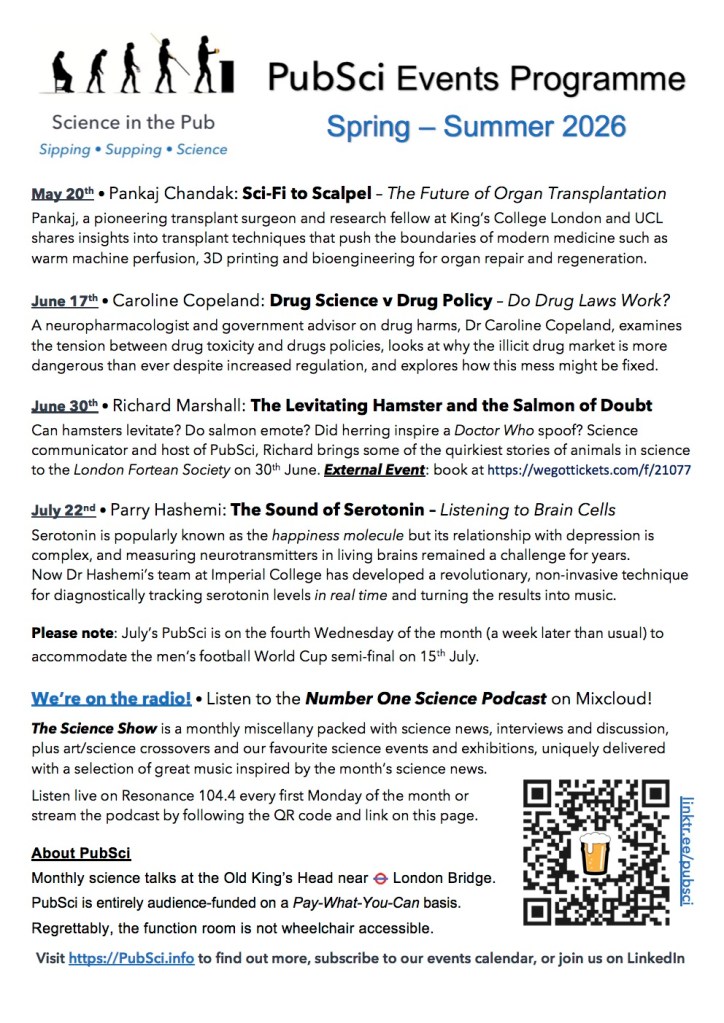
PubSci event programme
PubSci’s Spring / Summer Programme will soon be replaced by Summer / Autumn covering September to the end of the year. I’m already excited about the programme and can’t wait to share it with you. For now, here’s the current one.
Well that’s it from me. Hope to see you at the Old King’s Head on 22nd July for The Sound of Serotonin – Listening to Brain Cells with Dr Parry Hashemi.
Richard (Science communicator and PubSci organiser/host)
10th July 2026