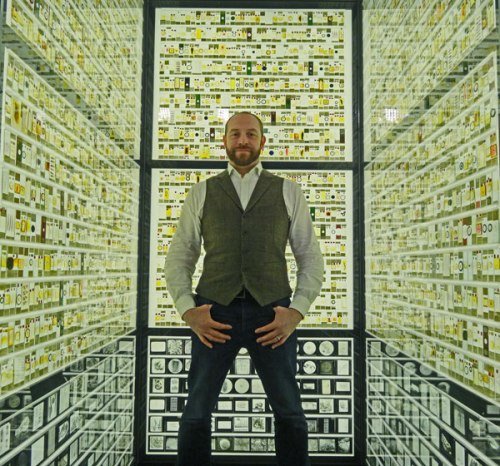
Paolo Viscardi – Science in Society: Battling the Bull

On Wednesday 3rd February the Curator of the Grant Museum of Zoology, UCL and regular host of PubSci, Paolo Viscardi will be exploring the role that science can play in challenging bullsh*t that we are bombarded with in society, particularly from some parts of the media.

micrarium

Topics covered will include scaremongering about False Widow spiders, assigning special meaning to simple pariedolia and the public’s weakness for the alien and unusual.

Join us from 6pm for a 7pm start at the Old King’s Head, near London Bridge station.

As usual, the event is free, but we will have a whip-round to cover costs – we hope to see you there!

Pubsci – Archive

Grand_Study_Hall_New_York_Public_Library

Welcome to the Pubsci archive, this is where you can find all the old events and posts from pubsci’s of yore, up until Jan 2013

Pubsci is moving

Dear all,

To help make improvement to our site making events easier to track and new content more prominent we are making changes to the site.

This will involve a couple of days of disruption and tweaks to our the site

We will try to get back to normal service asap

Sorry fo any confusion

The pubsci team

PUBSCI NEWS

New venue for monthly PubSci

After nearly two years of PubSci in the Upstairs bar at the Ritzy in Brixton, we have decided to move on. The Ritzy was a great place to run the events thanks to the helpful staff, but noise from the downstairs bar was an ongoing issue and we are moving on in search of slightly quieter pastures (we were also keen to find a venue with more ales than lagers).

The new venue for PubSci is the Albert Arms, which is a traditional boozer (with some proper beers) located in Southwark, just a short walk from Elephant & Castle tube.

The Albert Arms. Photo by Ewan-M

Starting with a BANG!

The first event at the Albert will be Claire Benson telling the stories of fire and explosions from the 19th century that captured imaginations, changed the face of the planet and the very way we see the cosmos.

So, if you want to know how spontaneous combustion led to the London Fire Brigade creation, how explosives actually saved many lives, and how the development of 1 small piece of laboratory equipment lead to us understanding the very makeup and expansion of the universe, then join us at 6:30pm on Monday 14th January (yes, the day before the pub quiz – our last event in Brixton).

We hope you like the new venue!

January PubSci: Pub Quiz

Science Pub Quiz

Happy New Year from PubSci! We will be starting 2013 with another sciencey pub quiz on Tuesday 15th January.

Darwin-pub-quiz

Doors of the Upstairs Bar of the Brixton Ritzy will open at 7:30pm for an 8pm start, so bring your brains and gather your team members (max of 5 per team) for a mixed bag of science, pseudoscience and sci-fi questions.

We will be asking for £2 per person to go into the prize pot, so be prepared and spread the word – the more people that come, the bigger the the prize!

December PubSci: Festive Pub Trip

On Wednesday 19th December we’re having a change of venue and going for a trip to the lovely King’s Arms pub near London Bridge.

It’ll be a chance for some science-flavoured socialising over some real ales in a traditional London boozer. Drop in from 6pm onward!

By the way, you can check out Palaeosam’s write-up of November’s PubSci here.

Designer Drugs 101: a Review

Many people say that the UK has some very strange, outdated laws – citing anecdotal examples involving Welshmen in Chester after sun-down. I don’t think you need to go much farther than our drugs legislation to find really loony stuff:

Last night I attended a talk by Dr James Moffat of St. George’s University on the subject of Pharmacology. Dr Moffat opened by stating that he is a cardiovascular specialist and that there will definitely be some questions raised by his talk that require a neurobiologist, or a lawyer, or a politician to give us the sort of detail we are looking for.

He started off by showing us a line of powder on a mirror and asking us to identify it. Naturally the consensus was Cocaine but the photograph was of Salbutamol (commonly known as “Ventolin”) which saves more lives than Cocaine will ever take.

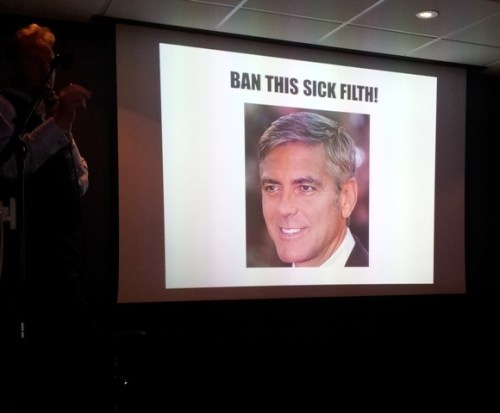
He explained that the brain works by pattern recognition and that it determines what it has taken by which receptors the chemical has triggered. He demonstrated this by asking us to imagine that our brains were simplified and had 1 receptor for each celebrity. Our eyes receive parts of these celebrities and our ‘celebrity receptors’ tell us who they have seen. We were shown a slide of George Clooney’s mouth, and another with Angelina Jolie’s eyes. In both cases the audience as a unit managed to identify the celebrities. Dr. Moffat then unveiled his scariest slide of all: an amalgam of Clooney and Jolie (“Georelina Cloolie”?). He explained that the brain receives the effects of chemicals in the same way: if a drug is designed to affect two receptors, we’ll recognise both at once with different parts of our brain.
Designer drugs target receptors in the brain responsible for releasing neurotransmitters, the key compounds targeted are: serotonin, which induces the happy response; dopamine, responsible for the reward response and addictive qualities; and noradrenalin, the effects of which are complex and still being discovered. The experience you get from taking the substance is based on the extent to which the substance interferes with normal brain activity in the receptors.

Substances such as caffeine, nicotine, and alcohol also interfere with the natural function of the brain in very similar ways. Why are they legal and other drugs aren’t? Also, what about ‘legal highs’ purchased in new age shops? These aren’t FDA approved drugs that get criminalised when new evidence comes to light: these have never been through any kind of official regulatory body whatsoever, nor do they need to have undergone any testing whatsoever. As Dr. Moffat puts it: “‘legal highs’ are an experiment on the general public done by scumbags”.

Let me stop for a moment and point something out here: an English establishment can be shut down for continuing to sell food where the ingredients are listed only in a foreign language because there is a good chance the consumer won’t know what they are consuming, and yet there is little to no regulations on the sale of substances for which the molecular structure is completely unknown. Something is very clearly wrong here.

The criminalisation of substances can, in some cases (such as in Phenethylamines), lead to the outlawing wholesale of any substance which contains the same molecular structure as the banned substance (except where it already has proven medicinal benefits, such as Bupropion). We are at a point now where we ban imaginary drugs and make life difficult for medical researchers without actually hindering the manufacturers of ‘legal highs’ – all they need to do is change a single atom in the molecule and the substance is unknown again. The legislation does not work as intended for anyone.

The questions section was the longest I had ever witnessed in a PubSci event. Even so, I came away from this talk with more questions:

  • How can we get accurate data on the harmful effects of narcotics in isolation? In the real world we don’t get someone admitted with just one thing in their system and to do so as a controlled experiment would be completely unethical.
  • Can we justify banning anything when alcohol abuse is filling our A&E wards on a regular weekly basis? On the one hand it feels a little bit like removing the brakes because road accidents are inevitable; On the other hand, I know of at least one case where a person refused medical attention for a copiously bleeding injury because he didn’t want to be ‘outed’ with substances in his system.
  • Does more money need to be spent on neurological research to remove the faulty parts of our brain that choose the reward response regardless of the cost to ourselves and others? I ask this as an unrepentant caffeine addict who is strongly opposed to drugs and tobacco. I fear the law may need to be made by more logical brains than we can offer it.
  • Who do I talk to about criminalising George Clooney’s eyes?

I don’t know who can answer these questions. Maybe you can help.

The PubSci organisers would like to thank Palaeosam for writing this review – check out his blog for other reviews and interesting stuff!

November PubSci: Museums and Science

Why museum collections are vital to life on Earth

On Tuesday 20th November we will have museum curator and regular PubSci host Paolo Viscardi talking about museum collections and their value to science, society and species survival.

Continue reading

October PubSci: Designer Drugs 101

On Tuesday 23rd October we will have Dr James Moffatt discussing the pharmacology of recreational drugs and the chemistry behind what has made successful or unsuccessful drugs in recent history.

4-MMC 3D Molecule

We’ll look at the recent designer drug business model and consider the process of designing the type of drug we could synthesise and market, what the competition have to offer, and how it works within the law.

Finally, we’ll consider ways to prevent people from being exploited or harmed by such “designer drugs”.

If we ever came up with the perfect recreational drug, should we legalise it? Can you make a safe recreational drug, or are health risks unavoidable?

Join us for this fascinating insight into the science and legalities of designer drugs in the usual place at the usual time – Brixton Ritzy Upstairs Bar from 18:45ish for food, drink and a chat, for an 19:45ish start.

As usual the event is free!

Ada Lovelace PubSci Special

Celebrating Women in STEM (Science, Technology, Engineering & Maths)

On Tuesday 16th October we will have a PubSci special celebrating women in STEM hosted by Dr Rebekah Higgitt.

Ada Lovelace Day is about sharing stories of women in STEM subjects who have been inspirational. Ada was born in 1815 and became a mathematician, writer and arguably the world’s first computer programmer over 100 years before the first electronic computer was invented. Talk about being ahead of her time!

We will celebrate by having a variety of women at different stages of their STEM careers talking about what they do, their experiences as a female in STEM and the female figures that have inspired them. Then the floor will open for the usual exchange of ideas and quaffing of appropriately alcoholic beverages until time is called at the bar.

Join us at the Brixton Ritzy Upstairs Bar from 18:45ish for food, drink and a chat, ready for an 19:30 start.

Oh yes, and as always entry is free!